

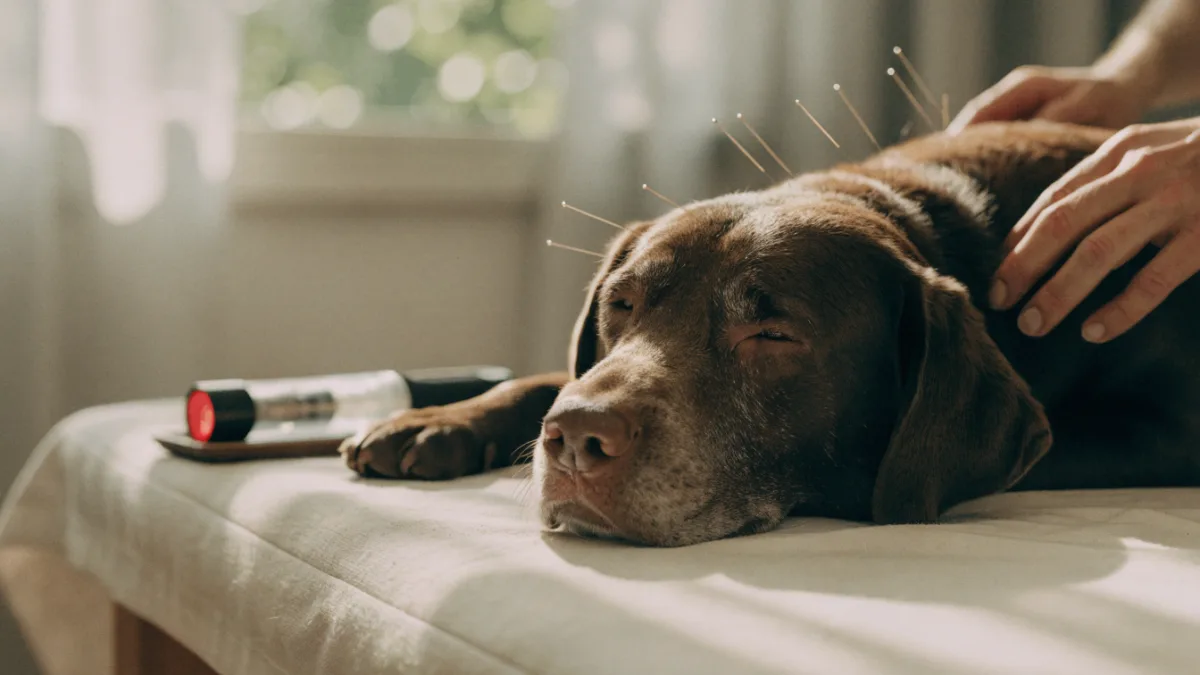
When a twelve-year-old Labrador named Gus hobbled into my exam room last spring, his owner Martha looked exhausted. Gus had been on the same non-steroidal anti-inflammatory drug for three years to manage his osteoarthritis, but his kidneys were starting to show wear. “I just don’t know what else to do,” she told me, her voice catching. “He’s still my puppy inside.” We talked for a while, and I suggested something that would have raised eyebrows in veterinary school two decades ago: acupuncture and cold laser therapy. Six weeks later, Gus was trotting to the mailbox again — on a lower medication dose, with kidney values that had stabilized. Stories like his are becoming the norm rather than the exception, and they represent a genuine shift in how we think about animal pain.
From Fringe to Mainstream: The Integrative Shift
I’ll be honest — when I first heard about veterinary acupuncture in the early 2000s, I rolled my eyes. It sounded like wellness-culture nonsense that had no place in a profession built on pharmacology and surgery. But then the research started piling up, and I started paying attention. What changed my mind wasn’t a sales pitch from a holistic seminar; it was a 2023 systematic review by D.L. Millis, published in PMC, that laid out the documented clinical benefits of light therapy in animals with enough hard data to make any skeptic pause and reconsider.
Today, organizations like the International Veterinary Academy of Pain Management and the American Animal Hospital Association don’t just tolerate these therapies — they actively recommend them as part of multimodal pain management plans for chronic and end-of-life care. Clinics across the country are blending traditional Western medicine with Eastern and holistic practices, creating comprehensive approaches that treat the whole animal rather than just suppressing symptoms.
The appeal becomes obvious when you’ve watched an aging cat’s liver enzymes climb after years of medication, or seen a dog develop gastrointestinal ulcers from long-term drug use. Sometimes the answer isn’t another prescription — it’s a different toolkit entirely.
How Acupuncture Actually Works (No, It’s Not Magic)
Acupuncture involves inserting incredibly fine, sterile needles into specific points on the body. When I say fine, I mean hair-like — most are significantly thinner than the needle used for a routine blood draw. The mechanism isn’t mystical at all; it’s neurological. Needle insertion stimulates the nervous system to release endogenous opioids, which is just a clinical way of saying your pet’s body produces its own natural painkillers, like endorphins. It also increases local blood circulation to areas that need healing.
I remember treating a nine-year-old Dachshund named Penny who had partially herniated a disc in her back — a common problem for the breed, clinically known as Intervertebral Disc Disease. Her owners were terrified of back surgery, and Penny wasn’t a great surgical candidate due to a heart murmur. We started weekly acupuncture sessions, and within three weeks, Penny was walking without dragging her hind paws. Her neurologist was genuinely surprised at her recovery speed.
Acupuncture tends to shine with systemic issues, nerve stimulation, and deep muscle spasms. It’s particularly valuable for conditions where the source of pain is diffuse or where nerve involvement complicates traditional pain management.
Cold Laser Therapy: Light as Medicine
The term “cold laser” sounds like an oxymoron, but it refers to a specific technology more accurately called photobiomodulation. The treatment uses specific wavelengths of light — typically in the red and near-infrared spectrum — that penetrate tissue without generating significant heat. That light energy gets absorbed by the mitochondria (the powerhouse of the cell, as you might remember from biology class), which stimulates ATP production. ATP is essentially cellular fuel, so you’re telling the body’s cells to ramp up their energy output, increase blood flow, and dial down inflammation.
Where acupuncture works on the nervous system broadly, cold laser is exceptionally effective for localized, surface-level inflammation, acute soft tissue injuries, and wound healing. A torn ligament, a surgical incision that’s slow to close, a hot spot that won’t quit — these are all candidates for laser work.
The Class IV Revolution
Historically, cold laser treatments meant Class IIIb devices, which worked well but required twenty-minute sessions — an eternity for an anxious cat or an arthritic dog who struggles to lie still. The recent explosion of Class IV lasers in veterinary clinics has changed that math entirely. These higher-powered units penetrate deeper into muscle and bone tissue, cutting treatment times to just three to five minutes per session. For a wiggly Golden Retriever who thinks the exam room is a playground, that difference is enormous.
When We Use Which — Or Both Together
One question I hear constantly is whether acupuncture or laser therapy is “better.” The honest answer is that they do different things, and the best results often come from combining them. Acupuncture addresses systemic and nerve-related pain; laser targets localized inflammation and tissue repair. For a dog with hip dysplasia, I might use acupuncture to release the chronic muscle spasms in the lower back while applying laser directly over the inflamed hip joint.
There’s also a hybrid approach that’s gained real traction: laserpuncture. For pets who can’t tolerate needles — and yes, some absolutely cannot, no matter how gentle the technique — we can use the laser to stimulate traditional acupuncture points instead. It’s particularly useful for cats, who generally have strong opinions about being poked with things.
What the Experience Is Actually Like
The biggest barrier I see isn’t skepticism about whether these therapies work — it’s worry that the treatment itself will be stressful or painful. So let me address that directly. Acupuncture needles are so thin that roughly ninety percent of pets don’t react at all when they’re inserted. The ones who do react usually just flinch briefly, then settle. Most pets become deeply relaxed during sessions. I’ve had dogs fall asleep mid-treatment with needles still in place, snoring softly on a heated blanket.
Laser therapy is even simpler. The pet simply lies or sits still while the practitioner passes a wand over the treatment area. Many animals lean into the warmth and find it soothing. The entire process is quiet, calm, and unhurried — which is part of why it works so well for anxious patients.
Setting Realistic Expectations
Here’s where I need to be straight with you: neither acupuncture nor laser therapy is a one-and-done fix. Effective treatment almost always requires an initial loading phase — typically once a week for four to six weeks — before tapering to maintenance visits. Some pets respond within the first two sessions; others take longer. I always tell owners to commit to the full initial protocol before judging whether it’s working. The improvements are often gradual, and sometimes you don’t notice how much better things have gotten until you realize your dog is jumping into the car again without hesitation.
The Debates Worth Knowing About
Acupuncture still faces skepticism in some corners of the profession. Some traditional veterinarians argue that the clinical evidence relies too heavily on small sample sizes or subjective owner observations — the so-called “placebo-by-proxy” effect, where owners want to see improvement so badly that they perceive changes that aren’t objectively measurable. It’s a fair criticism, and the research community is actively working to design better, larger studies that address these concerns.
Cold laser has an interesting problem: under-dosing. If a practitioner uses a low-level device without proper training, the dose may be too small to have any biological effect. The treatment “fails” not because the technology doesn’t work, but because it wasn’t applied correctly. This is why credentials and experience matter — ask your veterinarian about their training and what class of laser they use.
Eye safety is another critical consideration. Cold lasers can cause retinal damage with direct exposure, so reputable clinics follow strict protocols — protective eyewear for staff, dark goggles for pets when treating near the head, or simply avoiding the head and neck area entirely. If you tour a clinic and don’t see protective eyewear being used, that’s a red flag.
A Word on At-Home Devices
The market has exploded with FDA-cleared, over-the-counter LED and low-level laser devices for consumers. Some are legitimate; many are underpowered gimmicks. If you’re considering an at-home device, please talk to your veterinarian first — not because I want to gatekeep, but because using the wrong wavelength or treating the wrong condition can waste your money or, worse, mask a problem that needs actual medical intervention. A friend recently told me she’d been using a consumer device on her cat’s limping leg for weeks with no improvement. Turns out the cat had a hairline fracture. The device wasn’t faulty; the diagnosis was missing.
Where Do We Go From Here?
The rise of integrative therapies reflects something deeper than trend-chasing. It represents a growing recognition that pain management isn’t just about adding years to an animal’s life — it’s about adding life to those years. When we can reduce suffering without stacking side effects, when we can help a senior pet move comfortably without compromising organ function, we’re doing right by the animals who depend on us completely.
Not every therapy works for every pet. Acupuncture won’t cure cancer, and laser therapy can’t replace emergency surgery. But as part of a thoughtful, multimodal approach — combined with appropriate medication, physical rehabilitation, weight management, and environmental modification — these tools are genuinely changing outcomes. If your pet is dealing with chronic pain, post-surgical recovery, or age-related mobility issues, ask your veterinarian whether integrative options might help. The answer might surprise you, and your pet might just thank you with a wagging tail or a contented purr that says more than any clinical study ever could.
The future of animal welfare isn’t about choosing between conventional and alternative medicine — it’s about using every evidence-based tool we have to reduce suffering and honor the bond between pets and the people who love them.