

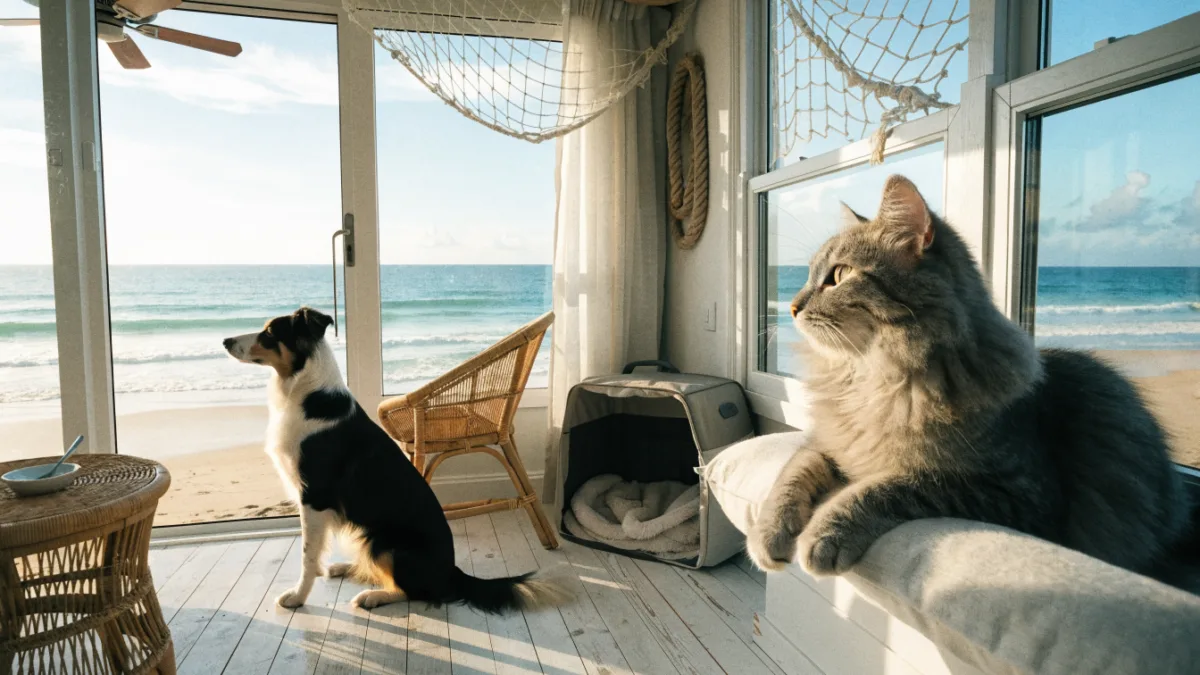
Planning a coastal vacation when you have a dog is relatively straightforward. You find a beach, you throw a ball, and your dog acts like they’ve just discovered the meaning of life. But trying to plan a seaside getaway when your household includes both a dog and a cat? That’s an entirely different sport. It’s an intricate game of logistics where you’re trying to balance one animal’s desperate need to roll in dead kelp with another animal’s firm belief that sand is an insult to their paws.
I’ve been there. My dog, Barnaby, treats the ocean like a long-lost best friend. My cat, Mochi, treats any environment outside her exact three-foot radius of living room carpet like a threat to her entire existence. Taking them both to the coast required a level of strategic planning usually reserved for military operations. But it is entirely possible to give your dog the beach day of their dreams without turning your cat into a stressed-out furball of anxiety. You just have to rethink the standard vacation playbook.
The Great Accommodation Compromise
If you’re traveling with both species, forget about booking a standard hotel room. Hotels are loud, they share walls with strangers, and they rarely offer the square footage necessary to keep a high-energy dog separated from a highly suspicious cat. Instead, you need to look into cabin rentals or pet-friendly standalone houses.
There’s a reason why the travel industry is seeing a massive boom in pet-friendly cabin getaways. Towns along the Oregon Coast, like Seaside, or the swanky pet-welcoming islands on the East Coast, have figured out that multi-pet families need space. A cabin provides the ultimate compromise. Your dog gets immediate access to outdoor trails and smells, while your cat gets the quiet, enclosed indoor security they desperately need to feel safe in a strange place.
When you’re booking, look for a property with an enclosed porch or, if you’re incredibly lucky, a “catio.” A screened-in porch is the holy grail of multi-pet travel. It allows your cat to sniff the salty ocean air and watch seagulls without the risk of them pulling a Houdini into an unfamiliar forest. You can set up a cozy bed, some water, and let them safely judge the outside world from behind a screen.
Divide and Conquer: The Only Survival Tactic
Let’s be perfectly clear: taking your cat to a crowded, public dog beach is a terrible idea. Even if your cat is harness-trained and bombproof, a public beach is full of off-leash dogs, loud waves, and chaotic energy. It’s a sensory overload that most cats—and frankly, most humans—want absolutely no part of.
The secret to a successful coastal trip with a dog and a cat is the “divide and conquer” strategy. If you’re traveling with a partner, a friend, or a family member, you split up. One person takes the dog to the designated dog beach for active, sandy, wave-chasing playtime. The other person stays back at the cabin with the cat for some quiet bonding and indoor enrichment.
If you’re traveling solo, this means relying heavily on your accommodation. You can absolutely leave your cat safely secured in the cabin or rental while you take the dog down to the shore for an hour. Just make sure the environment is safe: close all windows, ensure the doors latch securely, and leave a TV or radio on at a low volume to muffle the unfamiliar sounds of coastal wildlife or neighboring tourists. When you return, hose the dog off outside so they don’t track a pound of wet sand onto your cat’s temporary safe haven.
Feline Coastal Enrichment (Because They Want to Have Fun, Too)
Just because Mochi isn’t going to body-surf doesn’t mean she shouldn’t get a vacation. Cats require mental enrichment rather than wide-open physical exercise, and a coastal environment offers some incredible sensory opportunities if you know how to facilitate them.
The Window Perch Buffet
Bring a suction-cup window perch or a soft blanket to place on a windowsill with a good view. To a cat, a window overlooking the ocean or a coastal forest is basically an IMAX movie. The crashing waves, the rustling sea grass, and the bizarre squawking of seabirds provide hours of safe, passive entertainment.
The Travel Tent Revolution
If your rental doesn’t have an enclosed porch, consider bringing a pop-up travel tent. These are completely enclosed, mesh playpens designed specifically for cats. You can set it up on the patio or deck of your rental. It gives your cat a chance to feel the ocean breeze and smell the salty air without you having a panic attack every time a seagull flies by. Toss a few favorite toys and a mat inside, and you’ve got a feline relaxation station.
Harness Walks on the Down-Low
If your cat is used to a harness, skip the beach entirely and take them for a walk on quiet coastal trails. Stick to shaded, wooded paths that run parallel to the shore rather than the exposed boardwalks. Keep an eye out for hazards, though. Coastal environments have their own risks, including predatory wildlife like large birds of prey or coyotes, and extreme heat radiating off the sand.
Managing the Transit (and the Prey Drive)
Getting to the coast is often the hardest part. According to travel experts at,[1] traveling with multiple pets requires completely different setups depending on the species. Dogs generally adapt to road trips with enthusiasm, while cats require secure, enclosed carriers to keep their stress levels manageable.
During the drive, keep the dog and cat physically separated. Even if Barnaby and Mochi are best friends at home, the stress of travel can cause a dog’s prey drive to spike, or cause a cat to lash out defensively. Keep the cat securely buckled in a carrier, ideally with a breathable cover over it to block out the visually stimulating—and sometimes terrifying—sight of a highway zooming by.
When you finally arrive at your coastal destination, the unpacking sequence matters. Bring the cat inside first. Set up their litter box, food, and water in a quiet, low-traffic room—like a bathroom or a spare bedroom—and shut the door. Let them decompress and map out their safe zone for an hour or two before you bring the dog inside. This gives the cat a territorial anchor in the new space, making the inevitable sound and smell of a salty, excited dog walking through the door much easier to tolerate.
Respecting the Wild Coast
Finally, taking our pets into nature comes with a massive responsibility to the wildlife that already lives there. The coast is a fragile ecosystem, often serving as a nesting ground for vulnerable species like sea turtles and shorebirds, such as the piping plover.
Leash laws on beaches aren’t just bureaucratic nuisances; they are critical conservation measures. An off-leash dog, even a well-meaning one, can easily destroy hidden nests or chase exhausted migratory birds. How you manage your dog’s recall and behavior on a public beach is entirely up to you (or, honestly, up to Jake’s expertise if you want my opinion on training), but keeping them leashed in protected areas is non-negotiable.
And while it should go without saying, traveling cats must absolutely remain contained. Free-roaming outdoor cats are notorious for decimating local bird and small mammal populations. Bringing a cat to a coastal cabin and letting them roam outside unattended isn’t just dangerous for the cat—it’s an ecological hazard for the local wildlife.
At the end of the day, a coastal getaway with a dog and a cat isn’t about forcing them to share the exact same experiences. It’s about recognizing what makes each of them tick. Once you accept that your dog wants to swim until they drop and your cat just wants a sunny, quiet room to nap in, planning the trip becomes infinitely easier. It’s a bit of extra effort, but seeing Barnaby shake sand all over the porch while Mochi watches him from the safety of a screened window, totally unimpressed? That’s what multi-pet vacation memories are made of.
Sources
- Best Friends Animal Society — bestfriends.org