

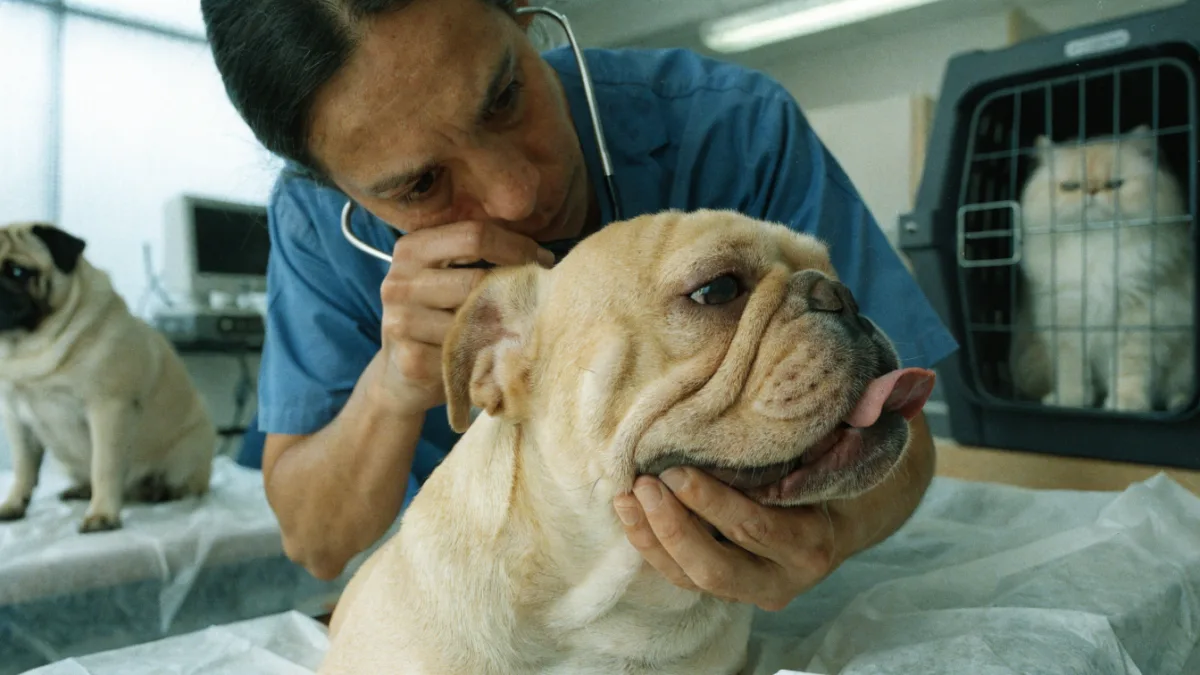
The most popular dog in America is a dog that struggles to breathe, can’t mate without help, and can’t give birth without a surgeon. The French Bulldog took the American Kennel Club’s top spot in 2022, ending the Labrador Retriever’s 31-year reign, and it has held the position since — even as the United Kingdom, which caught Frenchie fever a decade earlier, has watched registrations fall by roughly half from their peak. Meanwhile, a growing share of the veterinary profession has stopped issuing polite buyer warnings and started asking the uncomfortable question out loud: whether breeding dogs into this shape is itself the harm. If you’re shopping for a squish-nosed puppy right now, you’re walking into a live controversy, not just a purchase.
Why Your Brain Falls for the Flat Face
Start with the awkward truth: the trait that makes you want one is the trait that hurts them.,[1] shows that a short muzzle, round skull, and wide-set eyes hijack the same wiring that makes you melt at a human infant. Brachycephalic dog breeds aren’t winning us over despite their faces. They’re winning us over because of them — and the flatness of that face is the disease mechanism. The snorting that owners describe as personality is airway compromise performed as comedy. Once you can’t unsee that, kennel ads and viral Frenchie accounts start to read differently.
A friend of mine has a Frenchie named Gus. Sweet dog, alarming roommate. Gus snores like a retired linebacker, gagged his food until he learned to eat slowly, and can’t make it around the block on a warm afternoon. My friend thought all of that was normal for the breed. It is common for the breed. It is not normal — it’s the disorder, and the disorder has a name.
The Snore That Isn’t Cute: Understanding BOAS
Brachycephalic Obstructive Airway Syndrome, BOAS, is the signature condition of French Bulldog health problems and it’s brutally simple to explain: breeders shortened the skull and the soft tissue didn’t get the memo. The nostrils are pinched nearly shut (stenotic nares). The soft palate is sized for a muzzle the dog no longer has, so it flops across the airway. Laryngeal saccules get sucked inward and swell. The trachea is a straw where a pipe should be. Every breath is a workout, and the damage compounds over a lifetime. BOAS is progressive and incurable — surgery and management buy comfort, not a cure.
How bad is the risk? A 2015 study from the Royal Veterinary College’s Rowena Packer and colleagues, published in PLoS ONE, found that BOAS risk climbs steeply as the muzzle shortens relative to the skull. At the flattest conformations — the look currently dominating Instagram — virtually no dogs escape airway compromise. That’s not a predisposition. That’s a guarantee wearing a cute face.
The RVC’s VetCompass program has been quantifying the rest of it. A 2018 pug study found pugs at higher risk for 23 of 40 common disorders compared with other dogs. French Bulldogs showed increased risk for roughly 20 common disorders, leading epidemiologist Dr. Dan O’Neill to a conclusion that made headlines worldwide:
“French Bulldogs can no longer be considered a typical dog.”
There’s also the life-expectancy bombshell: a 2024 VetCompass analysis of UK vet records put the median life expectancy for French Bulldogs at about 4.5 years, against 11.2 years for dogs overall — the lowest of any breed studied. Kennel clubs argue the number is skewed because the UK Frenchie population exploded so recently that most living Frenchies are under four years old, dragging the median down. The RVC stands by the population-level math. I’ll say plainly what nobody disputes: the breed’s airways, eyes, skin folds, spine, and teeth all fail at elevated rates, more than 80% of French Bulldog and English Bulldog litters in UK Kennel Club data arrive by C-section, and a 2020 UK study found flat-faced breeds massively overrepresented in heatstroke cases because their panting machinery is broken. Delta, United, and American Airlines all restrict snub-nosed dogs from cargo for exactly this reason.
Vets, Courts, and a Profession at War
Europe has moved from opinion to law. In 2022, Norway’s Oslo District Court ruled that breeding English Bulldogs violated the country’s animal welfare law; a 2023 appeals ruling softened the ban by permitting breeding with welfare safeguards and outcrossing, but the landmark stands. Germany’s dog-breeding ordinance restricting extreme traits took effect in 2022. And in July 2024, the Netherlands expanded its rules to ban 77 extreme conformational traits in dogs and 10 in cats — one of the first regulations anywhere to explicitly cover flat-faced cats. [LOCALIZATION CHECK: Breed-specific breeding laws vary widely by country; verify current local rules before advising buyers in any given market.]
The UK took the soft-power route. After the BBC’s 2008 documentary Pedigree Dogs Exposed prompted the network to withdraw from Crufts, the Kennel Club revised breed standards in 2009, and the 2018 #BreedToBreathe campaign pressured brands including Heinz and Costa Coffee to stop using flat-faced animals in advertising. The [2] and Cambridge University’s Respiratory Function Grading scheme gives breeders a tool their grandparents never had.
The profession itself is split. Some veterinarians want breeding bans outright. Others argue harm reduction — health-tested breeders gradually lengthening muzzles — pointing to outcross projects like the Retro Pug and the Continental Bulldog, which purists hate and physiologists love. Breeders blame show-ring standards and celebrity Frenchie accounts; some breeders accuse vets of profiting from BOAS surgery while condemning the people who supply the patients. There’s a pointed question buried in there. And here’s the strangest twist: several of these breeds are now so genetically bottlenecked from founder effects that conservation genetics — the toolkit used to save endangered species — is being proposed to save breeds from their own heads. A Norwegian court case openly raised the possibility of deliberate breed extinction. That’s a first in animal welfare law.
Through all of this, the United States is the outlier. As [3] documents, flat-faced dog ownership is sliding globally — UK Frenchie, Pug, and Bulldog registrations have fallen hard from their peaks — while American demand keeps climbing. If ethics won’t curb US buying, the betting money says cost will: rising surgical bills, climbing insurance premiums, and an industry that increasingly excludes respiratory conditions the moment a snore lands in a vet’s chart.
The Second Front: Persians Get the Same Disease, Less Attention
Flat-faced cat breathing issues are the understudied half of this story. Extreme “ultra-type” Persians and Exotic Shorthairs share the whole pathological package: pinched nostrils, snoring, exercise and heat intolerance, plus chronically weeping eyes because the tear ducts drain from skulls they weren’t built for. An RVC VetCompass study in 2019 found about two-thirds of Persians had at least one recorded disorder in a single year, led by dental disease and eye discharge — both consequences of the flattened face. Historically, a third to a half of Persians also carried polycystic kidney disease before genetic testing became routine.
I judged a household cat show once where an ultra-type Persian took Best in Show with eyes streaming so badly the owner wiped its face between rings. The crowd saw elegance. The cat spent the day squinting. International Cat Care has campaigned against the ultra flat-faced show type for years, and traditional “doll-face” Persians — with an actual, visible muzzle — breathe dramatically better. If the Dutch rule covering cats signals anything, it’s that regulators have noticed the second front.
Buying Smart If You’re Buying at All
The surgery math
BOAS surgery — nostril widening, soft palate resection, sacculectomy, sometimes laser turbinate work — runs $1,500 to $6,000+ in the US and is frequently needed before age three. Gus had palate surgery at eighteen months. Four thousand dollars, and he breathes like a different dog — but he still wears a harness, still holds a strict weight, and still can’t do a July walk. That’s the deal: management for life. And insure the puppy before the first vet visit, because once a snore is documented, respiratory conditions become pre-existing and excluded on most policies.
Questions that separate breeders from sellers
- Ask for Respiratory Function Grading scores for both parents. If the breeder doesn’t know the term, leave.
- See the puppies awake and after light exercise. Noisy breathing is a red flag, not a breed quirk.
- Look at the nostrils. Open slits, not pinched lines.
- Skip the rare-color marketing. A $5,000 “exclusive” merle Frenchie is a profit strategy, not a health strategy.
- Consider retro or moderate-muzzle lines — or rescue. An adult rescue Frenchie’s airway is a known quantity; a puppy’s is a lottery ticket.
I like these dogs. I’ve met Frenchies I’d take home tomorrow, and I’ve also watched a pug collapse on a seventy-degree day, which rearranged my thinking about what we’ve normalized. The current extreme conformation isn’t a dog most people can care for well, and the shape is the problem — which means the solution isn’t loving them less. It’s demanding they be built to breathe. Every buyer who walks past the flattest face in the litter and asks for a muzzle they can actually see is a data point breeders can’t ignore. Right now, in the US market, that’s the only regulation that’s guaranteed to work.
Sources
- Research on the "baby schema" — facebook.com
- RSPCA now runs a dedicated program on extreme conformations — rspca.org.uk
- reporting by the Veterinary Information Network — news.vin.com