

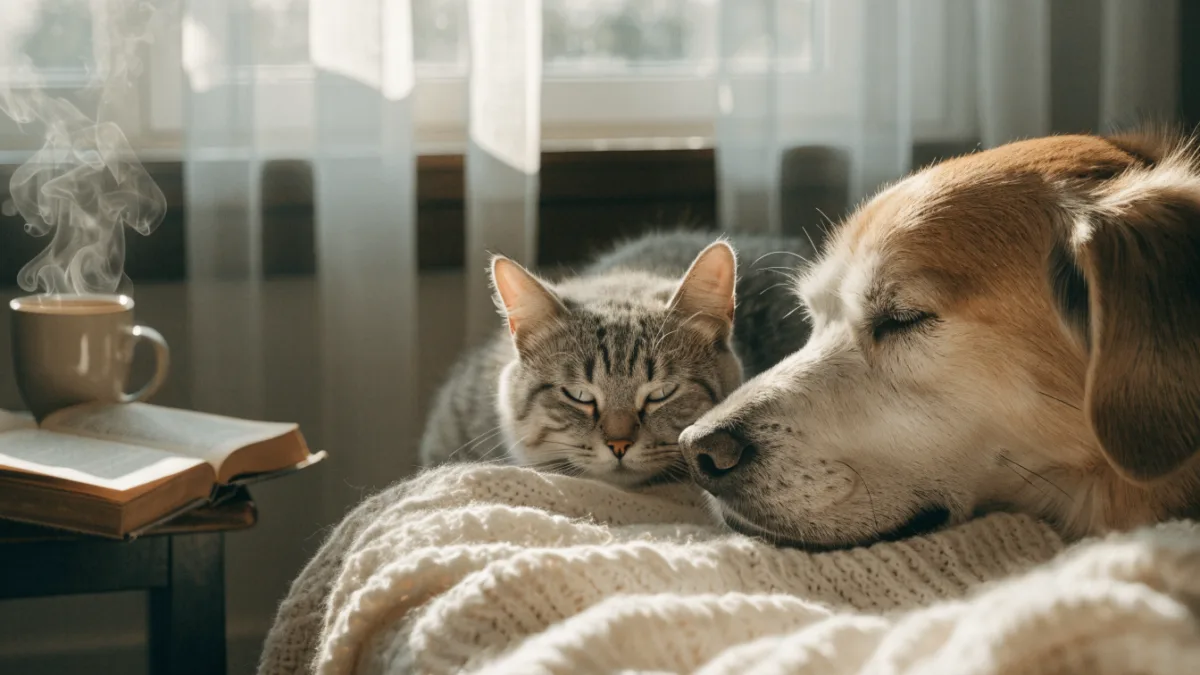
Every animal shelter has roughly the same floor plan: a scrum around the puppy room, a line for the kittens, and somewhere in the back, a grey-muzzled dog lying politely on her bed while everybody files past. For years, I filed past too. Then I met Mabel, an eleven-year-old tabby whose shelter profile read “grumpy, prefers to be left alone,” and now I’m the person who corners strangers in the cat room to talk about senior adoption. (Mabel, for the record, is not grumpy. She is asleep on my sweater as I type this, which is the opposite of left alone.) Here’s my honest pitch: if you want a companion whose personality you can actually meet before you commit — instead of an eight-week-old mystery box — a senior pet isn’t the consolation prize. It’s the shortcut.
What You See Is What You Get
Puppies and kittens are delightful, and they’re also a gamble. That fluffball in kennel four might grow into a marathon athlete when you wanted a Netflix partner, or a ninety-pound lap enthusiast when you signed up for a jogging buddy. Shelter staff make educated guesses, but temperament at eight weeks is a rough draft. A senior’s rough draft is finished. The dog leaning against your leg at the meet-and-greet is the dog you’ll live with. As the team at,[1] puts it, older dogs are calmer and their personalities are already fully formed. What you see is what you get.
If you’re retired or simply want a peaceful house — and I suspect that’s exactly who’s reading this — the predictability is the whole point. You’re not structuring your life around someone else’s developmental stages. You’re choosing a roommate you can interview.
Mabel’s “grumpiness,” it turned out, was arthritic hips plus a firm policy against being scooped up without consent. Once I respected the policy — no surprise lifts, a ramp to her window perch — she became the most openly affectionate cat I’ve ever lived with. I never had to wonder whether she’d mellow with age. She’d already done the mellowing. The mellowing is the product.
The Unglamorous Perks That Quietly Change Everything
None of this goes on the adoption flyer because it doesn’t photograph well, but here it is: most senior pets arrive trained. House-trained. Litter-box fluent. Past the chapter where your baseboards are a chew toy and your sofa is a scratching post. They sleep through the night. New animals of any age need time to decompress, sure — but you will skip the 3 a.m. potty-training era entirely, and I cannot put a price on that.
The economics tilt your way too. Senior adoption fees are frequently reduced or waived, and many U.S. shelters run “Senior for Senior” programs that discount or cover fees for adopters sixty and over. Availability varies by shelter and country, so ask locally — but don’t assume the older animal is the expensive one at the front desk.
The energy match is real as well. One or two leisurely walks, a sunny windowsill, a lap — a senior’s engine idles right where a calm household lives. If your hiking boots are aspirational décor, the senior kennel has your dog. He will not notice the boots. He will absolutely notice the couch.
“But Won’t I Have Less Time With Them?”
This is the question everyone asks, so let’s do the math instead of the flinching. “Senior” is a life stage, not a diagnosis. It starts around age 7 for most dogs — as early as 5 or 6 for giant breeds, not until 8 to 10 for small ones — and somewhere between 7 and 10 for cats. Small dogs routinely live 12 to 16 years. Indoor cats average 12 to 18, and plenty cross 20. Adopt a 9-year-old cat and you may be signing up for another decade. Adopt a 7-year-old small dog and the word “senior” is doing very little work in that sentence.
Yes, statistically fewer years than a puppy would offer. But “statistically” is carrying a lot of weight in that sentence too. Young animals get sick. Every timeline is a guess. What you’re really choosing is quality of companionship over quantity of years, and adopters who chose quality describe something remarkably consistent: an animal who settles in fast and attaches hard. Is that “gratitude”? It’s anecdotal, technically. But it’s anecdotal everywhere, from everyone, all the time — at some point consistent anecdotes are just a pattern.
Senior dogs have so much love left to give, yet they’re often the last to be adopted and the first at risk when shelters run out of space.
That’s the [2] a nonprofit funding programs to improve adoption outcomes and shorten shelter stays for older dogs since 2008. Their grants increasingly pay for veterinary care and home-retention support so seniors don’t lose their homes in the first place — which matters, because it works both ends of the problem.
I won’t pretend the math never stings. When Mabel’s time comes, it will flatten me. But I’d take these years — the known, the settled, the snoring-on-my-sweater years — over a longer hypothetical with an animal I hadn’t met yet. Every time.
Getting Ready: Senior Dog vs. Senior Cat
The prep differs by species, and — small confession — the cat list is shorter. Make of that what you will.
Prep List for a Senior Dog
- An orthopedic bed. Older joints need real cushioning, not a thin pad on a hard floor.
- Traction. Rugs or runners on slippery floors — hardwood plus arthritic hips is an ice rink.
- A ramp or steps for the car and the couch. Let him choose his own route up.
- Shorter, more frequent walks with plenty of sniffing. A slow “sniffari” is genuine mental exercise; let him read the neighborhood news.
- A predictable potty schedule. Older bladders appreciate a routine, not an endurance test.
- A baseline vet visit in the first week or two, plus a dental check and a clear demonstration of any medications — have the shelter show you exact doses and timing before you leave.
Prep List for a Senior Cat
- A low-entry litter box. High walls are a hip tax. Have one on every floor she uses.
- Steps or a ramp to her favorite perch. Mabel’s window ramp bought me years of bird-watching and zero resentment.
- Easy food and water stations on her main floor. Senior cats quietly eat and drink less when access becomes a chore.
- Warm, cushioned napping spots near heat or sun. To her, this isn’t furniture — it’s infrastructure.
- Twice-yearly vet visits. Cats famously mask illness; by the time a senior cat looks sick, she’s been toughing it out for a while.
- Short, gentle play. Senior cats do not stop being cats. Mabel at fourteen still ambushes a feather wand for exactly ninety seconds a day, then retires to restore her dignity.
The Budget Conversation, Honestly
Senior wellness care costs money: bloodwork, dental cleanings, possibly daily medication. Pet insurance for an older animal usually costs more and won’t cover pre-existing conditions, so read the fine print before you build a budget around it. Two things soften the math. First, those reduced or waived fees up front. Second, medical-assistance programs — Grey Muzzle grants help shelters and rescues offset veterinary costs, and some adoptions come with post-adoption support attached. Ask exactly what comes with your animal, then book that first vet visit. A baseline makes everything that follows easier to read.
How to Actually Find Your Grey Muzzle
Start where the seniors actually are: municipal shelters — that quiet back kennel again — and breed-specific rescues if you’ve always dreamed of a particular silhouette. If you’re in the U.S., [3] points you toward shelters actively invested in senior placement.
Whoever you talk to, ask four questions: What’s her full health history? What medications is she on, and what do they cost monthly? What does the behavior assessment say about kids, other animals, and being left alone? And how old is she really — because “senior” covers both a 7-year-old beagle and a 15-year-old, and those are very different books.
Then go meet some animals with an open afternoon. The best senior adoption is the one where the animal’s actual energy matches your actual life — not the aspirational one.
Domestic dogs and cats will never appear on a conservation registry — they don’t need protecting as a species, they need placing as individuals. Within the shelter system, seniors are the at-risk population: last to be adopted, first at risk when space runs out, overlooked for no reason except the color of their muzzles. Every senior adoption is direct action — it rehomes an animal who’s been waiting the longest and opens that back kennel for the next one. That’s the real Grey Muzzle advantage: you skip the chaos, get straight to the companion, and shift the shelter’s math a little in the right direction. The puppy line is long anyway. Go meet the quiet dog in the back — she’s been ready for you for years.
Sources
- Lucas County Canine Care & Control — facebook.com
- Grey Muzzle Organization — greymuzzle.org
- Grey Muzzle's network of grantee organizations — bestfriends.org