

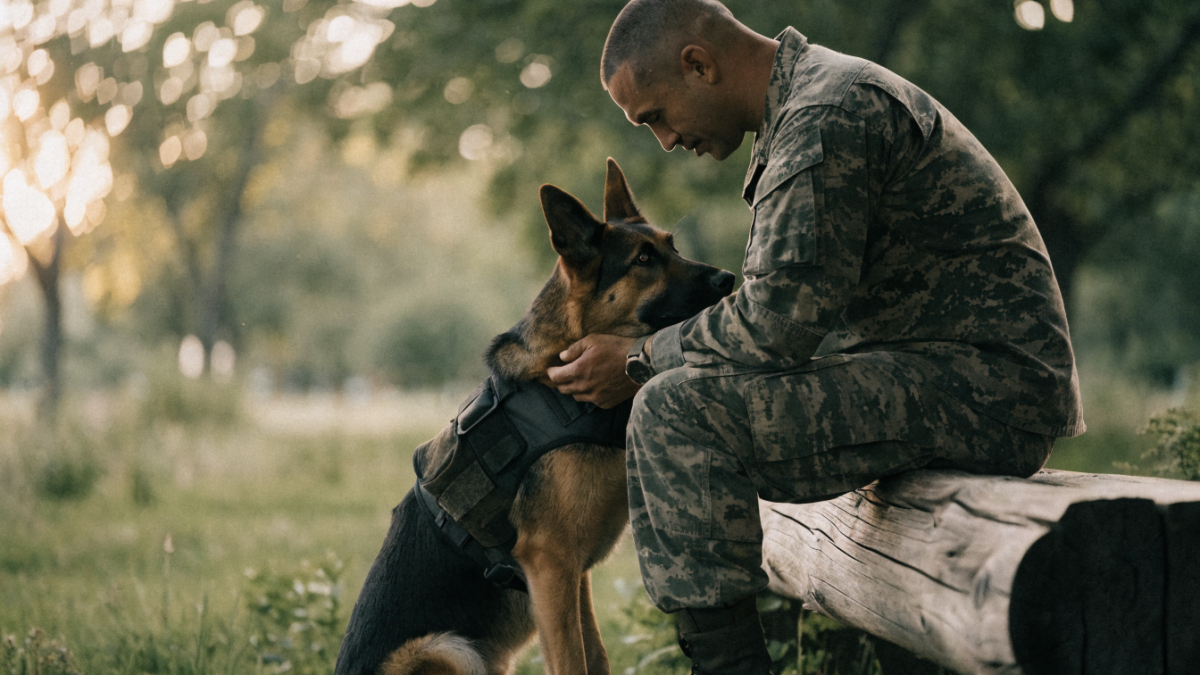
When Marcus, a 34-year-old Army veteran who served two tours in Afghanistan, first came to see me, he hadn’t slept through the night in almost three years. His wife, Rachel, told me he’d wake up gasping, sometimes punching the wall next to the bed. During the day, he couldn’t walk into a grocery store without his heart rate spiking to 140 beats per minute. He’d tried medications. He’d tried therapy. He was exhausted, cynical about treatment, and honestly, I understood why. Then Rachel asked me a question I wasn’t expecting: “Do you think a service dog could help him?” That was six years ago, and what I’ve learned since has fundamentally changed how I think about trauma recovery — not just for veterans, but for anyone living with severe anxiety and hypervigilance.
The Numbers Behind the Need
Roughly 11 to 20 percent of veterans who served in Operations Iraqi Freedom and Enduring Freedom experience PTSD in any given year. That’s not a vague statistic — that’s Marcus, and Jennifer, a 28-year-old Marine Corps veteran who couldn’t sit with her back to a door, and David, a former Navy corpsman who hadn’t been to a restaurant in four years because crowds made him feel like he needed to escape. PTSD, or Post-Traumatic Stress Disorder, is a condition where the brain’s threat-detection system gets stuck in overdrive after exposure to life-threatening trauma. The amygdala — that almond-shaped cluster of neurons deep in your brain responsible for processing fear — essentially becomes a smoke alarm that won’t stop ringing, even when there’s no fire.
Traditional treatments help many people. But they don’t help everyone. And for the veterans who fall through the gaps, service dogs have emerged as something genuinely remarkable.
What PTSD Service Dogs Actually Do
Here’s where I need to clear up a common misconception. A PTSD service dog is not the same as an emotional support animal, and it’s definitely not just a well-behaved pet. Under the Americans with Disabilities Act (ADA), only dogs are legally recognized as service animals — and they must be individually trained to perform specific tasks that directly mitigate their handler’s disability.
Tasks That Go Beyond Companionship
The dogs I’ve seen work with veterans are trained to do things that sound almost unbelievable until you watch them in action:
- Room clearing: For veterans with hypervigilance — that constant, exhausting state of scanning for threats — the dog enters a room first, checks it, and returns to the veteran with a signal that the space is safe. This isn’t a trick. It’s a trained task that reduces the veteran’s heart rate and allows them to function in spaces they’d otherwise avoid.
- Night terror interruption: The dog is trained to recognize the physical signs of a nightmare — rapid breathing, sweating, thrashing — and gently wake the veteran before the terror peaks. Marcus told me the first time his dog, a Labrador named Beau, woke him from a nightmare, he cried. Not from fear. From relief.
- Deep pressure therapy: When the dog detects early signs of a panic attack — changes in breathing rate, subtle shifts in body chemistry that humans can’t perceive but dogs can — they apply their body weight across the veteran’s lap or chest. This deep pressure stimulation activates the parasympathetic nervous system, which is the body’s natural calming mechanism. It’s the same neurological principle behind weighted blankets, but exponentially more effective because the dog responds in real time.
- Creating physical buffers: In crowded spaces, the dog positions themselves between the veteran and strangers, creating a sense of physical safety that allows the veteran to navigate grocery stores, airports, and medical appointments.
These aren’t vague comforts. These are specific, trained interventions that change how a veteran’s nervous system responds to the world.
The Science of Matching — Why One Size Doesn’t Fit All
This is where the field has evolved dramatically, and I’ll be honest — I’ve changed my mind on this. Early in my career, I thought a well-trained service dog was a well-trained service dog, and the matching process was secondary. The research has proven me wrong.
A 2024 study by J. Whitworth highlighted what top training organizations have suspected for years: the success of a service dog placement depends heavily on how thoughtfully the dog and veteran are matched. It’s not just about finding a smart dog. Agencies now consider the veteran’s lifestyle, their living situation, their specific trauma triggers, and even the other pets already in the home. A high-energy German Shepherd might be perfect for a veteran who hikes daily and needs a dog that commands respect in public spaces. That same dog might be a disaster for a veteran who lives in a small apartment and is triggered by loud, excitable behavior.
I saw this play out with Jennifer. Her first placement — a male Golden Retriever — was technically flawless in his training, but his size and enthusiasm made her more anxious, not less. The agency recognized the mismatch within the first month and paired her instead with a smaller, calmer female Labrador. The difference was immediate. “She doesn’t startle me,” Jennifer told me at her follow-up. “She just feels like part of my body.”
The Financial Reality — and Why It’s a Problem
Here’s the part of this conversation that frustrates me. Breeding, raising, and training a single PTSD service dog costs between $15,000 and $30,000. That figure reflects roughly two years of professional training, veterinary care, food, housing, and the specialized task training that makes these dogs different from pets. Most veterans don’t have that kind of money.
The Department of Veterans Affairs has historically covered service dogs for veterans with physical disabilities — guide dogs for visual impairment, mobility assistance dogs. But coverage for PTSD service dogs has faced bureaucratic hurdles and required pilot programs, like the Puppies Assisting Wounded Servicemembers (PAWS) Act, to prove what those of us working in the field already knew: these dogs work. The VA’s own research has shown reductions in PTSD symptoms, decreased reliance on psychiatric medications, and improved quality of life measures among veterans paired with service dogs.
Corporate partnerships are helping bridge the gap. Purina’s Dog Chow brand has directed significant funding toward service dog initiatives for veterans, and veterinary networks have expanded programs that provide free or reduced-cost care not just for the service dog, but for the veteran’s other pets as well — because keeping a veteran connected to their existing animals is a vital part of suicide prevention.
But I still sit across from veterans who tell me things like what David said to me last spring: “I’ve been approved. I just don’t know how I’m gonna make it through the month with the travel costs and the waiting.” No veteran should have to crowdfund their mental health treatment.
The Problem Nobody Wants to Talk About
I need to address something uncomfortable. The rise of “fake” service dogs — pets whose owners buy vests online and take them into public spaces — isn’t just an annoyance. For veterans with PTSD service dogs, it’s a genuine safety issue. An untrained pet in a grocery store lunging at or barking at a working service dog can shatter the calm that took months to build. I’ve had veterans tell me they stopped going certain places entirely after their service dog was attacked or distracted by an untrained pet in a vest. When your service dog is your lifeline, that’s not an inconvenience. It’s a crisis.
This isn’t about being gatekeepers about who gets to love their pet. It’s about protecting the integrity of a system that saves lives. Real service dogs undergo hundreds of hours of training to remain calm and focused in chaotic environments. That training deserves respect.
What I Tell Veterans Who Ask Me About Service Dogs
If you’re a veteran considering a service dog, or a family member researching options, here’s what I recommend based on what I’ve seen work:
- Talk to your VA healthcare team first. They can connect you with approved programs and help you understand what documentation you need. The organization [1] also maintains excellent resources.
- Work with accredited organizations. Look for programs accredited by Assistance Dogs International. They hold their member organizations to rigorous training and ethical standards. [2] is one of the most respected, but there are others. Ask about their matching process — if they don’t have a structured approach to pairing you with the right dog, keep looking.
- Be honest about your lifestyle. The best service dog in the world won’t help if the match is wrong. Tell the training team everything — your triggers, your routine, your home environment, your other pets.
- Understand it’s a partnership, not a prescription. A service dog isn’t a pill you take. It’s a relationship you build. Marcus still works with Beau daily on training and bonding. The dog isn’t magic. The relationship is.
The Bigger Picture
What strikes me most about this work is what it reveals about healing. We’ve spent decades trying to treat PTSD by talking about trauma, by medicating symptoms, by asking veterans to consciously override a nervous system that’s screaming at them to be afraid. Service dogs offer something different — a living, breathing presence that regulates the nervous system at a level below conscious thought. The dog doesn’t ask the veteran to explain their trauma. The dog simply responds to their body, moment by moment, and says through action what no words can: You’re safe right now. I’m here. I’ve got you.
Marcus sleeps through the night now. Last I heard, he and Beau were volunteering at a local veterans’ center, helping other vets see what’s possible. That’s not a medical outcome I can measure on a standardized scale. But I know it when I see it.
If you want to support this work — whether you’re a veterinarian, a donor, or simply someone who encounters service dogs in public — the most powerful thing you can do is respect what these animals do. Don’t distract a working dog. Don’t fake a vest for your pet. Support legislation and programs that fund service dogs for veterans. And if you know a veteran who’s struggling, share the resources. Sometimes the right help walks on four legs.
Sources
- DAV (Disabled American Veterans) — dav.org
- Canine Companions — canine.org