

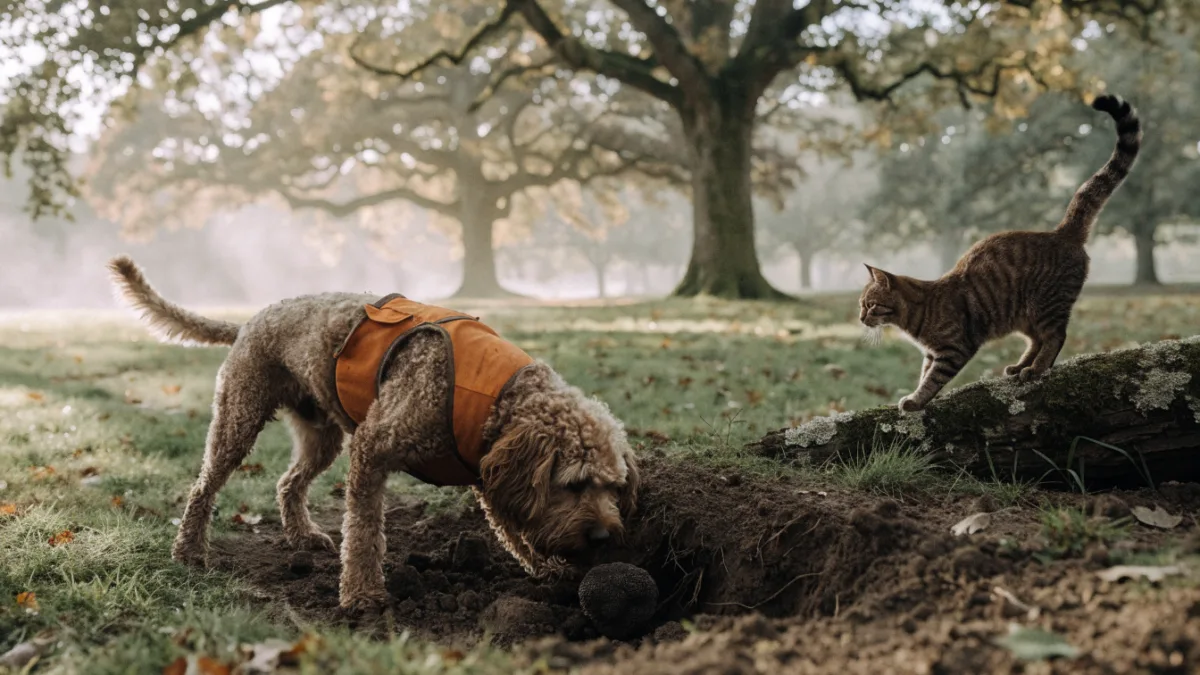
There’s a small truffle-hunting operation in Oregon that heads into the forest each season with a trained dog — and, as of recently, an unpaid trainee:,[1] who simply started tagging along on hunts like he was auditing the position before committing to anything. That detail stopped my scroll this week, mostly because my own cat Biscuit’s entire résumé consists of screaming at 5 a.m. and sitting on whatever I’m trying to read. We talk constantly about working dogs, and fair enough — but a cat voluntarily attending a shift? That’s news. And once you pull the thread, the working-animal economy turns out to be bigger, older, and considerably weirder than most of us assume.
The Hardware: A Nose That Beats Every Machine We’ve Built
Every canine career runs on the same equipment. Dogs carry an estimated 220 to 300 million olfactory receptors; humans get by with about 5 or 6 million. The portion of a dog’s brain devoted to analyzing scent is proportionally around 40 times larger than ours, and dogs can register certain odorants at concentrations of one to two parts per trillion. Every electronic nose engineered to compete with that has lost, quietly and repeatedly.
The hiring pipeline is where things get surprisingly corporate. A fully trained detection or guide dog typically represents $20,000 to $50,000-plus and 12 to 24 months of schooling — and “career change” dogs are common, because not every gifted nose wants a full-time job. The lifecycle runs puppy raiser, formal training, roughly 8 to 10 working years, then retirement; since Robby’s Law passed in 2000, retired military dogs can even be adopted by their handlers or the public. The training itself is a whole discipline — Jake can walk you through it far better than I can — but the short version is repetition, rewards, and a shockingly high washout rate.
Detection Work: Mango Confiscation, Bomb Squads, and COVID Duty
Detection is the single biggest employer of working dogs. The TSA fields roughly 1,000 explosives-detection canine teams, several hundred of them working passenger screening at U.S. airports. My favorite corner of airport security remains the USDA’s Beagle Brigade — dogs whose literal government job is sniffing baggage for forgotten fruit, and who confiscate a heroic quantity of contraband mangoes every year.
The U.S. military maintains an estimated 2,500 to 3,000 working dogs at any time, and the field has produced genuine celebrities: Cairo, the Belgian Malinois on the 2011 bin Laden raid, and Conan, honored at the White House after a 2019 operation — with WWI’s Sergeant Stubby, the most decorated war dog in American history, as the genre’s founding legend. The job board keeps growing, too. In 2021, Miami International became the first U.S. airport to deploy COVID-sniffing dogs, after pilots in Helsinki and Dubai, with lab studies showing accuracy above 90 percent. Medical-detection careers are expanding as well, though the evidence deserves a careful read — seizure-response dogs are well supported, while claims that dogs can predict seizures remain genuinely contested.
Search and Rescue Dogs: Running Toward What Everyone Else Is Fleeing
Nearly 300 search and rescue dogs deployed after 9/11 — at Ground Zero, the Pentagon, and the Shanksville crash site. For a sense of how selective this profession is, FEMA certifies only about 280 to 300 disaster-search canines in the entire country. The last surviving 9/11 search dog, a golden retriever named Bretagne, died in 2016 at 16, having spent her retirement doing therapy work and listening to kids practice reading — because apparently she wasn’t done being useful.
Modern SAR dogs specialize: wilderness, disaster rubble, avalanche, water and human-remains detection. The oft-cited industry figure for avalanche work holds that one trained dog can search a slope in about 30 minutes what would take a human probe line many hours — the sourcing on that stat is admittedly loose, but anyone who’s watched avalanche-dog footage finds it entirely believable. One reassuring footnote: a long-term PennVet study found the 9/11 dogs lived as long as or longer than comparison dogs. The dogs who gave the most, in other words, did okay.
Conservation Dogs: Scat Detectives on the Wildlife Beat
Conservation dogs may be the fastest-growing canine career, and it’s the one where their skills do something no gadget matches. Research from the University of Washington’s Conservation Canines program found that scat-detection dogs locate target scat three to four times more effectively than trained human observers, with far less habitat bias — and often more cheaply and accurately than camera traps or radio collars. Dogs have been sliding into ever-,[2] and this is the most consequential one.
- Orcas: dogs track the scent plumes of southern resident killer whale scat on Puget Sound to monitor a population hovering around 75 individuals.
- Koalas: a border collie named Bear became a national hero in Australia for sniffing out survivors of the 2019–20 bushfires; koalas were listed as endangered in eastern Australia in 2022.
- Invasive species: Minnesota’s natural-resources agency runs dogs that inspect boats for hitchhiking zebra and quagga mussels.
- Anti-poaching: in Africa, dogs screen cargo and vehicles for ivory and pangolin scales.
The frontier keeps widening — lanternfly egg masses, chronic wasting disease in deer scat, even bat and bird fatalities beneath wind turbines.
Truffles, Pigs, and the Cats Who Clock In Too
The Smell of Money
Truffle hunting is where working-dog economics get flashy. Betty, a wire-haired pointer,[3] has logged three seasons finding truffles — and she’s typical, in that most truffle dogs are versatile hunting or sporting breeds. Italy’s Lagotto Romagnolo, a former water retriever turned truffle specialist, is the breed most associated with the trade.
Pigs were the traditional partners — truffle aroma mimics a swine sex pheromone, so pigs arrive pre-motivated — but they eat the harvest and crater the soil, and Italy now effectively prohibits hunting with them. Dogs, it turns out, will work for kibble. Given that Oregon white truffles run roughly $150 to $400 a pound and Italian Alba whites can hit $3,000 to $6,000-plus — with record auction specimens reaching six figures — prize truffle dogs in Europe are sometimes stolen, and a top dog can be worth over €10,000. Oregon, arguably North America’s truffle capital, leans in: the Oregon Truffle Festival in Eugene has run annual dog-training seminars since 2006, and demand keeps climbing as European harvests collapse — France’s Périgord region went from thousands of tons a year in the 19th century to tens today, thanks to drought and habitat loss.
Meanwhile, the Cats Have Always Been Employed
Which brings us back to Larry, the Oregon cat auditing a canine career — reportedly joining the truffle hunts uninvited, which is the most feline onboarding process imaginable. And cats have held real jobs for centuries. The State Hermitage Museum in St. Petersburg has kept cats since Empress Elizabeth decreed it in 1745; about 50 patrol the galleries today. Disneyland quietly maintains a managed feral colony, reportedly well over a hundred strong, complete with feeding stations and spay/neuter to keep rodents in check. In Japan, Tama — appointed stationmaster of Kishi Station in 2007 — is credited with saving the rural rail line and generating an estimated ¥1.1 billion (roughly $10 million) in local economic impact before her death in 2015; her deputy, Nitama, now holds the post. And Larry, the UK Prime Minister’s “Chief Mouser to the Cabinet Office,” has served since 2011 under six prime ministers while being famously indifferent to actually catching mice — arguably the most successful exercise in managing up in British politics.
Honesty time, though: the mousing résumé can oversell. A 2018 New York City study found feral cats rarely killed adult rats, preferring smaller prey. And the landmark 2013 study in Nature Communications estimated free-roaming U.S. cats kill 1.3 to 4 billion birds and 6.3 to 22.3 billion small mammals annually. That’s exactly why the best modern working-cat programs — including the barn-cat placements U.S. shelters increasingly use as a live-release pathway for unsocialized cats — emphasize contained, managed settings like barns, cellars, and warehouses rather than free roaming. The job works when the workplace has walls.
What strikes me about all of this is that the best animal jobs take an animal’s nature seriously instead of fighting it. Dogs’ noses are out there quietly serving endangered orcas and post-fire koalas; cats’ hunting instincts do their most good — and their least harm — in a barn with a door and a managed food bowl. About 75 southern resident killer whales are left on Earth, and a meaningful slice of what we know about their health exists because a dog rode a boat and followed the wind. That’s the takeaway I’d hand anyone, career-curious kids included: the animal workforce isn’t a novelty act, it’s proof that conservation tends to work best when we enlist nature rather than bulldoze it. Larry the truffle cat seems to have worked out the employment thing on his own. Biscuit, meanwhile, remains comfortably retired at four.
Sources
- a cat named Larry — facebook.com
- stranger careers — caninestyles.com
- profiled in a "Dogs with Jobs" segment — youtube.com