

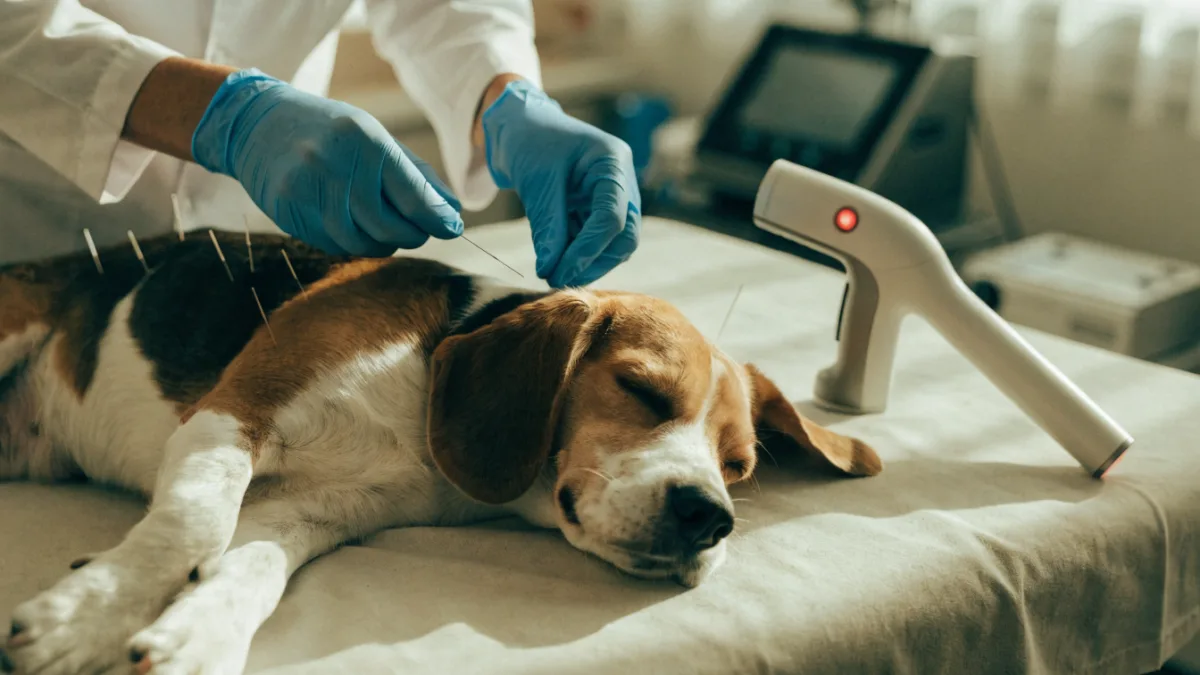
Consider Morris, a fourteen-year-old Beagle with a personality three times his size, hobbling into a clinic last spring with his owner Karen looking exhausted. Morris had been diagnosed with intervertebral disc disease (IVDD) — a painful condition where the cushioning discs between vertebrae bulge or rupture, pressing against the spinal cord. He’d already had one surgery, and while it saved his ability to walk, the recovery was brutal. “He won’t go up the stairs anymore,” Karen said, voice cracking. “He just stands at the bottom and cries.” His pain medications could have been increased — and they were adjusted slightly — but his vet wanted to try something else alongside the conventional treatment. Three weeks into a combined protocol of cold laser therapy and traditional acupuncture, Morris trotted up those stairs for the first time in months. Karen filmed it. It’s the kind of video you watch forty times.
From Fringe to Standard: How Acupuncture Became Mainstream Veterinary Medicine
I’ll be honest with you — when I first heard about veterinary acupuncture twenty years ago, I was skeptical. I grew up in a very conventional medical household, and the idea of inserting tiny needles into specific points on an animal’s body to trigger healing sounded, well, a bit magical. But the evidence has a funny way of changing your mind.
Traditional acupuncture works by inserting extremely fine needles at precise anatomical points — locations that correspond to concentrations of nerve endings, blood vessels, and connective tissue. When stimulated, these points trigger measurable physiological responses: endorphin release (your body’s natural painkillers), increased blood flow to targeted areas, and modulation of the nervous system’s pain signaling pathways. It’s not mysticism. It’s neurology.
What really turned me into a believer was seeing the research on severe nerve injuries. Studies in small animal medicine have shown that acupuncture can significantly accelerate healing for spinal cord damage caused by herniated discs — the exact condition Morris was dealing with. Dogs receiving acupuncture alongside conventional treatment were recovering mobility faster than those receiving surgery and medication alone. When you watch a paralyzed Dachshund take his first steps again weeks ahead of schedule, skepticism tends to evaporate.
Cold Laser Therapy: Light as Medicine
Cold laser therapy — technically called low-level laser therapy or photobiomodulation — sounds like science fiction, but the principle is elegantly simple. A therapeutic laser delivers specific wavelengths of light energy into tissue. This light is absorbed by mitochondria (the powerhouses inside your cells), which ramps up cellular energy production, reduces inflammation, and accelerates tissue repair.
The “cold” part is important. Unlike surgical lasers that cut or cauterize tissue, cold lasers don’t generate heat. They operate at intensities that stimulate healing rather than destroy tissue. When applied to an inflamed joint, a healing surgical incision, or an arthritic back, the result is reduced swelling, decreased pain, and faster recovery.
Laser Acupuncture: The Best of Both Worlds
Here’s where things get genuinely exciting. A technique called “laser acupuncture” combines both approaches by applying a therapeutic cold laser directly to traditional acupuncture points. The laser stimulates the same neurological pathways as a needle — but without breaking the skin. A 2021 study published by the National Institutes of Health confirmed that laser acupuncture is a “promising alternative” to manual needling, noting that it provides painless, highly controllable stimulation.
That controllability matters enormously. With traditional needles, I’m relying on my hands and the animal’s stillness. With a laser, I can dial in the exact dosage and intensity of stimulation, making each treatment precise and repeatable. It’s the difference between cooking on a campfire and cooking on a programmable oven.
The Comfort Factor: Why This Matters More Than You Think
Here’s something every pet owner understands: getting an animal to sit still for thirty minutes with a dozen needles in its back is not easy. Some dogs tolerate it beautifully. I had a Golden Retriever named Chester who would fall asleep during his sessions — snoring while needles dangled from his lumbar region like tiny metallic antennae. But cats? Cats are a different story entirely. And anxious dogs, rescue animals, pets with a history of trauma at the vet? Traditional needling can be stressful enough to undermine the very healing we’re trying to promote.
Laser acupuncture changes the equation completely. The procedure is painless, non-invasive, and doesn’t require the animal to remain perfectly motionless for extended periods. For fearful patients, geriatric animals with limited patience, or species that aren’t naturally inclined to cooperate with medical procedures, this is nothing short of a breakthrough.
This shift aligns perfectly with the modern veterinary movement toward “Fear-Free” and low-stress animal handling — an approach that recognizes how chronic stress and anxiety during veterinary visits can actually worsen clinical outcomes. Treatments that an animal tolerates well are treatments that get completed. That’s not just good welfare — it’s good medicine.
Beyond Dogs and Cats: Acupuncture for Every Species
One of the most remarkable developments in this field is how widely these techniques are being applied across species. This isn’t just a dog-and-cat phenomenon anymore. Veterinary professionals are successfully using acupuncture and laser therapy on horses, rabbits, birds, and increasingly on exotic and wildlife species in zoological and rehabilitation settings.
I’ve spoken with colleagues who work with zoo animals who have used laser therapy on elderly penguins suffering from degenerative joint disease. Others have treated llamas and alpacas for musculoskeletal pain. The physiological principles — reducing inflammation, promoting tissue repair, modulating pain signals — are consistent across vertebrate species. The anatomy changes, the technique adapts, but the science holds.
This matters enormously for wildlife conservation and captive animal welfare. When a rescued raptor with a wing injury can receive cold laser therapy to accelerate tissue healing, the chances of successful rehabilitation and release improve. When an aging endangered species in a zoo program can have its chronic pain managed without relying solely on pharmaceuticals that may have broader systemic effects, quality of life improves and longevity increases. Advanced veterinary techniques aren’t just pampering — they’re becoming genuine tools in the conservation toolkit.
Combination Therapy: Not Either/Or, But Both
If there’s one misconception worth clearing up, it’s that acupuncture and laser therapy are somehow alternatives to “real” veterinary medicine. They’re not. In virtually every modern veterinary hospital offering these modalities, they’re used as part of a comprehensive, multimodal approach to pain management and healing.
That means a dog recovering from orthopedic surgery might receive anti-inflammatory medication, controlled exercise rehabilitation, cold laser treatments on the surgical site, and acupuncture sessions targeting compensatory pain patterns developing elsewhere in the body. Each therapy addresses a different aspect of healing. Medication controls the biochemical cascade of inflammation. Laser therapy accelerates local tissue repair at the cellular level. Acupuncture modulates the nervous system’s pain processing and promotes systemic endorphin release. Together, they’re more effective than any single approach alone.
I often don’t choose between laser or acupuncture — I use both, strategically, depending on what the patient needs on a given day. When a rescue Greyhound named Daisy came to me with severe anxiety that made traditional needling impossible, we transitioned her to laser acupuncture exclusively. When a stoic ten-year-old Labrador named Bruno with hip dysplasia relaxed into his sessions like a spa guest, we kept manual acupuncture in his protocol because he clearly enjoyed the interaction.
Addressing the Skeptics
I understand the skepticism. Acupuncture has a complicated history in Western medicine, and for years, the primary counter-argument was that any perceived benefit was simply the placebo effect — patients feeling better because they expected to feel better.
But here’s the thing about veterinary acupuncture: animals don’t have psychological expectations. Morris the Beagle didn’t believe the needles would help him climb stairs. Daisy the Greyhound had no opinion about the therapeutic properties of specific light wavelengths. When these therapies produce measurable clinical results — faster healing of spinal injuries, improved mobility in arthritic joints, reduced medication requirements — the placebo argument simply doesn’t apply.
That said, I’m the first to acknowledge that these therapies aren’t miracle cures. They’re not appropriate for every condition, and they work best when integrated into a thoughtful treatment plan developed alongside diagnostics, medication, and sometimes surgery. If you’re considering acupuncture or laser therapy for your pet, have an honest conversation with your veterinarian about what these modalities can realistically achieve for your animal’s specific condition. And please — always consult with your vet before starting any new treatment protocol, including supplements or therapies you’ve read about online.
The rise of acupuncture and cold laser therapy in veterinary medicine represents something larger than any single treatment modality. It reflects a growing recognition that healing isn’t just about eliminating disease — it’s about supporting the body’s own capacity to repair, recover, and return to a life worth living. Whether that life belongs to a fourteen-year-old Beagle finally climbing his stairs again, a rescued penguin regaining mobility in a rehabilitation center, or your own animal companion simply moving through the world with less pain, that’s a future worth working toward. And increasingly, we have the tools — old and new — to help get them there.