

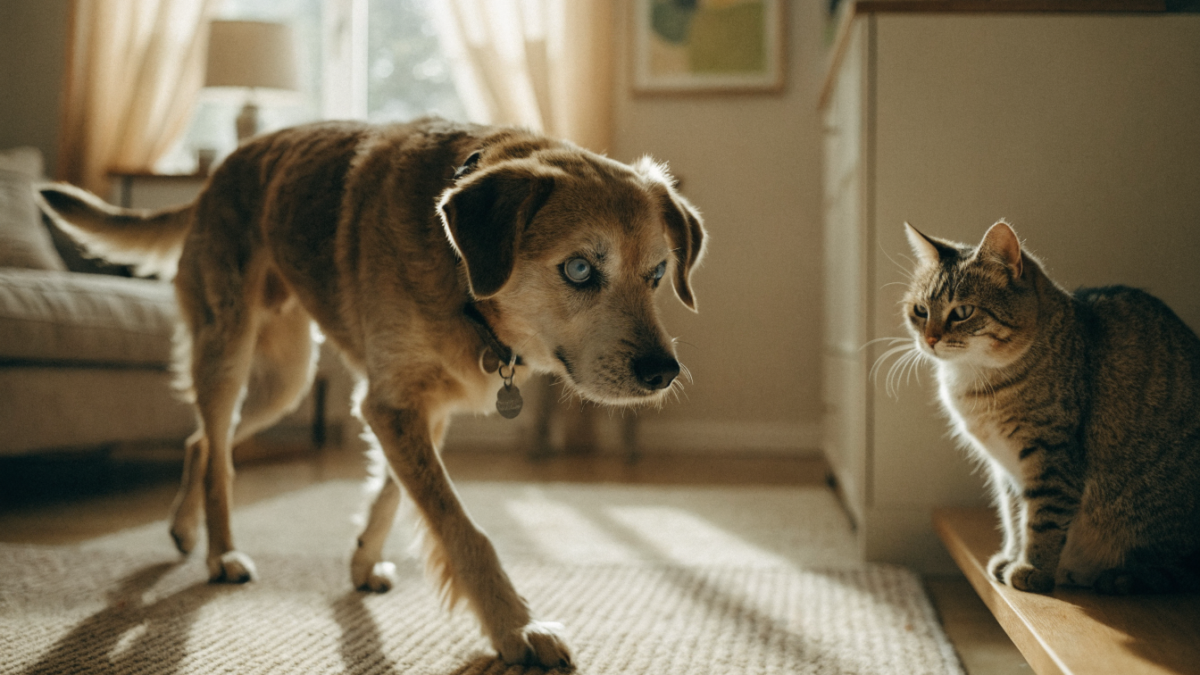
When my neighbor’s 14-year-old Poodle mix, Biscuit, went blind from cataracts last spring, the first thing her vet said was, “Don’t move your furniture.” My neighbor immediately moved every single piece she owned, reorganized the entire first floor, and then called me in tears because Biscuit kept walking into walls she’d never had trouble with before. I brought over coffee and watched this tiny confused dog bump gently into a newly repositioned ottoman, and it occurred to me that everything well-meaning people tell you about blind pets is simultaneously helpful and slightly wrong. The advice is right — don’t move your furniture — but the reason matters more than the rule.
Your Pet Is Building a Map in Their Head
Here’s what’s actually happening when a dog or cat loses their sight: they’re constructing what animal behaviorists call a mental map — a spatial memory of your home built from texture, sound, scent, and the physical distance between objects. Biscuit had a perfect map of my neighbor’s living room before the Great Rearrangement. After it, that map was garbage, and she had to start from scratch in a space that smelled the same but felt completely foreign.
This mental mapping is,[1] even though every cell in your body will scream at you to scoop them up and help. I know. When my cat Mabel tore her cornea and spent a week with a cone and limited vision, I carried her everywhere. She sat in my arms like a furry little statue, completely passive, and when I set her down in the kitchen, she froze. She had no idea how she’d gotten there. I’d bypassed her only way of learning the space.
Blind pets need to walk. They need to feel the transition from hardwood to tile to carpet. They need to count the steps between their bed and the water bowl. When you lift them, you’re erasing the route they’re trying to memorize.
The Safe Zone and the Grand Tour
Before you do anything else, establish what rescue organizations and veterinary behaviorists call a “safe zone” — a single small area where your pet’s essentials live. Food, water, bed, and for cats, a litter box. Everything within nose’s reach. This becomes their anchor point, the place they can always find their way back to when they get turned around.
Once the safe zone is set up, you walk them through the house. Literally walk them. For dogs, this means a leash and harness, moving slowly through each room, letting them stop and sniff and bump and figure out where walls are..[2] — yes, really — or very controlled exploration of one room at a time with you sitting on the floor as a familiar scent reference.
I know “put your cat in a harness” sounds like the setup for a joke. Mabel would rather remove her own teeth than wear a harness. But for a blind cat who needs to learn your home’s layout safely, it’s genuinely the kindest option. You’re their guide rail.
Dogs and Cats Need Different Homes
For Blind Dogs
Dogs are horizontal navigators. Their world is at ground level, which means your home modifications should focus on the floor plan and anything at nose-or-knee height.
- Block the stairs. Baby gates at the top and bottom of any staircase. Non-negotiable, even if your dog has always been confident on stairs. Disorientation plus stairs is a fall waiting to happen.
- Pad sharp corners on coffee tables and low furniture. You don’t need specialized gear — corner guards from any baby-proofing aisle work fine. Some people wrap pool noodles around table legs. It looks absurd. Do it anyway.
- Create scent trails. A tiny dab of a consistent scent — and I mean tiny, a Q-tip’s worth — near doorways or on the path to the yard can serve as a navigational landmark. Different scent for each major area.
- Think about the yard. Check for gaps in fencing, drop-offs, or anything they could walk into at speed. A blind dog in an unfamiliar outdoor space can cover ground surprisingly fast before you can intervene.
For Blind Cats
Cats are vertical creatures. Where a blind dog needs floor-level safety, a blind cat needs thoughtfully designed vertical access — and this is where people get tripped up, because the instinct is to eliminate all climbing. Don’t. Cats need height for their wellbeing, blind or not. You just have to make it accessible.
- Ramps to favorite perches. If your cat has always slept on the windowsill or the top of a bookshelf, build or buy a ramp with a textured surface so they can get there by feel. No jumping required.
- Litter boxes on every level. A blind cat who can’t find the box will find your laundry basket instead. This isn’t spite — it’s geometry. If the box is two rooms away and they can’t visualize the route, the route doesn’t exist for them.
- Scent-mark key locations. Cats already do this themselves through facial rubbing, but you can help by keeping their food, bed, and litter in the same spots permanently. Consistency is the whole infrastructure.
- Bell the other pets. If you have a dog or another cat, a small bell on their collar lets your blind cat track movement and avoid collisions. Mabel wears no collar — she’s indoor-only and microchipped — but in a multi-pet blind household, bells are genuinely useful navigation tools.
The Adaptation Timeline Is Not What You Think
Here’s something nobody told my neighbor: the adjustment period isn’t a weekend project. In blind dog support groups, [3] One woman described her Boston Terrier, post-eye-removal, bumping into the same kitchen island for weeks. Then one day he just… stopped. Something clicked. The map was finished.
This is normal, and it’s also why the first few weeks feel so devastating. You’re watching your pet fail repeatedly at something that used to be effortless. You’ll want to intervene, carry them, rearrange things to “help.” Resist all of this. They need the repetition. They need the bumps.
That said — talk to your vet if your pet seems unusually anxious, stops eating, or shows no signs of improvement after several weeks. There’s a difference between a normal learning curve and a pet who’s genuinely not coping, and your vet can help you figure out which one you’re looking at. I’m not going to pretend I can make that call from here.
Enrichment Matters More Than You’d Expect
A blind pet still needs mental stimulation, and this is actually where things get fun. Snuffle mats — those fabric mats where you hide kibble in strips of fleece — were originally designed for sighted dogs, but they’re genuinely perfect for blind ones. So are scent-based games: hiding treats in different rooms and letting your pet track them down. It’s enrichment that builds confidence and reinforces the mental map simultaneously.
For cats, try scent trails leading to puzzle feeders, or toys that make noise. Mabel has always been a fan of those crinkle balls — the ones that sound like a candy wrapper being murdered — and limited vision made her rely on sound more, not less. Her hunting instincts didn’t disappear. They just shifted channels.
Should You Keep Everything Frozen Forever?
There’s a debate in the blind pet community about whether your home has to stay static for the rest of your pet’s life. The consensus among veterinary behaviorists is more nuanced than “never change anything.” Once your pet has confidently mastered the layout — navigating at speed, not bumping, moving with ease — small changes can actually provide mental enrichment. A new rug in the hallway becomes a texture landmark. A rearranged chair becomes a puzzle to solve.
Major pathways should stay clear. Essential locations should stay put. But a home that never changes at all isn’t enrichment — it’s a museum, and your pet is capable of more adaptation than you think.
There are also products designed specifically for blind pets now — bumper collars with halo attachments that gently deflect pets away from walls before their nose makes contact. I’m not going to recommend a specific brand, but if your pet is in the early adjustment phase and really struggling with bumps, they’re worth researching. They’re not permanent — think of them as training wheels.
What changed everything for my neighbor and Biscuit wasn’t the furniture arrangement or the padded corners or the baby gates. It was the day, about six weeks in, when Biscuit trotted from her bed to the kitchen, navigated around the coffee table without touching it, and found her water bowl on the first try. My neighbor sent me a video. The dog looked completely ordinary. Just a small Poodle getting a drink of water. And that’s exactly the point — once a blind pet adapts, the blindness becomes the least interesting thing about them.
If you’re considering adopting a blind dog or cat, the honest truth is that the first few weeks will test you. You will second-guess yourself constantly. You will want to carry them everywhere. You will feel guilty when they bump into something. But shelters and rescues across the country are full of blind animals who are perfectly capable of full, rich lives — they just need someone willing to walk the house with them, slowly, as many times as it takes, until the map is finished. And that’s a remarkably small thing that changes everything.
Sources
- why carrying a blind pet from room to room is one of the worst things you can do — bestfriends.org
- For cats, it's a harness too — hillspet.com
- owners regularly share that their dogs were still struggling with navigation a full month after vision loss — facebook.com