

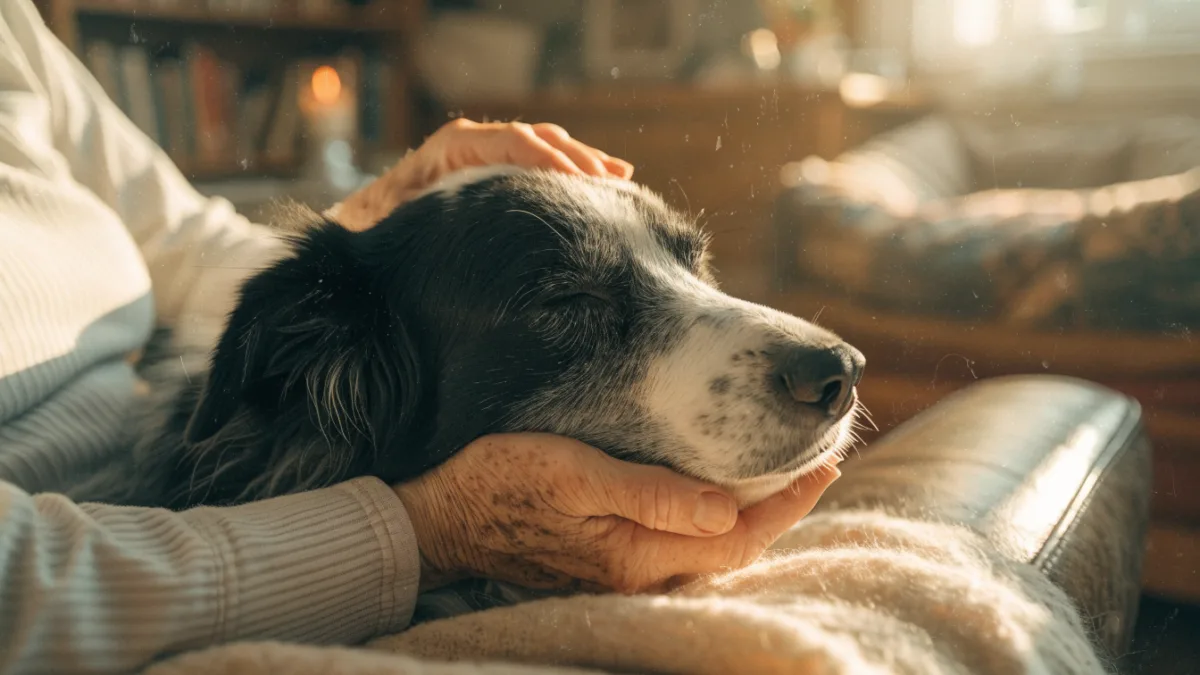
The hardest conversation I have in my exam room isn’t about diagnosis or treatment costs. It’s when a family looks at me across the steel table, eyes already glassy, and asks: “How will I know when it’s time?” I’ve had this conversation hundreds of times, and it never gets easier. But I’ve learned that the families who feel most at peace with their decisions are the ones who understood their options long before they had to make them. That’s why I want to talk about pet hospice — what it really means, how it works at home, and how to navigate the heartbreak of saying goodbye without losing yourself in the process.
What Pet Hospice Actually Means
When most people hear “hospice,” they picture a facility — somewhere you go. But pet hospice, sometimes called palliative care or “pawspice,” isn’t a place at all. It’s a philosophy. It’s the deliberate shift from curing to comforting, and it typically begins when a pet has a terminal illness or incurable condition where further curative treatment would cause more distress than relief.
I remember a Bernese Mountain Dog named Bruno who came to see me at eleven years old with an aggressive osteosarcoma — bone cancer — in his right forelimb. His owners, the Carpenters, were devastated. Amputation followed by chemotherapy was an option, but Bruno also had early kidney disease, and the Carpenters didn’t want his final months defined by surgery and hospital visits. So we built a hospice plan instead: multi-modal pain management, regular check-ins, modifications to their home so Bruno could navigate hardwood floors without slipping. He had four more months of eating breakfast on the back porch, watching squirrels, and leaning his massive head into Mrs. Carpenter’s lap during evening TV. That was hospice.
The focus becomes quality of life — managing pain, maintaining hydration and nutrition, preserving hygiene, and supporting the emotional bond between pet and family. It’s deeply individualized. No two plans look the same.
The Evolutionary Trick That Makes This So Hard
Here’s something I explain to every family entering hospice: dogs, cats, and most domestic animals evolved to hide pain and vulnerability. In the wild, showing weakness meant becoming prey. Your cat isn’t being “stoic” or “brave” — she’s genetically programmed to mask distress until she physically can’t anymore.
This means that by the time you notice obvious signs — limping, vocalizing, refusing food — your pet may have been uncomfortable for weeks or months. It’s one of the cruelest ironies of loving an animal: they spend their lives trying not to burden us, even at the end.
I worked with a cat named Mochi, a fourteen-year-old tabby, whose owner felt terrible guilt for “missing” her kidney disease until it was advanced. I told her what I’ll tell you: you didn’t miss it. Mochi hid it. That’s what cats do. The guilt you feel is evidence of how closely you were paying attention — not proof that you weren’t.
Measuring the Unmeasurable: Quality of Life Scales
Because our pets can’t tell us how they feel in words, veterinarians rely on objective frameworks to assess well-being. The most widely used tool in pet hospice is the HHHHHMM Quality of Life Scale, developed by Dr. Alice Villalobos, a pioneer in veterinary oncology and end-of-life care. It scores pets from 0 to 10 across seven categories:
- Hurt: Is pain adequately controlled? Are breathing and panting patterns normal?
- Hunger: Is the pet eating enough, either independently or with assistance?
- Hydration: Is fluid intake sufficient, or are subcutaneous fluids needed?
- Hygiene: Can the pet stay reasonably clean, especially around elimination areas?
- Happiness: Does the pet still express joy, interest, or engagement with the family?
- Mobility: Can the pet move around without significant struggle or risk of injury?
- More good days than bad: Are there more moments of comfort than distress across a typical week?
A total score above 35 generally suggests acceptable quality of life. Below that threshold, it’s time for an honest conversation. I have families keep a simple journal — a number each day, plus a sentence or two about what happened. Patterns emerge. It removes some of the emotional static and gives you something concrete to look at when your heart is foggy.
Recognizing the Signs
Beyond a formal scale, there are signals I ask families to watch for carefully:
- Loss of appetite that doesn’t respond to appetite stimulants or favorite foods
- Inability to stand or walk without significant assistance
- Labored or open-mouth breathing (a true emergency in cats)
- Chronic vomiting or diarrhea that leads to weight loss and dehydration
- Loss of interest in activities, people, or environments that previously brought pleasure
- Visible pain signs: restlessness, panting at rest, pacing at night, hiding, or flinching when touched
- Incontinence that causes the pet distress or leads to skin breakdown
One sign alone doesn’t necessarily mean the end is near. But when these cluster together and become the new normal rather than a bad day, the conversation needs to shift.
At-Home Care: Why Familiarity Matters
The growth of at-home hospice and in-home euthanasia services over the last decade reflects something I’ve believed for years: most pets do better at home. The car ride alone — for a senior dog with arthritis or a stressed cat with kidney disease — can undo a week of careful palliative management. The clinical environment of a veterinary office, with its smells and sounds, often triggers anxiety even in healthy animals.
At home, a hospice veterinarian can assess the environment itself: Are there rugs on slippery floors? Is the litter box low enough for an arthritic cat to enter? Is the food bowl elevated appropriately? These practical adjustments, which,[1] can dramatically improve daily comfort.
Telehealth has expanded these possibilities enormously. I now conduct video consultations with hospice families to assess breathing patterns, gait, and overall demeanor in real time, without transporting a fragile patient. This doesn’t replace hands-on exams entirely, but it bridges critical gaps — especially for families in rural areas or those with pets too unstable for transport.
The Integration of Complementary Therapies
I’ll admit I was skeptical when acupuncture and cold laser therapy started appearing in veterinary palliative care protocols. But the evidence has shifted my thinking. Studies and clinical experience support these modalities as valuable adjuncts — not replacements — for traditional pain medications. Acupuncture can reduce musculoskeletal pain and improve mobility in arthritic dogs. Cold laser therapy helps reduce inflammation in soft tissues. Physical rehabilitation, including underwater treadmill work, can extend functional mobility for months.
I now refer hospice patients for these therapies regularly, and I’ve seen the difference firsthand. A Golden Retriever named Sadie, diagnosed with degenerative myelopathy, regained three weeks of independent walking after starting a combined protocol of gabapentin, acupuncture, and assisted swim therapy. Three weeks of walking may sound small. For Sadie’s family, it meant three more weeks of neighborhood walks, which was her reason for getting up each morning.
The Hardest Question: How Do You Know?
[2] describes figuring out when to say goodbye as “one of the hardest decisions” a family will ever make, and [3] devoted an entire essay to the question. Research consistently shows that the grief following pet loss is comparable to losing a human family member. This isn’t sentimental exaggeration — it’s measurable psychological reality. So the weight you feel when making this decision is proportional to the relationship you’re honoring.
There’s an ethical tension in hospice that I discuss openly with families: the risk of prolonging life for our comfort rather than the pet’s. We want one more week, one more morning, one more moment. That desire is profoundly human and deeply loving. But it can also blur our judgment. I gently ask families to consider a specific question: “Who are we doing this for right now?”
Some families hope for a natural death at home. I understand that wish, and I never dismiss it. But I’m honest about what natural disease processes often look like. Organ failure and cancer can involve prolonged discomfort that palliative care struggles to fully control. Humane euthanasia, when chosen at the right moment, is not a failure — it’s often the most compassionate final act we can offer. I frame it as taking the pain onto ourselves so our pets don’t have to carry it.
Navigating Anticipatory Grief
The period between entering hospice and the final goodbye has a name: anticipatory grief. It starts the moment you receive a terminal diagnosis, and it can be just as intense as grief after loss. You grieve the future you imagined — more walks, more years, more ordinary mornings — while simultaneously watching the present slip away.
This period is emotionally exhausting in ways that people who haven’t loved a pet sometimes struggle to understand. I encourage families to:
- Talk to someone who understands — a pet loss support group, a counselor, or a hotline staffed by trained volunteers
- Accept that good days and bad days will alternate unpredictably
- Practice the self-care you’d recommend to a human friend going through loss
- Create memory moments intentionally — photos, paw prints, a final favorite meal, a special outing if mobility allows
Many pet insurance providers now cover bereavement counseling, and some hospice programs include it as part of their service. If cost is a barrier — and I want to acknowledge honestly that in-home hospice and euthanasia are typically more expensive than clinic-based care — ask your veterinarian about sliding-scale options, nonprofit programs, or local humane society resources. Every family deserves support through this process, regardless of financial circumstances.
The Final Gift
Saying goodbye to a beloved animal is among the most painful experiences a person can have, but it is also one of the most profound acts of love. You are choosing to carry the emotional weight so they don’t have to carry the physical weight. That choice — painful, brave, and selfless — honors everything they gave you during their life.
If you’re reading this while caring for a senior or ailing pet, please know that the veterinary community is here to walk this path with you. We’ve changed how we approach end-of-life care dramatically in the past decade — more compassionate, more individualized, more focused on comfort and dignity. Your pet deserves the gentlest possible departure, and you deserve support through every step of it. Don’t wait to ask for help. That’s not weakness. That’s exactly what love looks like when it has nowhere else to go but forward.
Sources
- experts increasingly emphasize — nbcsandiego.com
- Tufts University — facebook.com
- The New Yorker — newyorker.com