

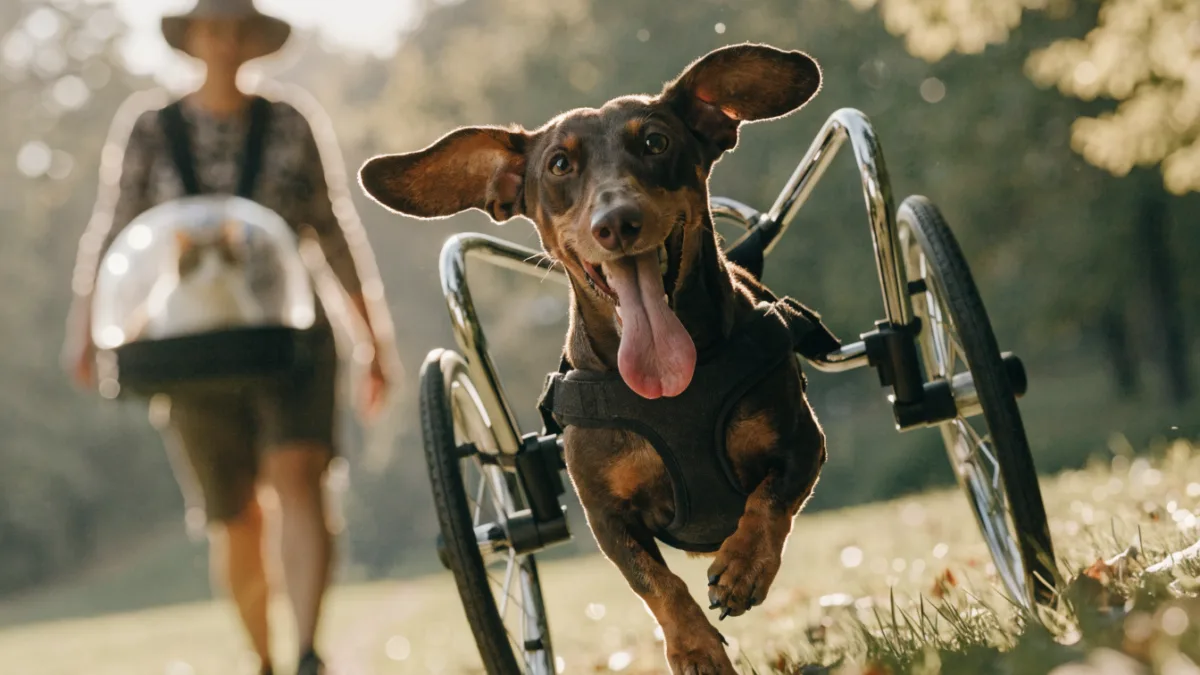
My cat Mabel has exactly three working brain cells when it comes to the outdoors. She wants to be there. She does not want to walk there. At fourteen, with arthritis in her hips that makes her glare at me like I personally invented stairs, she has strong opinions about which experiences are worth the physical cost. The answer, increasingly, is none of them — except sitting on the porch watching birds, which she would do until the sun burns out.
For a while, I thought that was just going to be her life. Less outside, more windowsill. Then I saw a video of a Westie named,[1] — fully paralyzed, absolutely booking it down a hiking trail in a wheelchair — and I realized I’d been thinking about this all wrong. Mobility aids for pets aren’t about convenience. They’re about access. They’re about the fact that Mabel’s brain still wants the world even when her joints don’t agree.
The “Lazy Pet” Myth Needs to End
Let’s address the elephant in the room: there is a genuinely weird cultural stigma around pets in strollers, backpacks, and wheelchairs. Scroll through comments on any video of a dog in a wheelchair and you’ll find someone asking why the owner doesn’t “just let the dog be a dog.” A quick search for [2] turns up a surprising amount of outrage for something that is, frankly, none of anyone’s business.
Here’s the reality: many pets deal with what advocates call invisible disabilities. Neurological issues. Chronic pain. Degenerative conditions like myelopathy that slowly take away hind-limb function. Severe stamina limits from heart or respiratory conditions. These pets don’t look “sick” at a glance, which makes the judgment from strangers even more frustrating.
When someone sees a dog in a stroller, they often project a story onto it: spoiled, pampered, carried everywhere like an accessory. What they don’t see is the fifteen-minute consultation where a vet explained that continued walking would cause irreversible joint damage. They don’t see the pet who used to run and now can’t. They see a fashion choice; the owner sees a medical necessity.
So if you’re considering a mobility aid for your pet and feeling self-conscious about it — don’t. The people judging you have never had to explain to a senior dog why the walk is over when she still wants to sniff the next bush. Pet mobility aids exist because animals deserve enrichment, stimulation, and joy regardless of their physical limitations.
Dog Wheelchairs: When the Front Legs Still Want to Go
A dog wheelchair is one of the most transformative tools available for dogs with hind-limb weakness or paralysis. The design is elegant in its simplicity: a lightweight frame supports the rear end using wheels, while the dog’s front legs do the walking. For dogs with conditions like degenerative myelopathy, spinal injuries, or advanced hip dysplasia, this setup allows them to maintain muscle tone in their front legs, continue eliminating normally, and — critically — keep moving through the world on their own terms.
Choosing the Right Fit
What matters most is adjustability. You want a frame with support struts you can fine-tune to your dog’s height and body length. The saddle — the part that supports the torso — should distribute weight evenly without pressing on the spine or abdomen. Look for models that allow you to adjust the height of the wheels independently, because no dog’s body is perfectly symmetrical, especially when muscle atrophy is involved.
Material matters too. Aluminum frames are lightweight and resist corrosion, which matters if your dog is going to encounter grass, mud, or — as one memorable Pumpkin video demonstrated — beach waves. The wheels should have some give to them; rigid wheels on hard pavement create a jarring experience for a dog whose joints are already compromised.
Acclimation: Slow Wins This Race
I’ll defer to professional trainers for the specifics here, but the general principle is universally agreed upon: go slow and make it positive. A wheelchair is a strange object with straps and wheels, and dogs are rightfully suspicious of things that make noise and touch them in new places.
Start with the wheelchair off. Let your dog sniff it. Put treats on it. Then try fitting it loosely — don’t tighten everything immediately. Give a high-value reward. Take it off. Repeat. Over several sessions, gradually increase the time and snugness. The first time your dog actually walks in it, stick to a flat, familiar surface like a hallway or a quiet sidewalk. Five minutes. Then celebrate like they just won an Olympic medal, because honestly? They kind of did.
One thing I cannot stress enough: watch for signs of frustration or fatigue. A dog who’s overworked in a wheelchair can develop soreness in the front limbs, which are now doing double duty. Short, successful sessions are infinitely better than one long, exhausting outing that makes the wheelchair a negative association.
Cat Backpack Carriers: Outdoor Enrichment Without the Exhaustion
Cats are a different beast — literally and figuratively. Where dogs often want to go, cats want to observe. Mabel doesn’t need to hike a trail. She needs to smell grass, feel a breeze, watch a butterfly fail to navigate a bush, and then come inside and sleep for nine hours. A cat backpack carrier makes this possible without asking her arthritic body to do something it can’t sustain.
What to Look For
The best cat backpacks share a few key features. Ventilation is non-negotiable — look for mesh panels on multiple sides so air circulates. A rigid or semi-rigid frame prevents the carrier from collapsing against your cat’s body, which is both uncomfortable and potentially painful for a cat with joint issues. A soft, removable bottom pad lets you add familiar bedding (Mabel’s has a blanket she’s been kneading since 2016, and no, she will not accept a replacement).
Security features matter too. The backpack should have a secure harness attachment inside — not just a collar clip, but something that keeps the cat from accidentally slipping out if a sudden noise startorts them. Zippers should be the kind that can’t be pawed open from the inside, because if there’s one thing I’ve learned about cats, it’s that they are problem-solvers with no respect for your plans.
Getting Your Cat Comfortable
This is where patience becomes an art form. Cats do not appreciate being shoved into a bag and carried outside. The acclimation process should start entirely indoors, with the carrier open and stationary on the floor. Put a favorite blanket inside. Maybe a treat or two. Let the cat investigate on their schedule — and if your cat is like Mabel, “their schedule” means ignoring it pointedly for four days before suddenly deciding it’s the best napping spot in the house.
Once they’re voluntarily spending time inside, try closing the flap for short periods while you’re sitting nearby. Then try picking it up — just an inch. Then a short walk around the living room. The first outdoor trip should be somewhere quiet: your backyard, a peaceful park bench, anywhere that isn’t a busy sidewalk full of dogs and delivery trucks. Build confidence gradually. A cat who has one terrifying experience in a backpack may never trust it again, so err on the side of boring.
Pet Strollers: The Underrated All-Rounder
Strollers get the worst reputation and do the most work. Modern pet mobility aids in the stroller category have come a long way from the bulky, hospital-equipment-looking designs of a decade ago. Today’s models feature smooth-rolling four-wheel designs, [3] and weight capacities that safely accommodate medium-sized dogs and cats — some up to 55 pounds.
The removable carrier feature is easy to overlook until you need it. Being able to unlatch the carrier section and carry it into a vet appointment, into the car, or through a building saves your pet from unnecessary transfers. Every transfer is a moment of instability for a pet with mobility issues, so minimizing them is genuinely a quality-of-life improvement.
Smooth-rolling wheels sound like a luxury feature until you’ve pushed a stroller with cheap plastic wheels over a sidewalk crack and watched your pet wince. For animals with joint pain, spinal issues, or neurological conditions, consistent jostling isn’t just uncomfortable — it can cause real pain and muscle tension. Look for wheels with rubber or air-filled tires, suspension if you can find it, and bearings that don’t squeak (your pet will thank you for the silence; you’ll thank you for the sanity).
The Sensory Payoff
Here’s what I think people miss about strollers specifically: even if your pet never takes a step, the sensory experience of being outside is enormously beneficial. They observe passing cars. They watch other animals. They feel temperature changes, smell new smells, hear different sounds. For a pet whose world has shrunk to one room and one couch, this is not a luxury — it’s mental stimulation that staves off cognitive decline and depression.
I’ve watched Mabel’s ears rotate like satellite dishes from inside her stroller, tracking a squirrel she has no intention of chasing but is deeply, philosophically invested in monitoring. That’s enrichment. That’s a life. It just looks different than a marathon run through the dog park.
What All These Aids Share
Whether it’s a wheelchair, a backpack, or a stroller, the best mobility aid is the one your pet will actually use — and that means prioritizing their comfort and confidence over your aesthetic preferences. (Although, honestly, the market has improved dramatically. You can find options that don’t look like they belong in a 1990s hospital supply catalog.) Look for secure harness attachments inside any enclosed carrier. Prioritize easy-to-clean materials, because life with a disabled pet involves more bodily fluids than anyone warned you about. And consider the weight of the aid itself — if it’s too heavy for you to maneuver comfortably, you won’t use it, and then it helps no one.
The surge in adaptive, lightweight, multi-functional designs reflects something bigger than market trends. It reflects a shift in how we think about disability in animals. We’re moving past the idea that a pet who can’t walk unaided has nothing left to experience. We’re recognizing that enrichment, exploration, and engagement with the world aren’t rewards for physical capability — they’re fundamental needs.
If you’re navigating life with a senior, disabled, or recovering pet, talk to your vet about which mobility aid makes sense for their specific condition. Not every option suits every pet, and getting the fit right — especially for wheelchairs — often benefits from professional input. But don’t let the stigma, the awkward comments, or the eye-rolls from strangers talk you out of giving your animal a fuller life.
Because here’s the thing: the animals don’t care what they look like. They care that they’re outside. They care that they can smell the wind, see the birds, and be part of a world that didn’t shrink just because their bodies changed. The least we can do — the absolute bare minimum — is help them get there. Whether that’s on four wheels, in a backpack, or rolled along in a stroller that some stranger on the internet thinks is “too much.” It’s not too much. It’s exactly enough.
Sources
- Pumpkin — instagram.com
- why people are against dogs in strollers — facebook.com
- removable carrier compartments — petroverusa.com