

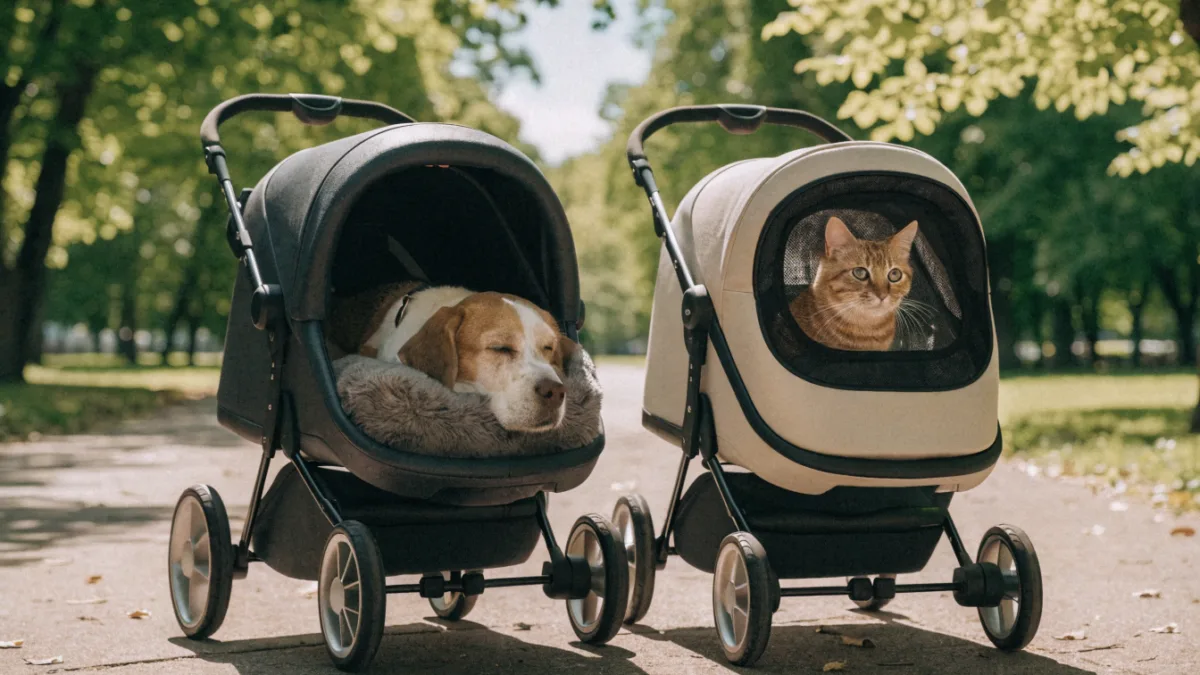
Let me be honest about something: the first time I saw someone pushing a dog in a stroller through the park, I had opinions. Strong ones. The kind where you’re standing there with your own dog on a leash thinking, that animal has four perfectly good legs.
I was wrong, obviously. I didn’t know then what I know now — that for some pets, those four legs don’t work the way they used to, and a stroller isn’t a luxury accessory for a spoiled chihuahua. It’s a mobility device. It’s a quality-of-life preserver. It’s the reason a fourteen-year-old dog can still smell the river and watch the ducks instead of staring at the same living room wall every single day.
But here’s where it gets interesting: strollers aren’t just for elderly dogs anymore. They’re showing up in the hands of cat owners — specifically, indoor cat owners who want to give their pets safe outdoor enrichment without the very real dangers that come with free-roaming. And the decision of when to buy wheels for an aging dog versus when to buy them for an indoor-only cat involves completely different logic, different needs, and honestly, different amounts of social courage.
The Elderly Dog: Preserving the Sniff-and-Stroll
My neighbor’s dog, a scruffy terrier mix named Walter, is sixteen. Sixteen. That’s roughly ninety in human years, depending on which aging calculator you trust. Walter still lights up when he hears the word “walk” — ears forward, tail going, the whole production. But his back legs have other ideas now. Arthritis has turned his afternoon strolls into a few blocks of enthusiasm followed by a slow, painful hobble back home.
This is exactly where veterinarians say strollers earn their keep. Senior dogs don’t lose their desire for mental stimulation just because their joints stop cooperating. That daily walk isn’t just exercise — it’s their newspaper. It’s how they know what dogs passed through the neighborhood, what raccoon rummaged through the recycling, whether the mail carrier switched routes.,[1] and taking that away from an aging dog because they can’t physically handle the distance anymore is genuinely sad.
The stroller solution that works for Walter — and that I’ve seen recommended.[2] — is the hybrid walk. He walks the first stretch on his own terms, sniffing every blade of grass for an embarrassingly long time, and when his legs say we’re done, he rides the rest of the way home. He still gets the full sensory experience. He just doesn’t have to physically grind through pain to get it.
Signs It Might Be Time
The indicators are usually pretty clear. If your dog sits down mid-walk and refuses to go further, if they’re limping by the time you get home, if recovery from a normal outing takes hours instead of minutes — those are signals that a stroller might extend their outdoor life rather than end it. Talk to your vet about what’s driving the fatigue, whether that’s joint disease, heart issues, or general age-related decline, and ask whether a stroller fits into their overall care plan.
The Indoor Cat: A Catio on Wheels
This is where the conversation shifts into completely different territory.
My cat Pepper is strictly indoor. She has been since the day I found her as a kitten under a parked car, and she’ll stay that way. Indoor cats live longer, face fewer diseases, and avoid the genuinely scary risks that come with the outside world. That’s not debated. But they also miss out on a lot — the changing smells, the breeze, the birds, the pure sensory fireworks of a world beyond the window.
Leash walking works for some cats. If yours tolerates a harness and doesn’t flatten themselves into the ground every time a car door slams, that’s wonderful. But many cats find the experience stressful rather than enriching. They get spooked by sudden noises. They panic when a dog rounds a corner. They freeze completely, or worse, they slip a harness and bolt.
A stroller solves this differently. It creates a secure, enclosed space where the cat can observe the world without being vulnerable to it. The mesh keeps them contained while still letting them see, smell, and hear everything going on around them. For cats who experience distress when confined in traditional carriers for long periods, a stroller’s more open design can actually [1] — it feels less like a trap and more like a window seat.
The first time I took Pepper out, she sat in the back looking like I’d betrayed her entire species. By the third trip, she was perched on the front cushion, eyes wide, watching a crow pick at a french fry in the parking lot with the intensity of someone watching a thriller.
She now runs to the stroller when she hears me unzip it. Not every cat will have this reaction — Pepper is unusually bold for an indoor cat — but for the right temperament, it can genuinely expand their world in a way that leash walking simply can’t.
The Stigma Is Real — and It’s Loud
Let’s address the judgmental elephant in the park.
There is a specific social discomfort that comes with pushing a cat in a stroller. Dog owners get a pass — people see a senior dog in wheels and think aww, how sweet. Cat owners get something closer to is that a cat? In a stroller? Are you okay?
I’ve scrolled through enough forums to know I’m not imagining this. People genuinely ask “am I extra?” before buying one. There’s a fear of being perceived as the kind of person who treats their pet like a literal human infant, and depending on where you live, that social friction can be intense.
Here’s my take: who cares.
If your pet benefits from it — if your elderly dog gets to keep going outside, if your indoor cat gets enrichment they’d otherwise never experience — the opinions of strangers are genuinely irrelevant. The people judging haven’t watched their fifteen-year-old dog try to stand up and fail. They haven’t seen a cat who’s lived in a one-bedroom apartment for nine years discover grass for the first time.
The “Convenience” Argument
Some critics frame strollers as lazy pet ownership — you’re pushing your animal instead of letting them walk naturally. This criticism falls apart pretty quickly when you apply it to senior pets or animals recovering from surgery. A stroller is a medical and enrichment tool, not a substitute for exercise. For dogs who can still walk, it’s a supplement, not a replacement. For cats, there is no natural leash walk to compare it to — the stroller is the outdoor access.
What to Actually Look For
I’m not going to name brands — that’s not my job and honestly, what’s available changes constantly depending on where you live. But here’s what matters regardless of what you buy:
For elderly dogs: Look for a low entry point. If your dog has to jump or be lifted awkwardly into the stroller, you’ve defeated the purpose. You want something that handles their full weight comfortably, with enough floor space for them to lie down if they want. Wheels that can handle uneven pavement are non-negotiable, because the whole point is going places — not just rolling around a smooth mall floor.
For cats: Enclosure security is everything. Cats are escape artists, and a panicked cat in an unsecured stroller is a disaster waiting to happen. The zippers need to be solid, the mesh needs to be tight enough that a freaked-out cat can’t push through it, and there should be no gaps where a determined feline can squeeze out. Look for something that lets you clip a harness inside as a backup safety measure.
For both: Consider how the stroller folds, whether it fits through your door, and whether you can actually lift it into a vehicle or carry it up apartment stairs. The best stroller in the world is useless if it’s too heavy to transport.
The Unexpected Use Case: Injury Recovery
One thing I don’t see discussed enough: strollers as rehabilitation tools. When a dog or cat is recovering from surgery — orthopedic procedures, fracture repair, amputation adaptation — their activity is severely restricted for weeks or sometimes months. But [3] A stroller lets a recovering pet get fresh air and visual stimulation without bearing weight on a healing limb.
It’s not a replacement for crate rest when your vet prescribes it, obviously. But it can be a genuine sanity-saver during those long, tedious recovery windows where your pet is going stir-crazy and so are you.
City Living and the Buffer Zone
There’s another angle here that’s particularly relevant if you live somewhere dense. Strollers create what behaviorists describe as a buffer zone — a physical barrier between your pet and the rest of the world.
If you’ve ever had an off-leash dog charge your leashed senior, you understand why this matters. A stroller doesn’t make your pet invincible, but it does create a layer of separation that can prevent direct contact with aggressive animals, overly friendly strangers who want to pet without asking, or unpredictable wildlife. For a vulnerable elderly dog or a nervous cat, that buffer can be the difference between a pleasant outing and a traumatic one.
This is especially true in urban environments where crowded sidewalks, construction noise, and unpredictable encounters are just daily reality. A stroller gives your pet a contained, familiar space in the middle of chaos. It’s their portable safe zone.
I think the bigger picture here is this: we’re in the middle of a genuine cultural shift in how we care for aging and special-needs pets. More people are adopting seniors. More people are keeping pets alive longer with better veterinary care. More people are recognizing that a cat’s life doesn’t have to be limited to four walls just because the outdoors is dangerous. Products like strollers aren’t fringe luxuries anymore — they’re tools that let us honor the commitment we made when we brought these animals home. That commitment wasn’t just for the easy years. It was for all of them. If a set of wheels helps your pet live a richer, fuller life during the harder ones, that’s not extra. That’s just showing up.
Sources
- Sniffing is cognitive enrichment — petroverusa.com
- countless times in senior pet communities — facebook.com
- confinement drives pets and their humans a little crazy — youtube.com