

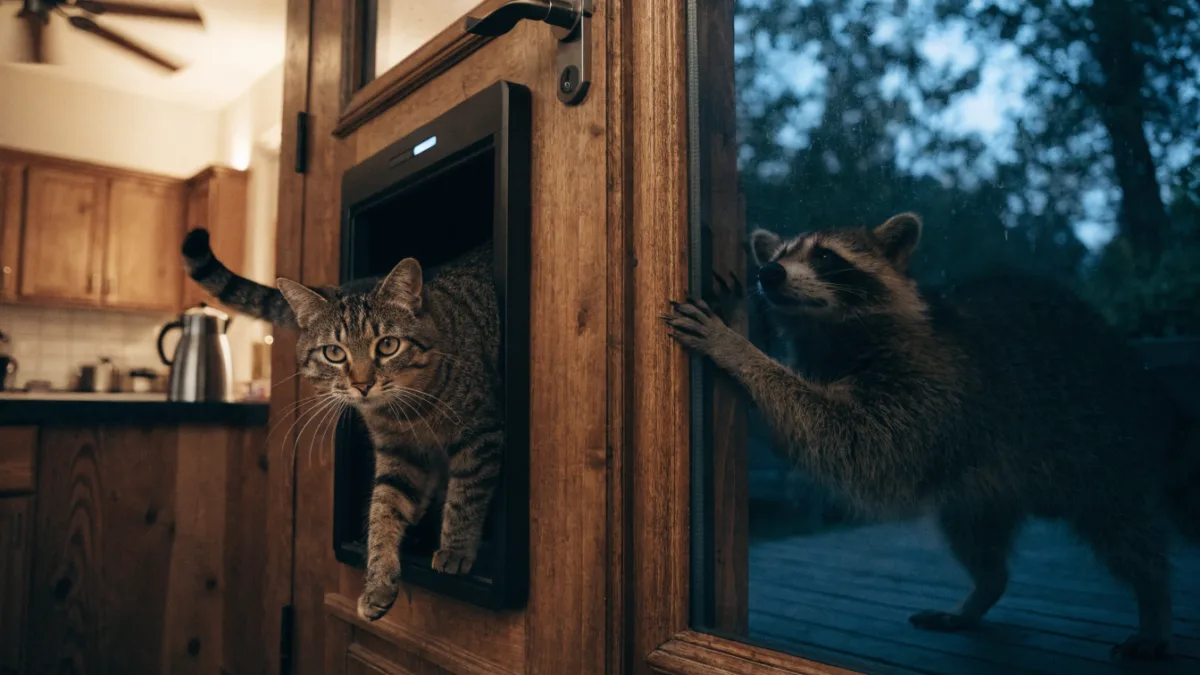
Let me paint a picture for you. It’s 6 AM. You’re standing in your kitchen, bleary-eyed, waiting for the coffee to finish doing its thing. Your dog needs out. Your cat needs in. The old flap door you installed three years ago — the one you thought was such a great idea — swings open, and in trots your neighbor’s cat, bold as brass, heading straight for the food bowl like he pays rent. Meanwhile, your own cat is sitting on the back fence giving you a look that says “you’re really going to let this happen?”
I’ve been there. Specifically, I lived through what I now call “The Spring of the Raccoon,” where a particularly bold raccoon figured out my traditional flap door in about 48 hours. Mochi, my calico, was furious. I was exhausted. Something had to change.
Enter microchip pet doors — the supposedly genius solution that reads your pet’s existing microchip and only unlocks for them. They sound perfect on paper. But after spending months researching, testing, and talking to other multi-pet households, I can tell you the reality is a lot more complicated than the marketing suggests. Especially if you live with a clever cat. Or a large, enthusiastic dog. Or — heaven help you — both.
How Microchip Pet Doors Actually Work
The concept is genuinely clever. Most pets are already microchipped — that tiny rice-grain-sized implant sitting between your cat’s shoulder blades or along your dog’s back contains a unique identification number. A microchip pet door has a built-in scanner that reads that number. Program your pet’s chip into the door’s memory, and theoretically, the flap only unlocks when the right animal approaches.
No collar keys to lose. No magnets that stop working after your dog swims in a pond. No random strays sauntering into your kitchen at dawn. The door reads the chip, unlocks for a few seconds, and locks back up. Simple, elegant, secure.
And for a lot of single-pet households, especially those with cats, it genuinely works that smoothly. The problems start when you introduce variables — and if you’ve ever shared your life with animals, you know that variables are basically all you get.
The Multi-Pet Dilemma: When Your Cat Outsmarts the Door
Here’s where things get spicy. A huge number of pet owners looking into microchip doors aren’t trying to solve a single-animal problem. They’re trying to solve a multi-animal problem. Specifically: they need a door large enough for a medium-sized dog to comfortably pass through, but smart enough to keep an indoor cat safely inside.
This sounds simple until you realize that cats are, pound for pound, some of the most determined escape artists on the planet. And they learn by watching.
Tailgating: The Feline Art of the Sneak-Through
So your dog pushes through the microchip door. The flap opens, unlocks, your dog walks through. But your cat — who has been observing this sequence with the intensity of a jewel thief studying a vault — is right behind him. The door is still unlocked for those few seconds. Cat goes through. You now have an “indoor” cat who is suddenly examining the bushes in your backyard with great enthusiasm.
This isn’t a rare problem. It’s so common that entire online communities of pet owners have formed around solving it. In one discussion I came across, a pet owner was desperately trying to find a door that could handle their medium dog while keeping their cat contained — and the responses were a mix of commiseration and increasingly creative DIY solutions.
The honest truth? Most microchip doors on the market aren’t great at preventing tailgating. The technology reads the chip of the approaching animal, but it can’t detect what’s sneaking through behind them. Some doors have tried to address this with faster lock mechanisms or dual-sensor systems, but it remains one of the weakest links in the whole concept.
The Prey Problem
And then there’s the other issue that keeps cat owners up at night. Your cat goes out through the microchip door — totally fine, the door recognizes Mochi, unlocks, she exits. But what Mochi brings back through that door is another matter entirely.
Mice. Birds. Frogs. Once, memorably, a small snake. The microchip door doesn’t know your cat is carrying a gift. It unlocks for the chip, and your cat walks into your living room with a live animal clamped in their jaws. Traditional microchip doors have zero capacity to detect what your pet is carrying — and for a lot of cat owners, that’s a dealbreaker.
The Brand Question: Microchip Readers vs. AI Detection
I’m not going to tell you which specific brand to buy — that depends on your pet, your home, your budget, and honestly, your tolerance for app notifications. But there’s a real technological shift happening right now that’s worth understanding, because it fundamentally changes what these doors can do.
The older generation of microchip doors — and still the most common type on the market — rely purely on RFID microchip reading. Think of products like the SureFlap Microchip Cat Door Connect line. These doors read your pet’s chip, can connect to your home Wi-Fi, and send push notifications to your phone when your pet enters or exits. The app connectivity is genuinely useful — you can lock and unlock the door remotely, track movement patterns, and set curfews. For a lot of cat owners, this is plenty.
But newer entrants are taking a fundamentally different approach. Products like the OnlyCat Cat Door are using artificial intelligence and visual recognition rather than (or in addition to) microchip reading. The door doesn’t just ask “is this a registered pet?” — it uses a camera and AI to identify the specific cat and, crucially, to detect whether that cat is carrying something in its mouth.
If the AI detects prey, the door stays locked. Your cat is stuck outside with their prize until they drop it. This is a genuinely significant development, and it directly addresses one of the biggest complaints about traditional microchip doors.
For some cats — especially determined hunters in areas with vulnerable wildlife populations — this feature alone could be the difference between keeping the door and ripping it out in frustration.
The trade-off? AI doors tend to be more expensive, and because the technology is newer, there are legitimate questions about reliability over time. Microchip reading is a mature, well-understood technology. AI image recognition in variable lighting conditions, at night, with a fast-moving animal? That’s harder, and it’s worth being honest about that.
The Dog Problem: Why Microchip Doors Struggle With Canines
Here’s where I have to deliver some disappointing news to dog people. Microchip pet door technology — at least as it currently exists — is significantly less reliable for dogs than for cats. And the reasons are physical, not technological incompetence.
Dog microchips are often implanted deeper under the skin than cat microchips, particularly in larger breeds with thicker muscle and fat layers. The scanner in the pet door has to read that chip through tissue, and if the chip is sitting deep or has migrated slightly from its original position, the door may not read it consistently.
Then there’s the speed factor. Cats tend to approach doors with a certain cautious deliberation — they pause, they sniff, they consider whether the outside world meets their standards today. Dogs, especially younger and more energetic ones, tend to approach doors at full speed. The scanner may not have time to read the chip and unlock the flap before your dog collides with it.
I’ve heard from dog owners who watched their pets essentially body-check the microchip door repeatedly because the lock didn’t disengage fast enough. That’s not just frustrating — it can be genuinely stressful for the dog, and over time, some dogs simply stop trying to use the door altogether.
The Collar Key Alternative
For this reason, many experts and experienced dog owners recommend automatic pet doors triggered by a physical collar key — either a magnetic tag or an RFID collar fob — rather than relying on the implanted microchip. The collar key sits right at the door’s sensor level, it’s consistently readable regardless of implant depth, and the response time tends to be faster.
Yes, you have to put a collar on your dog, and yes, collars can be lost or removed. But for reliability — especially with larger, stronger dogs who need a sturdy door — the collar-key system often outperforms the microchip-only approach.
Physical Limitations: Not Every Pet Is a Good Candidate
One thing the marketing materials don’t always emphasize: even when the technology works perfectly, the pet still has to physically push through the flap. Microchip doors, by design, have a locking mechanism that creates some resistance. The flap doesn’t swing freely the way a traditional flap door does.
For young, healthy, energetic pets, this is a non-issue. But for older animals, pets with arthritis, or animals recovering from injury or surgery, that extra resistance can be enough to make the door unusable. If your senior cat has to throw their full body weight against a resistant flap to get to their litter box, that’s a problem — and no amount of fancy technology fixes it.
Talk to your vet if you’re unsure whether a microchip door is appropriate for a pet with mobility issues. There may be modifications or alternative setups that work better.
The Bigger Picture: Wildlife, Conservation, and Keeping CatsContained
Here’s where I think microchip pet doors — despite their imperfections — genuinely earn their keep. And it’s not just about convenience. It’s about the impact our pets have on the world around them.
Free-roaming cats are a significant threat to wildlife, particularly songbirds and small mammals. This isn’t a moral judgment of cats — they’re doing what cats evolved to do. But in many ecosystems, particularly on islands and in urban areas with vulnerable native species, outdoor cats contribute to real conservation problems. A selective-entry door that lets you control when your cat goes outside — locking them in during dawn and dusk when birds are most active, for instance — can meaningfully reduce their hunting impact.
And the flip side matters too. Traditional flap doors are basically an open invitation to raccoons, opossums, feral cats, and in some regions, skunks or coyotes. Every unwanted animal that enters your home creates stress — for you, for your pets, and sometimes for the wild animal itself, who is just following a food scent and has no idea it’s about to end up in someone’s laundry room. Microchip doors, even imperfect ones, dramatically reduce these encounters.
So… Do They Actually Work?
The honest answer is: it depends. For single-cat households where the goal is keeping strays out while letting your cat come and go — yes, microchip doors work well. The technology is mature, reliable, and the app connectivity on newer models adds genuinely useful features.
For multi-pet households with a dog and a crafty cat, or for owners of large, fast-moving dogs — the current technology has real gaps. Tailgating, inconsistent chip reading, and prey detection are all live problems that haven’t been fully solved. The newer AI-based doors are promising, but they’re still proving themselves.
My advice? Be honest about what you’re trying to solve. If your main problem is raccoons in the kitchen, a basic microchip door will likely fix it. If your main problem is your cat escaping through the dog’s door, you may need a more specialized setup — and possibly some patience while the technology catches up to the problem.
And whatever you choose, remember that technology is never a substitute for knowing your pet. Mochi still occasionally outsmarts whatever system I put in front of her. She’s a cat. It’s what she does. The best we can do is make it interesting for her — and try to keep the raccoons out while she works on her next scheme.