

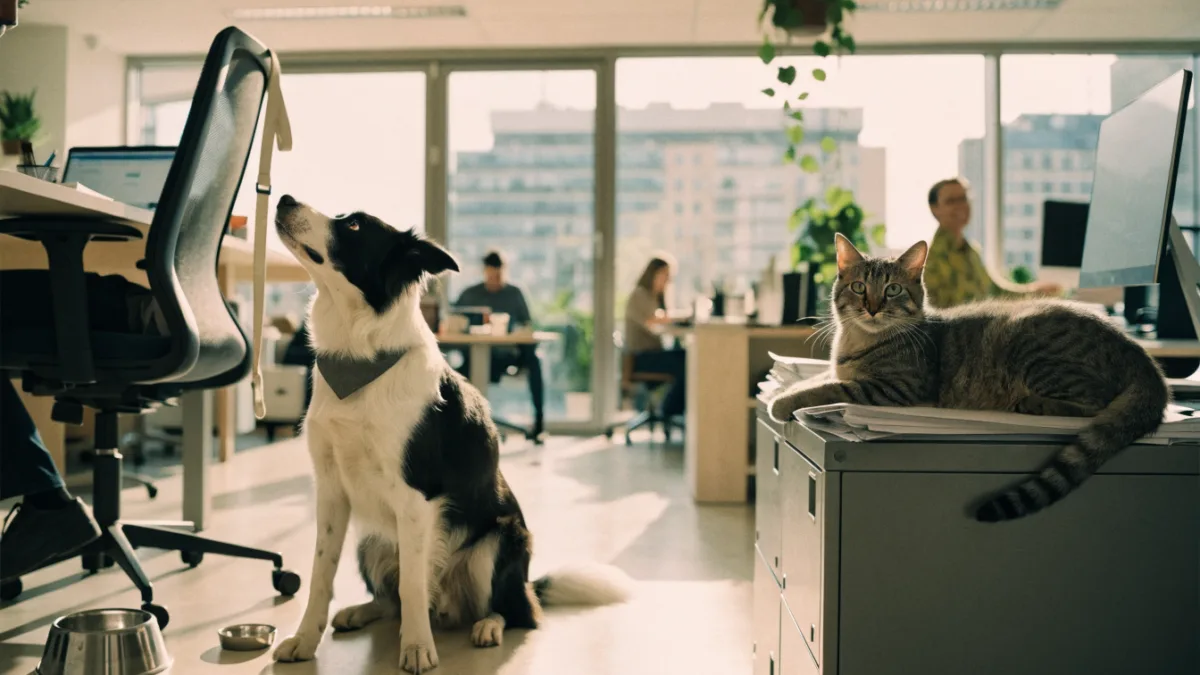
My coworker Dave used to eat sad desk salads in silence. Now he throws tennis balls down the hallway between meetings and has actual color in his face. The difference? A golden retriever named Biscuit who started coming to the office three days a week. Meanwhile, in the corner office, a tabby named Sandra Pawbulin sleeps on the warmest laptop and judges everyone who walks past. Both have fundamentally changed how our office feels — but in wildly different ways.
What the Science Actually Says About Pets at Work
Office pets have graduated from quirky startup perk to legitimate corporate wellness strategy, and the research backs it up. A 2021 multiple case study published through the National Institutes of Health analyzed how dogs specifically influence workplace environments, and the findings were striking: workers who had dogs present showed objectively lower levels of stress hormones in their saliva compared to control groups working in pet-free zones.
That’s not vibes-based science. That’s measurable biology. Your body literally produces less cortisol when a dog is snoozing under your desk.
But here’s where it gets interesting — and where my loyalties as a dedicated cat person get validated by actual data. Separate research suggests that cats may actually be more relaxing than dogs in an office setting. More on that in a minute, because I want to savor it.
The Case for the Office Dog
Dogs are the mainstream choice for a reason. They’re social, they’re enthusiastic, and they force you to interact with other humans because someone has to coordinate the 2 PM walk schedule. Biscuit has done more for cross-departmental communication than every team-building retreat combined. You haven’t lived until you’ve watched the CFO and the intern bond over whose turn it is to hold the leash.
What dogs bring to the table
- Forced movement: Dogs need walks. You need walks. Everyone wins.
- Ice-breaking: Nobody is awkward when there’s a dog with a wagging tail in the room. It’s physically impossible.
- Routine: Dogs impose structure on chaotic workdays. The 4 PM “I need to go outside” face is a better clock than anything on your computer.
- Measurable stress reduction: The NIH study confirmed what dog owners have always known — having a dog nearby genuinely lowers stress hormones in ways you can measure.
The trade-off, of course, is that dogs are work. Someone has to manage bathroom breaks, lunch schedules, and the occasional territorial disagreement about whose chair is whose. Biscuit once ate an entire quarterly report. Printed. Bound. Gone. The IT department still hasn’t recovered from the emotional betrayal of watching their carefully formatted spreadsheets become a chew toy.
And then there’s the enthusiasm factor. Dogs bring energy, which is fantastic when you need motivation and less fantastic when you’re on a client call and someone starts barking at the delivery person with evangelical intensity.
The Case for the Office Cat
Here’s the thing nobody expects: research indicates cats may actually provide superior relaxation benefits compared to dogs in workplace settings. I’m not saying this because I’m biased toward cats — although I absolutely am, and my two at home would never let me forget it if I suggested otherwise. I’m saying it because the data points to something cat people have quietly known forever.
Why cats might be the better office pet
Cats offer what I call “ambient companionship.” They don’t demand walks. They don’t need you to coordinate their social calendar. They simply exist nearby, radiating calm in a way that dogs — with all their wonderful, high-energy enthusiasm — sometimes can’t match when you’re trying to focus.
A cat sleeping on a filing cabinet doesn’t require anything from you. But somehow, just knowing it’s there makes the open-plan office feel less like a fluorescent hellscape and more like a place where living things coexist peacefully. Sandra Pawbulin has never interrupted a meeting. She has, however, knocked a coffee mug off a desk with surgical precision during a tense budget discussion, and honestly, it lightened the mood more than any icebreaker would have.
The NIH-validated research on dogs is crucial context here. Dogs reduce stress biologically — that’s proven. But the relaxation paradox suggests cats might edge them out in environments where the goal is calm rather than engagement. Dogs bring energy and connection. Cats bring stillness and quiet presence. Depending on your office culture, one might serve your team significantly better than the other.
The Logistics: Why Most Offices Get It Wrong
Here’s where the dream meets reality, and where most well-intentioned pet policies collapse into chaos. The 2021 NIH study was clear about this: companies only reap the benefits when specific conditions are met. You can’t just declare “bring your pet to work day” every day and hope for the best.
What actually needs to happen
Allergies come first, always. Before you even think about pet policies, you need to know who in your office has allergies or phobias. This isn’t a minor accommodation — it’s a health issue. Some people are genuinely afraid of dogs, and that fear deserves the same respect as any other workplace consideration. Talk to your team. Actually talk to them. An anonymous survey where people can be honest without feeling like the fun-police is usually the move.
Behavioral standards matter more than species. A well-trained cat is a better office citizen than a poorly trained dog, and vice versa. The NIH research emphasized that pet-friendly policies only function when there are clear expectations for animal behavior. This means:
- House-trained, reliably — no exceptions
- Socialized enough to handle strangers, unexpected noises, and the occasional dropped snack without melting down
- Vaccinated and healthy (talk to your vet about what “office-ready” looks like for your specific animal)
- Respectful of boundaries — both animal and human
Physical space matters. Dogs need outdoor access and a designated relief area. Cats need litter box logistics that don’t make your office smell like a shelter. Both need safe spaces where they can retreat when the stimulation gets overwhelming — because eight hours of fluorescent lights and keyboard noise is a lot for any animal, not just the humans pretending to enjoy it.
Designated handlers are non-negotiable. Every office pet needs one person who is ultimately responsible. Not a rotation. Not “whoever’s around.” One human who knows that animal’s signals, schedules, and stress triggers. Biscuit has Dave. Sandra has Margaret in accounting. When things go sideways — and they will — everyone needs to know who’s in charge.
The Honest Truth About Office Pets
Not every workplace is ready for this. Some offices have open floor plans that make pets stressful rather than soothing. Some teams are too large, or too transient, or too allergic. Some company cultures treat pets as decoration rather than living beings with needs, and that’s a recipe for disaster for everyone involved, especially the animal.
But when it works — when the logistics are thought through, when the right animal matches the right environment, when leadership treats it as a real wellness initiative rather than a recruitment gimmick — something shifts. People relax. Conversations happen. The office starts to feel less like a place you endure and more like a place where life actually happens.
What This Means Beyond the Office
Thinking seriously about how animals fit into our workspaces reveals something bigger: we designed modern work environments for productivity and forgot to design them for humans. The fact that a dog under a desk or a cat on a windowsill can measurably reduce stress hormones tells us something important about what we’ve been missing.
The same logic extends to how we think about animals everywhere. The workplace wellness trend mirrors a broader recognition that human wellbeing is deeply connected to the living world around us — not just companion animals, but urban wildlife, green spaces, and ecosystems that quietly support our mental health whether we notice them or not. When we make room for animals in our daily environments, we’re not just accommodating pets. We’re acknowledging that we’re part of something larger than our spreadsheets and meeting calendars.
So whether your office ends up with a golden retriever who eats quarterly reports or a tabby who judges your PowerPoint slides, the real takeaway is this: we function better when we stop pretending we’re the only ones in the room.