

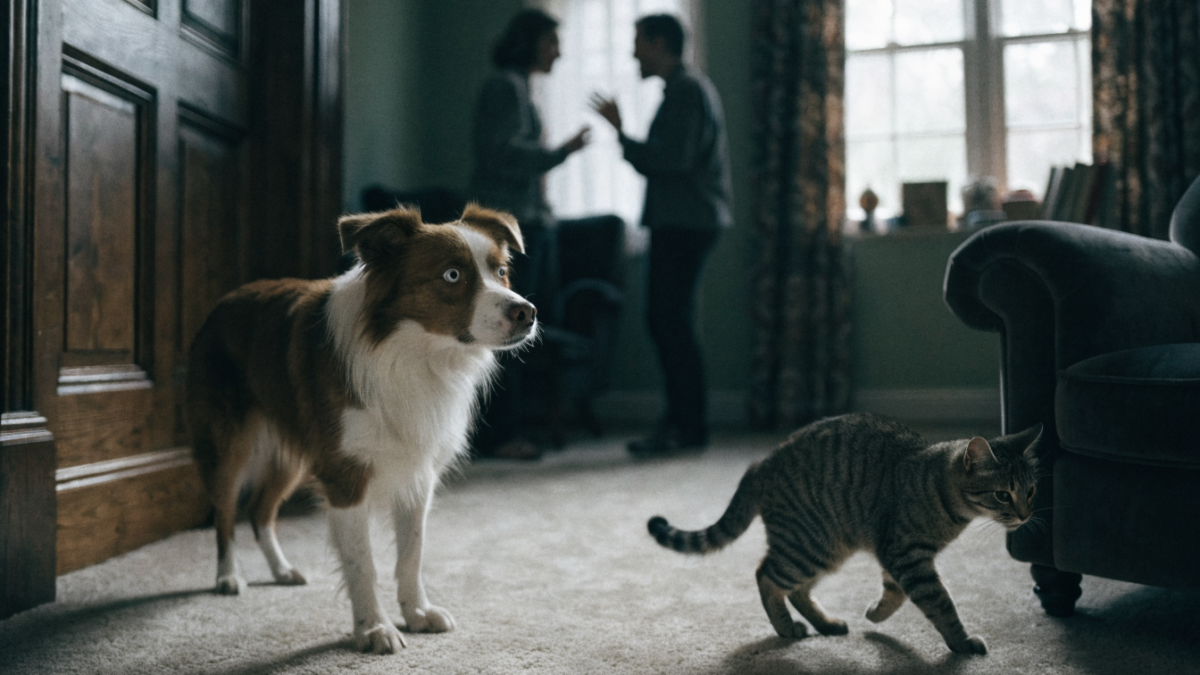
The living room felt heavy when I walked in. Nothing obvious — nice furniture, decent light. But you could feel it. The couple on the couch had been going at it, and that energy doesn’t just vanish because a guest shows up. On the floor, their German Shepherd, Ranger, paced in tight circles, panting hard despite the AC running full blast. His eyes kept flicking between them like he was watching a tennis match. Meanwhile, their cat Olive — usually perched on the windowsill judging birds — had vanished entirely. I found her later wedged behind the dryer, pupils blown wide, not moving a muscle.
Two animals. Same house. Same argument. Two completely different responses. And it made me rethink something I’d been getting wrong for a long time: we tend to lump “pet stress” into one category, but dogs and cats process human tension in fundamentally different ways.
How Dogs Read the Room
Dogs are built to monitor their group. Thousands of years of living alongside humans wired them to track our faces, our voices, even where we’re looking. When your tone shifts or your posture stiffens, your dog picks up on it — and not in some vague, general way. They’re reading specifics.
I worked with a Lab mix named Daisy who’d start lip-licking and yawning the second her owners’ voices got tight, well before anyone started yelling. Those are textbook calming signals — behaviors dogs use to self-soothe and try to defuse tension they can’t actually control. Then the pacing would kick in. Then the whining. If the argument escalated, she’d press herself against whoever seemed less upset, like she was physically trying to hold the household together.
Here’s what’s happening under the hood: when a dog detects conflict, their cortisol spikes. A:[1] highlighted how veterinarians increasingly link unexplained behavioral issues to family tension. Your dog doesn’t just hear the argument. Their body responds to it.
Watch for these signs during or after conflict:
- Pacing or inability to settle
- Excessive panting when they haven’t exercised
- Whining, barking, or unusual vocalizing
- Tail tucking, cowering, or hiding behind furniture
- Lip licking and yawning completely out of context
- Destructive behavior that crops up after fights — chewing, digging, shredding
When Cats Go Quiet
Cats take a different approach. Where dogs get louder and more active when stressed, cats go the opposite direction. They get quiet. They disappear. And because their signals fly under the radar, people miss them entirely.
I’ll be honest — I used to think cats just didn’t care as much. That’s tough to admit now, but I think a lot of people make that assumption. The reality? Cats care deeply. They just speak a language we’re worse at hearing.
A cat’s evolutionary playbook as a solo hunter tells them to avoid danger, not confront it. When the household energy shifts — raised voices, aggressive movements, unpredictable behavior — a cat’s hardwired response is to find safety. They’ll squeeze behind furniture, crawl under beds, or stake out a high shelf where they can watch without being reached. Some freeze in place, barely breathing. Others stop eating.
And here’s what should genuinely worry you: chronic stress in cats doesn’t stay behavioral. It goes physical. A cat living in a tense home can develop feline lower urinary tract disease (FLUTD), a painful condition with strong links to anxiety. They might over-groom until they’ve created bald patches or open sores. These aren’t random health problems. They’re the body’s answer to prolonged emotional strain.
Feline stress signals include:
- Hiding in new spots or more frequently than usual
- Appetite changes — eating less or refusing food
- Over-grooming, especially on the belly or flanks
- Urinating outside the litter box
- Freezing or reluctance to move when approached
- Subtle cues: dilated pupils, flattened ears, a tail tip that won’t stop twitching
The Myth of the Unfeeling Cat
A [2] turned up something that should make every cat person nod grimly. Pet owners generally believe dogs experience a wider, more complex range of emotions than cats. Those same owners also reported relying on entirely different behavioral cues to spot stress in each species.
Put those two findings together and you’ve got a problem. If we already think cats feel less, we watch them less. And if we’re watching them less, we miss the signals that they’re actually struggling.
Do dogs truly feel a wider range of emotions, or are we just better at reading them because dogs wear everything on the surface?
That’s the debate dividing animal behaviorists right now. Dog body language is big and obvious — a wagging tail, a play bow, a cower. Cat communication lives in micro-expressions. A half-second ear flick. A pause mid-groom. A tail that twitches twice instead of three times. Missing those signals doesn’t mean they aren’t happening. It means we haven’t learned the language.
The strongest argument from cat researchers is this: cats probably feel the same emotional depth as dogs. Their expression is just compressed into smaller, quieter, faster signals. When we read that as coldness or indifference, we’re really just confessing our own blind spots.
The Feedback Loop Nobody Talks About
Recent research has [3] pets absorb our emotions. They’re emotional sponges, soaking up whatever we’re putting out. But here’s the twist that caught me off guard.
When you’re stressed and you reach for your pet to feel better, it doesn’t always work the way you’d expect. If you’re in a state of high anxiety or anger, forcing interaction can actually transfer your stress onto the animal. You might feel a brief hit of relief. They just got loaded with your emotional weight.
I watched this play out with a client navigating a brutal divorce. Her Golden Retriever, Cooper, became her emotional anchor. Every time she cried, she’d pull him close. He’d lick her face, she’d calm down for a minute. But within a few weeks, Cooper started shredding the couch cushions every time she left the house. He’d never done that before in his life. He wasn’t misbehaving. He was carrying anxiety he couldn’t process or release.
This creates a loop that feeds on itself. Stressed human makes stressed pet. Stressed pet acts out or gets sick. Human gets more stressed. Pet absorbs more. Breaking the cycle starts with recognizing that your pet’s mental health and yours are linked — and that you’re the one with the agency to change the pattern.
One more thing worth knowing: the stress-relieving benefits of pet ownership don’t depend on species. Whether you’ve got a dog or a cat, what matters is the bond. A devoted cat owner gets just as much emotional benefit from their animal as a committed dog person. The strength of the connection is the variable — not the species.
What Actually Helps
If you’re in a rough stretch — relationship trouble, grief, financial pressure, any of it — your pets are riding shotgun. Here’s what I’ve seen make a real difference:
Give them an escape route. During arguments, make sure your pets can leave the room. Don’t accidentally corner them in with you. Crate-trained dogs should have access to their crate as a safe zone, not have the door forced shut.
Don’t make them your only outlet. Pets can be part of your support system. They can’t be the whole thing. If you’re in genuine crisis, talk to someone who can actually help. Your dog or cat isn’t equipped to carry that load, and pretending otherwise hurts you both.
Keep the routine intact. Animals thrive on predictability. When everything feels chaotic, consistent feeding times, walks, and play sessions send a signal that some things still hold steady. That predictability is a form of safety.
Learn their specific stress language. Your dog’s signals won’t look exactly like your neighbor’s dog. Your cat’s particular hiding spot might be different from another cat’s. Study your own animal when things are calm so you’ll recognize the shift when it comes.
Work on your own stuff. I’m not telling you to never argue or never feel stressed. That’s not realistic. But if your pet suddenly shows stress signs and nothing else has changed — no move, no new animal, no food switch — look at the household atmosphere. Are you more on edge? Is tension running higher than usual? Sometimes the answer isn’t in the pet’s behavior. It’s in the room around them.
Your home is your pet’s whole world. Dogs can’t hit the gym to blow off steam. Cats can’t book a therapy session. They live inside whatever emotional environment you create, every single day. So when you have the awareness and the bandwidth — protect the peace. Not just for yourself. For the animals who have no choice but to soak up whatever you’re putting out. They’re counting on you to notice.
Sources
- Newsweek investigation into household stress and pet mental health — newsweek.com
- 2023 study by Pickersgill and colleagues — pmc.ncbi.nlm.nih.gov
- confirmed what pet owners have suspected for years — facebook.com