

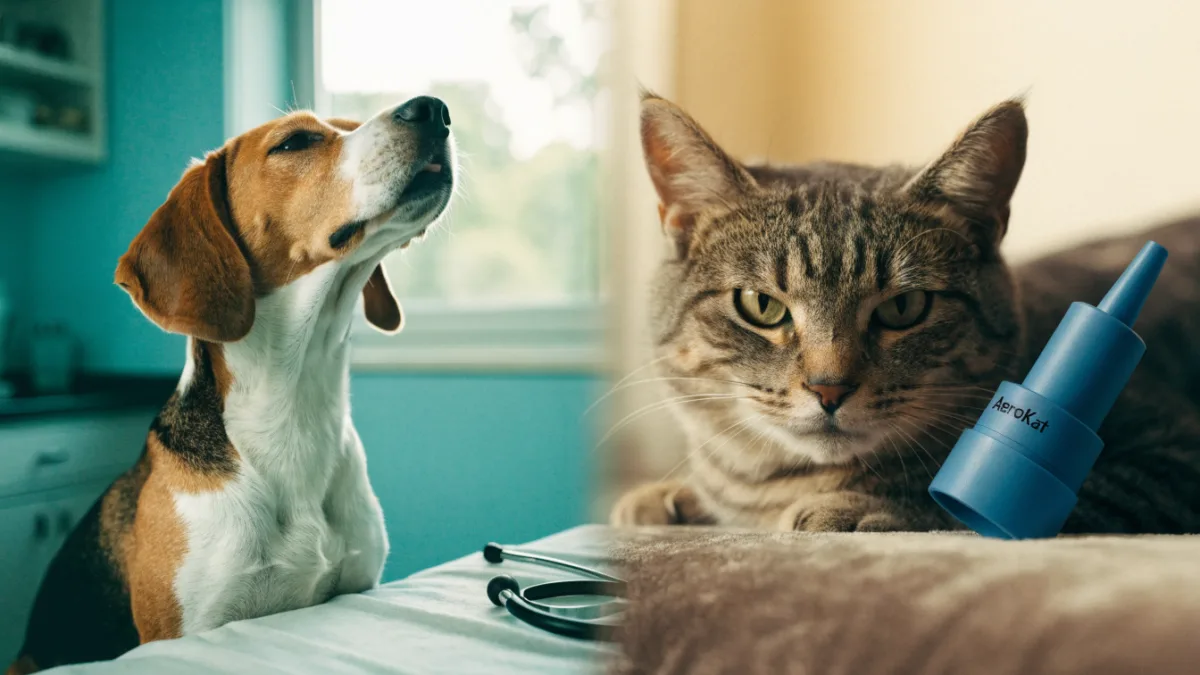
Two patients came through my exam rooms on the same Friday morning: Cooper, a two-year-old Golden Retriever who’d bounced home from daycare full of energy, and Miso, an eight-year-old Siamese whose owner had spent three months waiting for a hairball that never arrived. Cooper had kennel cough. Miso has feline asthma. Here’s what struck me — both owners described the sounds almost identically. “She’s gagging, like something’s stuck in her throat.” One was describing a contagious infection his dog would shake off in a couple of weeks. The other was describing a chronic inflammatory disease her cat will manage for life. If you share your home with both species, learning to tell these two apart is genuinely useful — because the response each one demands is completely different.
The Honk: Recognizing Kennel Cough in Dogs
If you’ve never heard kennel cough before, the sound is unmistakable once you have. It’s a loud, dry, honking cough — clients tell me it sounds like a goose has gotten into the house, or like their dog inhaled a feather. Cooper’s owner put it this way:
“He sounds like a goose got loose in our kitchen. Nothing comes up. He just honks, looks confused, and does it again.”
That honk is the signature of canine infectious tracheobronchitis — inflammation of the windpipe and bronchial tubes caused most often by Bordetella bronchiseptica bacteria, canine parainfluenza virus, or a combination of the two working together. It spreads through airborne droplets, nose-to-nose contact, and shared water bowls and toys, which is exactly why daycares, boarding kennels, and groomers are ground zero.
Here’s the detail that trips up daycare users: the incubation period runs two to fourteen days. Cooper left daycare on a Saturday looking perfectly healthy and started honking the following Thursday — long after his playgroup had dispersed. So when the facility calls to say a dog in Tuesday’s group tested positive, don’t assume your dog dodged it because they seem fine. The clock may still be running.
The reassuring news is that most cases are self-limiting and resolve within one to three weeks. And yes — vaccinated dogs can still catch it, because the vaccine covers the most common culprits but not every pathogen involved. Those dogs usually get a milder, shorter version. That’s not a failed vaccine; that’s the vaccine doing its job.
The Wheeze: Feline Asthma Symptoms Hiding in Plain Sight
Feline asthma couldn’t be more different under the hood. It’s not an infection at all — it’s a chronic allergic inflammation of the small airways deep in the lungs, estimated to affect somewhere between 1 and 5 percent of all cats, which makes it one of the most common respiratory conditions I diagnose.
Miso’s case is textbook, and textbook is exactly the problem. Her owner spent a full season assuming every coughing episode was a hairball on its way out.
“She’d crouch down low, stretch her neck out, and hack and hack. I kept waiting for a hairball that never showed up. When she finally did cough up a wad of frothy mucus, I thought — well, there it is. It wasn’t it.”
That hairball confusion delays treatment more than any other mistake I see in cat owners, and I understand why — the postures genuinely look similar. But an asthmatic cat has a tell: she’ll hunker into a low, crouched position with her neck extended, and her belly will heave with the effort of moving air. You may hear an audible wheeze, especially on exhale. Some cats cough up clear, foamy mucus and then swallow it, which owners often miss entirely.
According to,[1] the warning signs include persistent coughing or gagging, wheezing, and rapid or labored breathing — and the triggers are usually environmental: house dust, pollen, cigarette smoke, perfumes, aerosol sprays, mold, and dusty cat litter. Asthma is lifelong and incurable, but very manageable. It is not, however, something a cat outgrows or catches.
Contagious or Chronic? What Multi-Pet Homes Need to Know
This is the question I get asked most by clients with dogs and cats under one roof, and the answer is clean and simple in both directions.
- Kennel cough spreads dog to dog. Keep your coughing dog away from daycare, dog parks, and the neighborhood greeting ritual until your vet clears him. Cats are largely resistant, though in rare cases Bordetella has crossed species to cats and to immunocompromised humans — one more reason for good handwashing, not panic.
- Feline asthma is not contagious, period. Your wheezing cat poses zero risk to the dog, the other cats, or you. It’s an overactive immune response, not an infection.
One caveat before you file every cough under one of these two headings: not everything that honks is kennel cough, and not everything that wheezes is asthma. As [2] makes clear, heart disease, heartworm, and inhaled foreign objects can all mimic respiratory disease. I learned this the hard way with Duke, a twelve-year-old Cavalier King Charles Spaniel whose cough sounded “kennel-cough-ish” — except he hadn’t been near another dog in months. His heart, not his airways, was the culprit. If your dog coughs with no exposure history, or if the patient is a senior, skip the wait-and-see and get an exam. Dogs can also develop their own allergic bronchitis, by the way — it’s just far less common than in cats.
Two Very Different Treatment Roads
Dog coughing treatment: mostly patience
For a straightforward case of kennel cough, [3] drives everything. Since most cases are viral or self-limiting, the pillars are supportive: rest (yes, that means skipping daycare — hard sell with a young Lab), plenty of fluids, humidified air from a steamy bathroom session, and swapping the collar for a harness so pressure on the irritated trachea doesn’t trigger another honking fit. Your vet may prescribe a cough suppressant for nighttime misery, or antibiotics when there’s evidence of a significant bacterial component.
I’ll admit I’ve changed my mind here. Early in my career I reached for antibiotics almost reflexively. Now I hold off far more often, because overusing them for self-limiting infections contributes to resistance without speeding recovery. That’s a conversation to have with your own vet — every case is a little different.
Feline asthma treatment: inhalers, actually
Cats with asthma need the opposite philosophy: lifelong control rather than wait-and-see. The mainstays are corticosteroids (to calm the airway inflammation) and bronchodilators (to open narrowed airways), and the delivery method has genuinely improved cats’ lives. Instead of long-term oral steroids — which carry real risks of diabetes and other complications with chronic use — many cats now receive inhaled medication through a metered-dose inhaler attached to a spacer chamber designed for feline facial anatomy, with a soft mask and a flow indicator so you can see your cat actually inhaling the dose. Ask your vet what features to look for; the right equipment makes the training process far easier.
And yes, cats can learn to accept a face mask. Start with treats and short, pressure-free sessions, and most cats adjust within a couple of weeks. Miso now trots to the couch at inhaler time because it’s become part of her routine. Dosing decisions always belong with your veterinarian, so treat this as a map of the conversation, not a prescription.
Red Flags and Prevention
When a cough becomes an emergency
- In cats: open-mouth breathing, blue- or gray-tinged gums, or heaving breaths at rest. Cats aren’t panters — open-mouth breathing is always an emergency, day or night.
- In dogs: fever, lethargy, loss of appetite, a wet or productive cough, or symptoms worsening instead of improving after several days. Puppies, seniors, and immunocompromised dogs can slide from kennel cough into pneumonia, and that transition needs fast treatment.
Stopping trouble before it starts
For dogs headed to daycare or boarding, the Bordetella vaccine — given ideally a week or two ahead of exposure — dramatically reduces the risk and severity of kennel cough. You’ll find facilities vary on booster requirements, some asking annually and some every six months; the evidence for the shorter interval is genuinely debated among veterinarians, so discuss what fits your dog’s actual lifestyle rather than assuming more is automatically better. For asthmatic cats, prevention means managing the air itself: unscented low-dust litter, a strictly smoke-free home, no aerosol sprays near your cat’s spaces, and a good HEPA air purifier, which many of my clients swear by.
The distinction worth carrying with you is this: the cough is something your dog catches and clears; the wheeze is something your cat lives with and you manage together. One asks for patience and a quiet week at home, the other for vigilance and a lifelong partnership with your vet. Learn the sound each of your animals makes when breathing goes wrong — that knowledge is the single best diagnostic tool you own. And there’s a quiet bonus to the asthma side of prevention: the choices that protect a sensitive cat’s airways — cleaner indoor air, fewer aerosols, no secondhand smoke — ripple outward to every breathing creature sharing that air, including the birds and wildlife just outside your window. Caring well for the animals closest to us has always been good practice for caring for the rest.
Sources
- Blue Cross's guidance on caring for a cat with asthma — bluecross.org.uk
- this rundown of conditions that cause coughing in pets — pets-doctor.com
- understanding why your dog is coughing — hahpets.com