

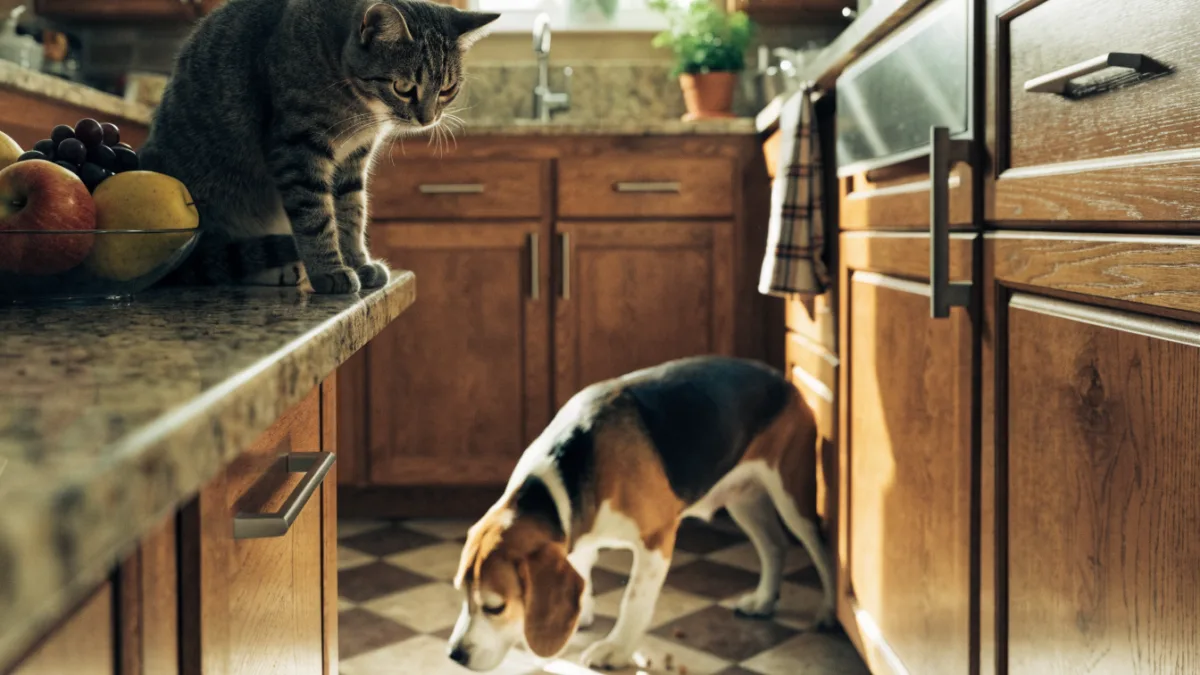
There’s a scene that plays out in my kitchen every single evening, and if you live with both a cat and a dog, you probably recognize it. My tabby, Mochi, perches on the edge of the counter like she’s surveying her kingdom from a cliffside throne. Below her, my senior mutt, Biscuit, orbits the baseboards with the focus of a metal detector sweeping a beach. Neither of them is being “bad.” They’re both just being exactly what thousands of years of evolution designed them to be — and somehow, I’m the one who feels caught in the middle.
The Vertical Brain: What’s Going On With Your Cat on the Kitchen Counter
Here’s the thing that took me an embarrassingly long time to accept: your cat on the kitchen counter isn’t plotting against you. Cats occupy a fascinating evolutionary middle ground — they’re predators who hunt, but they’re also small enough to be prey. That dual identity wires them to crave height. Up high, they can see threats coming and spot opportunities. A cat who can survey the whole room from a safe vantage point is a cat who feels genuinely relaxed.
The kitchen counter just happens to be the tallest accessible surface in most homes. According to feline behavior experts, cats are typically drawn there for a mix of reasons: the height itself, food smells, a desire for your attention, or simple boredom. And here’s the kicker — even if you shoo them off every time, that’s still interaction. You looked at them. You spoke to them. You touched them. From the cat’s perspective, jumping on the counter works.
The current consensus among veterinary behaviorists has shifted firmly away from punishment. Spraying a cat with water or yelling doesn’t teach them not to jump — it teaches them to wait until you leave the room.
Mochi taught me this the hard way. For months, I’d hiss “get down” like a broken record, and for months, she’d wait exactly long enough for my back to turn before springing right back up. I wasn’t discouraging the behavior. I was providing a predictable, reliable social interaction. I was, in cat terms, her most entertaining coworker.
The Horizontal Life: Why Dogs Live for the Crumbs
Dogs approach kitchens from a completely different angle — and I mean that literally. Where cats look up, dogs look down. This isn’t laziness or lack of imagination; it’s hardwired scavenging instinct. Long before dogs were agility champions or emotional support animals, they survived as opportunistic foragers. Their ancestors didn’t catch prey every day, so they evolved to eat basically anything edible they could find on the ground.
Biscuit’s nose is roughly ten thousand times more sensitive than mine. When I drop a shred of cheese, I see a mess to wipe up. He experiences a detailed aromatic symphony announcing that somewhere in this room, dairy has achieved freedom. His whole body vibrates with purpose.
Dog scavenging becomes a real problem in the kitchen because the floor catches everything — not just safe crumbs, but onion skins, garlic cloves, dropped medication, chocolate chips. The same nose that makes dogs incredible companions makes the kitchen a minefield. A dog who hoovers up a stray raisin off the tile isn’t being greedy or defiant; he’s doing exactly what his brain was built to do.
When Worlds Collide: The Multi-Pet Kitchen Dynamic
If you have both animals, you’ve probably witnessed an unintended tag-team situation. The cat knocks something off the counter — half a piece of toast, a wrapper with chicken residue, maybe your phone charger because they thought it was a toy. The dog, stationed below like a dedicated cleanup crew, consumes the evidence before you even notice anything happened.
I call this the “Mochi and Biscuit Pipeline,” and it’s accidentally brilliant from their perspective. Mochi gets entertainment and the satisfaction of causing a small gravitational event. Biscuit gets a treat. Neither of them experiences a consequence. Meanwhile, I find a suspiciously clean floor and spend ten minutes trying to remember if I actually ate that toast or just dreamed it.
There’s also a hygiene conversation that gets surprisingly heated in multi-pet households. Some people are far more bothered by a cat on the kitchen counter than a dog on the kitchen floor — and honestly, I understand the instinct. Cats dig in litter boxes. Their paws touch things. But here’s the part people forget: dogs lick their own feet, lie on floors that shoes walk across, and eat things off the ground that would make your stomach turn. Neither animal is pristine. The difference is mostly about which surfaces we touch directly with our food.
Pet Proofing the Kitchen: Working With Instincts, Not Against Them
Once you accept that you’re never going to train away millions of years of evolution, the whole approach shifts. You stop asking “how do I make my pet stop doing this” and start asking “how do I make this less rewarding and less dangerous.” Pet proofing a kitchen is really about environmental design.
For the Cat: Give Them Somewhere Better
If your cat wants height — and they do, desperately — give them height that isn’t the counter. A tall cat tree in the corner of the kitchen, a wall-mounted shelf nearby, even a cleared-off top of the refrigerator can redirect that instinct. The goal is to offer an approved lookout spot that’s actually better than the counter: higher up, more stable, maybe near a window.
Also — and I cannot stress this enough — keep the counters boring. Wipe up crumbs. Put food away immediately. Don’t leave the butter dish out “just for a minute.” Cats are practical creatures. If the counter offers nothing interesting and the cat tree offers a sunny window with a view of the neighborhood squirrels, the math starts working in your favor.
For the Dog: Manage the Ground Game
With dogs, the strategy is different because you’re never going to outcompete a dog’s nose. Instead, focus on controlling what reaches the floor and teaching a solid “leave it” cue. (For actual training technique, I defer to professional dog trainers — that’s not my lane.) But from a management standpoint, a locking trash can is non-negotiable. Push toxic foods to the back of counters or into cabinets. Sweep regularly. And be honest with yourself about what your dog can reach when you’re not watching.
Puzzle feeders and snuffle mats can also satisfy that foraging drive in a way that doesn’t involve stealing garlic cloves off the floor. Biscuit has a beat-up snuffle mat that I hide kibble in when I’m cooking, and it buys me roughly fifteen minutes of peaceful meal prep — which, in multi-pet household time, feels like a luxurious eternity.
General Kitchen Safety
- Use stove burner covers — cats especially will walk across still-warm surfaces without understanding the danger.
- Store knives in blocks or drawers, not loose on the counter where a curious paw can send them flying.
- Keep a list of toxic foods taped inside a cabinet: onions, garlic, grapes, raisins, chocolate, xylitol (found in sugar-free gum and some peanut butters).
- Secure cords from small appliances — both cats and dogs can pull a toaster or coffee maker down on themselves.
Accepting the Messy Reality
I’m not going to pretend my kitchen is a perfectly controlled environment. Last week, Mochi knocked an entire bag of flour off the counter while Biscuit watched hopefully from below, and I spent the evening covered in white dust like some kind of baking ghost. That’s just the cost of doing business with animals.
But the shift from fighting instinct to managing environment genuinely changed things. Mochi still likes the counter — she’s a cat, and it’s there — but she spends more time on her window perch now because it’s actually her favorite spot. Biscuit still scans the floor like it owes him money, but the locking trash can means his efforts are mostly reward-free. The kitchen isn’t perfect, but it’s safer, cleaner, and less of a daily battle.
The animals in our homes aren’t broken versions of humans who just need better rules. They’re whole, complete beings with ancient drives that predate us by millennia. Cats climbed before counters existed. Dogs scavenged before kitchens were invented. When we design our spaces around who they actually are — rather than who we wish they were — everyone’s life gets a little easier. Even if the flour still ends up on the floor sometimes.
Have questions about your own kitchen dynamic? The best resources are always your veterinarian for safety concerns and a certified animal behaviorist for persistent challenges — every pet is an individual, and what works in my kitchen might need adjusting for yours.