

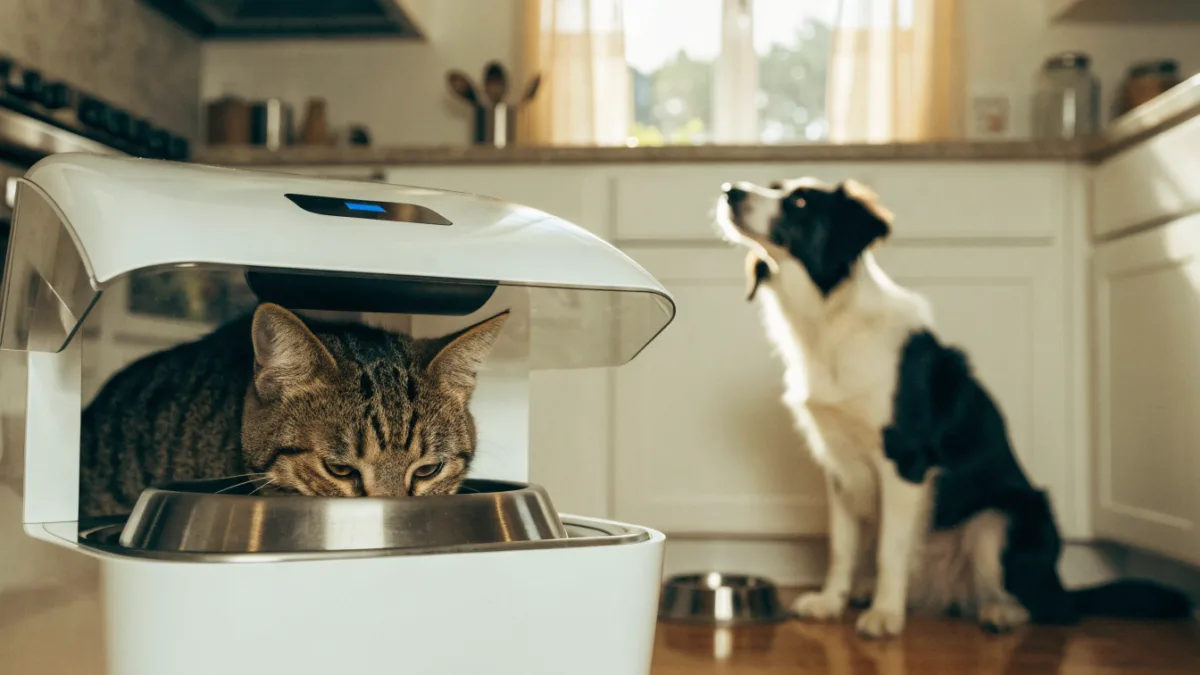
I walked into my kitchen one Tuesday evening to find my dog, Biscuit, standing over the cat bowl with the kind of guilty expression that only a golden retriever with cat food breath can produce. Meanwhile, my cat Olive was sitting on top of the refrigerator, staring at him with pure, undiluted contempt. She’d been banished to her elevated perch while her dinner disappeared down the throat of a 65-pound food vacuum who already had his own meal twenty minutes earlier. This was not a one-time event. This was every single night. And if you’re living in a multi-pet household, I’m guessing you have a version of this story too.
Why Your Dog Treats the Cat Bowl Like a Michelin-Star Restaurant
Here’s the thing nobody tells you before you get a dog when you already have a cat: dogs are obsessed with cat food. Not casually interested. Obsessed. And there’s a biological reason for it that isn’t just “dogs will eat anything” — though that’s also true.
Cats are obligate carnivores, which means their food is formulated to be significantly richer in protein, fat, and specific nutrients like taurine than dog food. Dogs are omnivores. So when your dog sidles up to the cat bowl, they’re essentially hitting up a richer, more calorie-dense meal than anything in their own dish. It’s the difference between a salad and a steak. Of course they want the steak.
But here’s where it stops being funny. A dog eating cat food regularly isn’t just an annoyance — it’s a genuine health concern. Cat food’s high fat content can trigger gastrointestinal upset, meaning vomiting and diarrhea, and in more serious cases, conditions like pancreatitis. And while we’re talking about it — and I want to be clear, I’m not your vet — if your dog is showing any digestive distress, please just call one. Don’t Google it at 2 a.m. like I did.
There’s also the flip side that doesn’t get talked about enough. If Biscuit is eating Olive’s food every night, Olive isn’t getting the nutrition she needs. Cats who are chronically robbed of their meals can become malnourished and stressed, and cat stress manifests in ways that are decidedly worse than a dog with a slightly upset stomach — trust me on that one.
The Old-School Workarounds (And Why They Made Me Lose My Mind)
Before I got a microchip feeder, I tried everything short of building a moat around the cat bowl. I put Olive’s food on the kitchen counter. She was fine with this — she’s a cat, vertical space is her thing — but it meant constantly sweeping up crumbs and finding the occasional sardine-shaped surprise behind my toaster. Not ideal.
I tried a baby gate with a small opening cut into the bottom for Olive. Biscuit looked at it, looked at me, and then bulldozed through it like it was a suggestion. I tried feeding them in separate rooms. This required standing guard like a prison warden twice a day, because Olive is a grazer and Biscuit inhales his food in forty-five seconds flat, leaving him plenty of time to come hunting for seconds.
If you scroll through pet owner forums, you’ll see I’m not alone in this circus. Multi-pet owners everywhere are lifting gates, stacking books, squeezing through half-closed doors, and engineering increasingly elaborate feeding zones. One person on a popular pet hacks subreddit described balancing cat food on top of a washing machine. Another cut a hole in a closet door. We are all out here acting like MacGyver because our animals can’t share.
How Microchip Feeders Actually Work (And Why They’re Different From Automatic Feeders)
Let me clarify something important, because the terminology gets confusing fast. An automatic cat feeder dispenses food on a timer. It’s wonderful for portion control and scheduling, but it will not stop your dog from eating that food. A timer goes off, food appears, and whoever gets there first wins. In my house, Biscuit always wins.
A microchip pet feeder is a completely different animal — pun intended. It uses RFID technology, the same kind that reads the microchip your vet implanted under your cat’s skin (or a small RFID collar tag that comes with the feeder). When your registered cat approaches, the scanner reads the chip, and a latch opens the bowl lid. When the cat walks away, the lid closes. The dog simply cannot get in.
This is the technology that finally solved the Biscuit-and-Olive situation. Olive walks up, the lid opens with a small click, she eats her meal at her own weird, slow pace, and when she’s done, the bowl seals shut. Biscuit can stand there and drool all he wants. The food is locked behind a door that only opens for the cat.
What to Look For When Shopping
- Training mode: This is non-negotiable. The feeder should have a button that lets you prop the lid open while your cat gets used to it. More on this below.
- Compatibility with your cat’s existing microchip: Most modern feeders read standard veterinary microchips, but double-check the specifications before buying. Some also include a collar tag as a backup.
- Sturdy, tip-resistant design: If you have a large or determined dog, weight matters. Look for feeders with wide bases or the option to add weights.
- Easy-to-clean bowls: The bowl should be removable and dishwasher-safe. Cats are particular about cleanliness, and you’ll thank yourself later.
- App connectivity (if that’s your thing): The newest models offer Wi-Fi and Bluetooth, so you can track how much and how often your cat is eating from your phone.
Training a Cat to Trust a Robot
Here’s the part the marketing materials don’t emphasize enough: cats are not naturally thrilled about a mechanical device making clicking noises near their face while they eat. Olive is a confident cat in most situations, but when I set the feeder down for the first time and the lid opened with its little mechanical whir, she looked at me like I had betrayed everything she’d ever trusted about me.
Training mode saved us. Here’s how it works: you press a button on the back of the feeder, and the lid stays propped open. No movement, no clicking, no drama. I put treats inside. Olive approached cautiously, ate them, and left. We did this for two days. On day three, I set the training mode to close partially — the lid lowered halfway and stopped. More treats. Day four, the lid closed fully but slowly. By day five, Olive was comfortable enough to eat a full meal while the lid opened and closed on its own.
The key is patience. I won’t lie — there were moments during training when I thought, “This is never going to work, I just spent money on a robot my cat won’t go near.” But cats are smart. Once Olive understood that the feeder was her personal food safe and Biscuit couldn’t access it, she actually seemed to enjoy the exclusivity. There may have been a smugness in her eating posture after that. I’m not imagining it.
The Honest Trade-offs (Because Nothing Is Perfect)
Cost
Microchip feeders are an investment. They typically range from $60 to over $150 per unit, which is a significant jump from a $5 stainless steel bowl. If you have multiple cats, you may need multiple feeders or accessories like splitter bowls. For some households, a baby gate with a built-in cat door is genuinely the more practical solution. I’m not going to pretend otherwise.
But for me, the math worked out. I was wasting food — Olive would leave half her meal, Biscuit would finish it, and I’d put down more. I was also paying for the stress of constant monitoring, and you can’t really put a price on eating your own dinner without having to leap up every thirty seconds to yell “Leave it!”
Reliability and the “Houdini Dog” Problem
Some owners report occasional glitches where the RFID scanner is slow to read the microchip, causing the lid to close while the cat is still eating. This hasn’t been a major issue for me, but it’s worth knowing about. Using the collar tag that comes with many feeders can offer faster reads, though you then have the risk of the tag falling off — which is its own headache.
Then there are the determined dogs. If you have a large, food-motivated dog who treats every object in the house as a puzzle to be solved, you need a feeder that can withstand some abuse. There are stories of crafty dogs learning to pry lids open with their noses or knocking the whole feeder over. A heavy, stable base is your friend here. Some owners attach the feeder to a board or place it in a corner to reduce tipping angles.
Is It Worth It?
For my household, absolutely. The microchip feeder changed the dynamic between Biscuit and Olive. He’s no longer rewarded for hovering around her food. She eats without interruption or stress. And I spend my evenings doing something other than refereeing a mealtime standoff.
The newer generation of feeders has only gotten better — app integration lets me see exactly when and how much Olive has eaten, which is genuinely useful for monitoring her health. And as more companies enter the pet tech space, prices are becoming more accessible and designs more varied.
If you’re on the fence, I’d say this: think about how much time and stress you’re currently spending managing your pets’ meals. If the answer is “a lot” and the traditional workarounds aren’t cutting it, this is a technology worth considering. Not every pet household needs one. But for those of us living with a dedicated food bandit and a cat who deserves to eat in peace, it’s a genuine quality-of-life upgrade — for all three of us.