

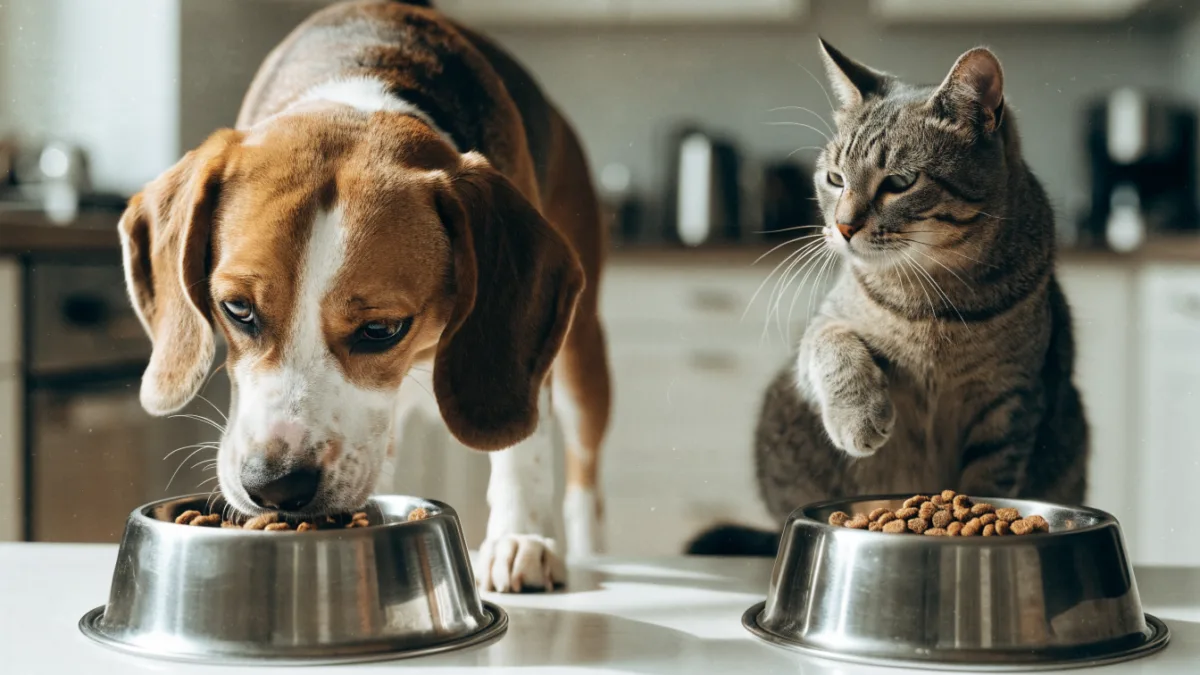
Every veterinarian has a version of this phone call. It usually starts the same way: “He’s holding out for the good stuff,” or “She’ll eat if I hand-feed her, but otherwise she just walks away.” And every time, my first question is the same one I’ll ask you: are we talking about a cat or a dog? Because the dog turning up his nose at a full bowl and the picky eater cat stalking past hers look identical at the dinner table, but they are entirely different problems. One is a negotiation — and it’s probably one you started. The other is a clock ticking.
Two Species, Two Very Different Kinds of Finicky
Let’s start with the biology, because it explains almost everything. A cat has roughly 470 taste buds. A dog has around 1,700. You have about 9,000. Cats aren’t experiencing less flavor and complaining anyway — they’re barely tasting at all in the way we understand it. Feline appetite is driven overwhelmingly by smell and aroma, which is why a cat with a congested nose from a cold will refuse food she loved last week. Cats also can’t taste sweetness — the receptor gene simply doesn’t work. You cannot bribe a cat the way you can bribe a dog.
Cats are also wired with neophobia, a wariness of new foods. It sounds like a personality flaw, but it’s an inherited survival strategy: wild kittens learn what’s safe to eat from their mother, and anything unfamiliar registers as potentially dangerous. When your cat stares at a new food like you’ve offered her a live scorpion, that’s ancient biology doing its job. And here’s the part that surprises new cat owners: in the wild, cats eat 10–20 small meals a day. A cat who nibbles, walks away, and comes back in an hour isn’t picky. She’s being a cat.
Dogs, on the other hand, evolved alongside us partly as scavengers of human food waste. For a healthy dog, skipping a meal carries essentially no metabolic risk — which is exactly why refusing food works so well as a bargaining tactic. Every time a finicky dog holds out and gets chicken instead of kibble, the lesson lands: refusal pays. That’s not stubbornness. That’s training. Just not the training you meant to do.
Step One: Rule Out Illness — Especially in Cats
Before anyone retrain anyone, we need to make sure “picky” isn’t actually “sick.” Sudden fussiness is often the first visible sign of dental disease, kidney disease, pancreatitis, or plain nausea in both species — and in cats, an upper respiratory infection can shut down appetite simply by blocking the nose.
- Vomiting or diarrhea alongside the food refusal
- Lethargy, hiding, or a sudden drop in social behavior
- Weight loss (weigh your cat monthly — trust me on this)
- Drooling, dropping food, or chewing on one side of the mouth
- Any cat who has refused all food for 24 hours
That last one isn’t alarmism — it’s math. A cat in a full hunger strike can develop hepatic lipidosis, or fatty liver disease, in as little as two to three days of not eating. In plain terms: the body, panicked, floods the liver with fat from storage faster than the liver can process it, and the liver starts to fail. It can be fatal. The cruel irony is that overweight cats are at highest risk — the cats most likely to go on strike have the most fat to mobilize. And with roughly 60% of cats and over half of dogs now overweight or obese according to the Association for Pet Obesity Prevention, that describes a lot of our patients.
One case stays with me. Miso, a ten-year-old tabby carrying a few extra pounds, whose owner called me after switching him from his usual wet-and-dry mix to dry-only kibble to save money. He’d eaten almost nothing in a day and a half. We checked him over, ruled out illness, warmed up some pâté, and he ate within the hour — fine outcome. But what I remember is what she said:
“I just figured if he got hungry enough, he’d eat.”
That sentence is perfectly reasonable for a dog. For a cat, it’s the one that keeps veterinarians up at night.
For the record, we also have better tools than we used to. There are now vet-prescribed appetite stimulants — a transdermal mirtazapine gel you rub inside the ear, and capromorelin, developed for cats with kidney disease — and in many places, a telehealth consult can triage appetite loss quickly and affordably. These are for medical cases under veterinary supervision, not for talking a healthy cat into new kibble.
Retraining the Dog Not Eating: The Protocol
Once your vet has confirmed your dog is healthy, the fix for canine pickiness is refreshingly boring. Some owners find it harsh — I’d argue it’s the opposite, because it removes a confusing mixed signal:
- Serve scheduled meals — twice daily for most adults — rather than leaving food down all day.
- Put the bowl down for 15–30 minutes, then pick it up, eaten or not. No commentary, no apology.
- Zero treats, toppers, or table food between meals during retraining.
- No coaxing, no hand-feeding, no performing.
- Every household member follows the rules — one soft-hearted teenager feeding cheese from the couch resets the whole program.
Expect the extinction burst: the refusal behavior often gets louder and more dramatic for one to three days before it collapses. This is normal, and it’s actually a sign the plan is working. A healthy dog will not starve herself — but keep water available, and call your vet if a dog goes beyond 24–48 hours without eating anything, or seems dull or unwell while doing it.
Winning Over the Picky Eater Cat (Never “Tough Love”)
With cats, we don’t break the strategy — we outsmart the biology. The goal is aroma, familiarity, and low stress:
- Warm wet food slightly, just above room temperature. Ten seconds of warmth can double the aroma, and aroma is everything to a cat.
- Rotate textures — pâté versus chunks in gravy are genuinely different experiences to a cat, and many have strong preferences.
- Use a wide, shallow bowl. I’ll admit I’ve changed my mind here: for years I dismissed “whisker fatigue” as internet lore, and the formal evidence genuinely is thin. But shallow dishes cost nothing and some cats clearly prefer them, so now I say try it — just skip the overpriced bowls marketed as a cure.
- Feed in a quiet, low-traffic spot, away from the dog, the washing machine, and general chaos.
- Add a splash of warm water or tuna juice — one of the cheapest fixes that exists.
- Transition new foods over 7–10 days, mixing a shrinking proportion of the old food into the new. This gradual ratio-shift approach is one of the better-documented strategies out there.[1]
The budget constraint is real, and it deserves respect. I recently read a post from an owner whose cat went on a genuine hunger strike after finances forced a switch from a wet-and-dry mix to dry only — a near-universal story, and a dangerous one to wait out. The fixes cost almost nothing: warm water on the kibble to release aroma, a spoonful of the previously preferred food mixed in, and a slow ratio shift rather than an abrupt change. Pop into any cat-owner [2] and you’ll find dozens of variations of the same two tricks — warming and texture — because they work. The original [3] is worth reading for exactly this reason: finicky pets on a budget are solvable with patience, not premium products.
One warning while we’re here. The lickable-tube-and-topper industry has exploded by selling directly to picky-eater anxiety, and I understand the appeal — I’ve stood in that aisle too. But a topper sprinkled on every meal is a permanent ransom payment, not a solution. It teaches refusal just as efficiently as chicken does. Keep all treats under 10% of daily calories, and think of toppers as a short bridge during a food transition, not a lifelong line item.
So here’s the takeaway I’d give you over dinner: if your dog’s not eating, you’re in a negotiation you can end this week with consistency and a kitchen timer. If your picky eater cat isn’t eating, put down the strategy and warm up the food — and if it lasts more than a day, call your vet. And maybe hold a little respect for the fussiness itself. The caution that makes a cat eye new food suspiciously, and the opportunistic cleverness that lets a dog wait you out, are the exact instincts that kept their wild ancestors alive. We’re not fixing a flaw. We’re working with ancient biology — and the cats, as always, set the terms.
Sources
- here's a good overview — nw-naturals.net
- thread on picky eating — facebook.com
- hunger-strike post — reddit.com