
The question caught me off guard, mostly because of where it happened. I was standing at the gate of our local dog park, watching a Golden Retriever body-slam a German Shepherd into the dirt while both owners laughed, when a woman holding a cat carrier asked me — completely serious — “Is there a place like this for cats?” No. There isn’t. And there never will be. But the question stuck with me, because it gets at something dog owners take for granted: the dog park works because of what dogs are. And it would fail for cats because of exactly what they are. Before we get to the biology, though, the dog park itself deserves an honest look — because even for dogs, it’s more complicated than the happy chaos suggests.
Are Dog Parks Actually Good for Dogs?
The honest answer: for some dogs, absolutely. For others, they’re counterproductive. A 2022 systematic review by Chen and colleagues found that dog parks deliver real physical and social benefits — not just for the dogs, but for the owners too. That mattered even more after 2020, when pandemic adoptions surged and parks became the main outlet for a wave of first-time owners who suddenly had an adolescent dog and no idea what to do with him.
But there’s a real counterargument, and I used to be on the wrong side of it. Early in my career, I sent nearly every adolescent dog I worked with to the park. More socialization had to be better, right? Then I met a two-year-old Australian Cattle Dog who came back from the park worse every single time — overstimulated, wired, snarky with other dogs by the end of the week. His owner figured more park time would fix it. Less park time fixed it. We swapped crowded afternoons for decompression walks and playdates with two dogs he already knew, and the snark faded within a month.
Meanwhile, I’ve watched a Labradoodle named Biscuit treat the park gate like the entrance to Disneyland every day for six years. Both dogs exist. The debate gets heated —,[1] and the comments split right down the middle — because both camps are describing real dogs. If your dog does better with structure, one-on-one play, or a private field rental (hourly private-field booking services have exploded since 2020), that’s not a failure. That’s knowing your dog.
Dog Park Etiquette: The Rules That Keep the Peace
Most park problems aren’t dog problems. They’re people problems. Here’s the etiquette that actually matters:
- Unclip the leash inside the gate. This one feels backwards to new owners, so here’s the why: a leashed dog surrounded by off-leash dogs can’t move freely, can’t signal properly, and can’t leave. That trapped feeling is where a lot of gateway scuffles start.
- Use the double gate properly. Close the outer gate before opening the inner one, and don’t let your dog crowd the entrance. Entry points are the most charged real estate in the park.
- No food, minimal toys. Resource guarding among strangers is a fight waiting to happen. Leave the tennis ball at home if the park is busy.
- Ditch anything that can snag. Wrestling dogs get tangled. Prong and slip collars can injure your dog mid-play, and more parks ban them outright every year. A flat collar is the move.
- Put the phone down. Phone-staring is the number one cited etiquette failure, and it’s the one behind most of the “it happened so fast” stories.
- Right section, right time. Small dogs in the small-dog section. Puppies only after full vaccination, usually around 16 weeks. Females in heat stay home, and if your dog’s got a cough, so does yours.
One tip that gets skipped too often: visit at off-peak hours first. An empty Tuesday-morning park lets a nervous or new dog sniff, explore, and learn the space without pressure. Build up to the Saturday circus. And if your park posts signage explaining play signals — the good ones do — actually read it. It’s a free lesson.
Reading Play vs. Conflict: The Skill That Prevents Fights
What healthy play looks like
Real play is loose, bouncy, and — this is the part people miss — interrupted. Look for play bows (elbows down, butt up), role reversals where the chaser becomes the chased, big dogs dumbing themselves down to play gentle with small ones, open relaxed mouths, and frequent pauses. Those full-body shake-offs, the kind that look like a dog drying off? Those are stress resets. Dogs taking breaks are dogs playing well.
What trouble looks like
Stiffness. Hard stares. Hackles that stay up. Growling with no play face on it. One dog pinning another with no way out. Mounting. Cornering. And the big one: play that never pauses and keeps climbing in intensity.
I watched a Boxer and a Vizsla go from wrestling buddies to the edge of a real fight in about four minutes. Nothing sudden about it — the play just never broke. Intensity ramped like a thermometer. The moment the Boxer’s tail stopped and his body went flat, the Vizsla’s owner (who’d been watching, credit to her) was already crossing the field. Nobody got hurt, because she intervened at the stiffening, not after contact. That’s the whole skill. Call your dog off for a sniff break early and often. And if a fight does start, never reach in and grab a collar — reaching hands and flailing leashes get bitten. Use noise, distance, or a barrier between the dogs instead.
Dog Park Safety Tips: The Health Fine Print
Now the stuff nobody wants to think about at a fun place. A nationwide fecal testing study found roughly one in five dogs positive for intestinal parasites, with dog parks flagged as a meaningful exposure setting. Shared water bowls and puddles spread giardia and leptospirosis. Coughing dogs spread kennel cough and canine influenza. Parvovirus lives in soil for months.
Your basic dog park safety checklist:
- Vaccines current: rabies, DHPP, and Bordetella at minimum — ask your vet about canine flu and lepto shots based on what’s circulating locally.
- Bring your own collapsible water bowl. Skip the communal one.
- Tick check — dog and human — after every visit.
- Watch for coughing, lethargy, or soft stool for about ten days after a park visit.
Some perspective, though: the CDC estimates about 4.5 million dog bites a year in the US, and most happen at home, not at parks. The risk is real, but it’s manageable if you’re watching your dog instead of your phone.
Why a Cat Park Would Be a Battlefield
Back to the woman with the carrier. Here’s the biology she didn’t know she was asking about.
Dogs descend from cooperative, pack-hunting wolves. Cats descend from the African wildcat — a solitary, territorial hunter. For a dog, a strange dog is a potential playmate. For a cat, a strange cat is a territorial threat, full stop. And the socialization windows couldn’t be more different: kittens’ window for learning to accept others closes somewhere around 2 to 7 weeks of age. Most adult cats simply do not make new cat friends. Even feral colonies — the “exception” people cite — are usually built on kinship and a concentrated food source, not any feline desire for a social life. There’s still drama. There are still abscesses.
And cat fights are medically serious in a way dog scuffles usually aren’t. Cat teeth are hypodermic needles: bite wounds seal over, abscess, and become one of the most common feline vet emergencies there is. Deep bites transmit FIV and FeLV. Now imagine fifty unneutered, terrified cats in a fenced field and you’ve invented a disease incubator, not a park. [2] — sunbeams on benches, catnip stations, and everyone hissing from opposite corners.
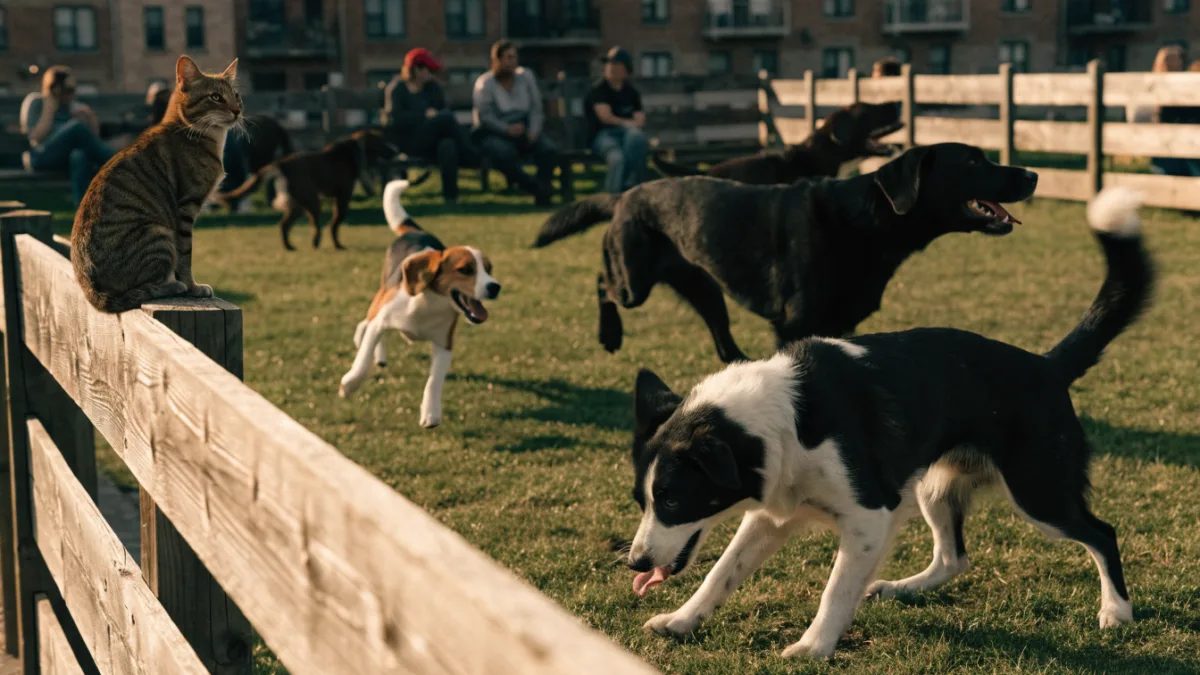
What’s not a joke is bringing an actual cat to a dog park, which happens more than you’d think. [3] and the community’s blunt consensus is correct: a cat in an off-leash dog park is a prey-sized animal surrounded by a dozen aroused, chasing dogs. Don’t. The real alternatives are better anyway — catios, harness training, and serious vertical and scent enrichment at home solve what cats actually need, which is territory, not buddies. And it matters beyond the cat: indoor cats commonly live 10 to 15-plus years, while free-roaming cats average just 2 to 5.
So love your dog park if your dog loves it — go at the right times, watch the play, skip the communal bowl. And love your cat by respecting what she is. Free-roaming cats kill an estimated 1.3 to 4 billion birds a year in the US alone, and our pampered house cats’ wild ancestor, the African wildcat, is quietly being genetically diluted by interbreeding with its domestic cousins. The dog park, for all its chaos, at least concentrates that chaos in one designated spot — away from the shorebird nests and the hedgerows. Heaven for the right dog, a disaster for a cat, and knowing which is which might be the most basic, most important thing any of us does as an owner.
Sources
- plenty of training pages run "love them or hate them" polls — facebook.com
- When people game this out online, the answers trend absurd fast — quora.com
- There are entire rant threads about it — reddit.com