
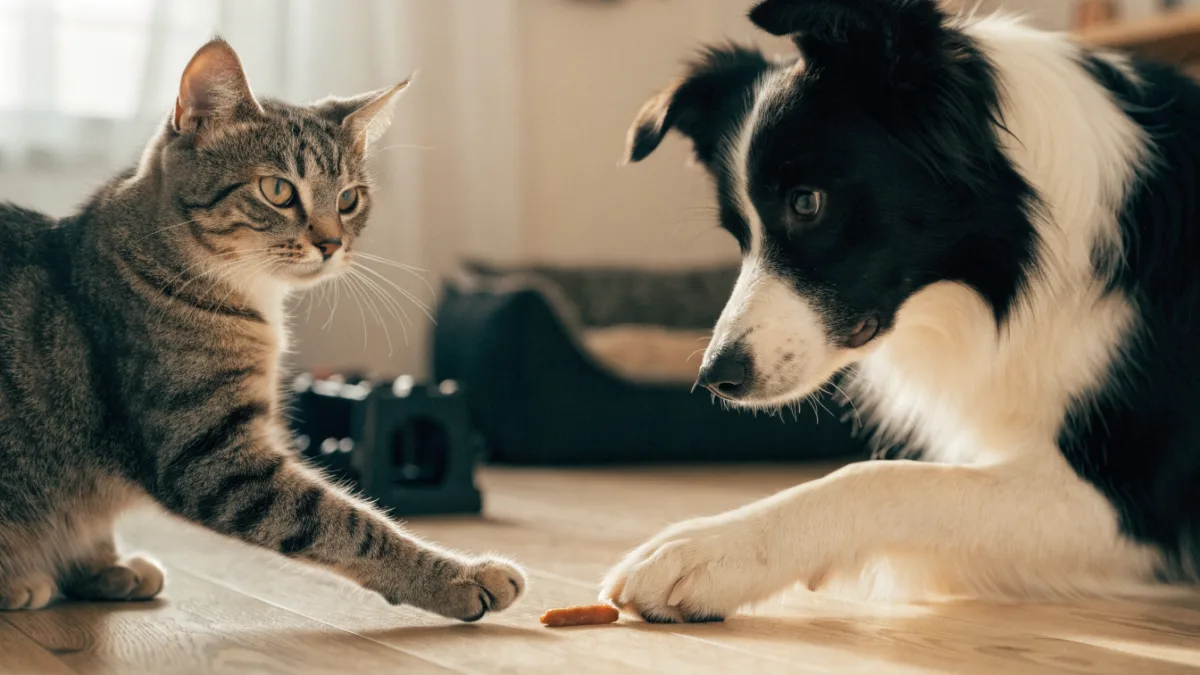
Your dog reaches for a toy tucked under the couch and — thwack — out comes the left paw. Every single time. You probably never thought twice about it. But that little movement actually tells you something fascinating about how your pet’s brain is wired.
Scientists call it “laterality” — the preference for one side of the body over the other. And while humans are about 90% right-handed, the animal kingdom plays by completely different rules. If you’ve got a dog or cat at home, there’s a decent chance you’re living with a southpaw and never even knew it.
## What the Science Actually Says
Here’s where it gets interesting. At the species level, dogs and cats don’t have a dominant side. The split is roughly 50/50 — nothing like the human bias toward right-handedness. But that doesn’t mean your individual pet is ambidextrous.
A study on canine laterality found that 68% of dogs show a clear preference for either their left or right paw. The remaining third either swap back and forth or haven’t made up their minds yet. So while the species as a whole is evenly divided, most individual dogs definitely have a favorite.
Cats follow a similar species-wide pattern, but with a twist: gender matters. Research from the Animal Medical Center in New York and other institutions has shown that,[1] while male cats lean left-pawed. Nobody’s entirely sure why yet, but the pattern shows up consistently across studies.
If you’ve ever watched a cat bat a toy mouse across the floor, you’ve probably seen laterality in action without realizing it had a name.
## How to Test Your Own Pet
This is the fun part. You can run a few quick experiments at home to figure out whether your dog or cat is a leftie, a rightie, or somewhere in between.
The Treat Trap
Grab a hard-sided puzzle toy or a rubber toy with a treat stuffed inside — something your pet can’t just lick clean. Put it on the floor and watch. Which paw do they use to hold it steady? Which paw do they use to swat at it? Repeat this a few times over several days to see if the pattern holds.
You can also try sliding a high-value treat — a piece of cheese, a bit of liver — under a low piece of furniture, just barely out of reach. The paw your pet extends to try to hook it back? That’s usually the dominant one.
The First Step
Take your dog outside on a loose leash and from a standing still position, start walking forward. Do this five or six times. Count which front paw moves first each time. Most dogs will show a clear pattern after just a few repetitions.
Cats are a little trickier for this one since they don’t exactly go for structured leash walks. But you can watch them come out of a room or hop down from a perch and note which paw hits the ground first.
The Shake Test
If you’ve taught your dog to shake, which paw do they offer most often? This one isn’t perfect — some dogs learn to offer the paw that got rewarded most consistently during training — but it’s still a useful data point.
The key with all of these tests is repetition. One paw swat doesn’t tell you much. Ten or fifteen trials across a week? Now you’ve got something.
## The Surprising Link Between You and Your Dog
This is where the research gets genuinely surprising, and honestly, it’s one of those findings that made me rethink how dogs and humans coexist.
A [2] found that human handedness directly influences canine paw preference. Left-handed owners were significantly more likely to have left-pawed dogs. Right-handed owners were more likely to have right-pawed dogs.
Think about that for a second. Your dog isn’t just picking a paw at random — they may be subconsciously mirroring you.
The likely explanation is that dogs adapt to how we physically interact with them every day. Which hand you use to hold the leash. Which side you walk them on. How you reach down to pet them or hand them a treat. Over months and years, these small patterns probably shape which paw your dog relies on most.
This feeds directly into one of the bigger debates in animal behavior research: is paw dominance genetic or environmental? The Charlton study doesn’t settle it completely, but it’s a strong argument that nurture plays a bigger role than we used to think. Your dog isn’t born with a fixed paw preference the way humans seem to be born with handedness. They’re developing it in response to their environment — and you’re a big part of that environment.
## Does Paw Preference Change Behavior?
Here’s something I didn’t know until recently, and it changed how I think about certain dogs.
Left-pawed animals — like left-handed humans — tend to be right-brain dominant. The right hemisphere of the brain is more involved in processing fear, anxiety, and emotional reactivity. Some studies suggest that left-pawed dogs can be slightly more reactive to stressors than right-pawed ones.
I want to be careful here because this is a general trend, not a rule. I’ve worked with plenty of left-pawed dogs who were steady as rocks, and right-pawed dogs who lost their minds at the sound of a trash bag opening. Individual personality, socialization, and training history all matter far more than which paw your dog leads with.
But if you’ve got a left-pawed dog who tends to be a little more sensitive or environmentally aware, this might explain part of what you’re seeing. It doesn’t change how you train them — you still use positive reinforcement, you still build confidence through gradual exposure, you still set them up to succeed. But understanding that there might be a neurological component to their sensitivity can help you be more patient when they react to something that doesn’t bother other dogs.
## Cats Are Their Own Story
Cats don’t have the same owner-mirroring pattern that dogs show — at least, nobody’s proven it yet. They’re less physically entangled with us. You’re not walking your cat on a leash twice a day or guiding them through structured training sessions the way you do with a dog.
What you can watch for is that gender split. If you’ve got a male cat, pay attention to whether he leads with his left paw when jumping or batting at something. If you’ve got a female cat, check her right side. You might be surprised at how consistent they are.
The [3] even used International Left-Handers Day as an excuse to encourage people to figure out their pets’ paw preference. It’s a fun, low-pressure way to pay closer attention to how your animal moves through the world.
## True Ambidexterity or Just the Wrong Test?
There’s one more wrinkle worth mentioning. Some researchers debate whether pets who seem to switch paws a lot are truly ambidextrous or whether we just haven’t tested them with the right task.
A dog might use her left paw to bat at a toy but her right paw for balance on a steep hiking trail. Different tasks demand different things, and a dog who seems to have no preference in your living room might show a very clear one when the stakes change.
This is why testing across multiple scenarios matters. Don’t just do the treat-under-the-couch test once and call it. Watch your dog on walks. Watch your cat at the food bowl. The more contexts you observe, the more accurate your read will be.
## Why Any of This Matters
Here’s what I’d take away from all of this. Your pet’s paw preference is a small window into how their brain is organized. It’s not going to dramatically change how you train or live with them, but it adds another layer to understanding who they are as an individual.
And there’s something bigger underneath all of this. The fact that your dog might be subconsciously mirroring your handedness — that the daily rhythms of life together are literally shaping their physical development — says a lot about how deeply bonded we are with these animals. Dogs aren’t just living in our houses. They’re adapting to us, syncing with us, becoming part of our patterns in ways we don’t fully understand yet.
So go grab a treat, put it under the couch, and see what happens. You might learn something new about the animal you thought you knew everything about.
Sources
- female cats are significantly more likely to be right-pawed — amcny.org
- 2022 study by K. Charlton — pmc.ncbi.nlm.nih.gov
- Humane Society of Huron Valley — facebook.com