

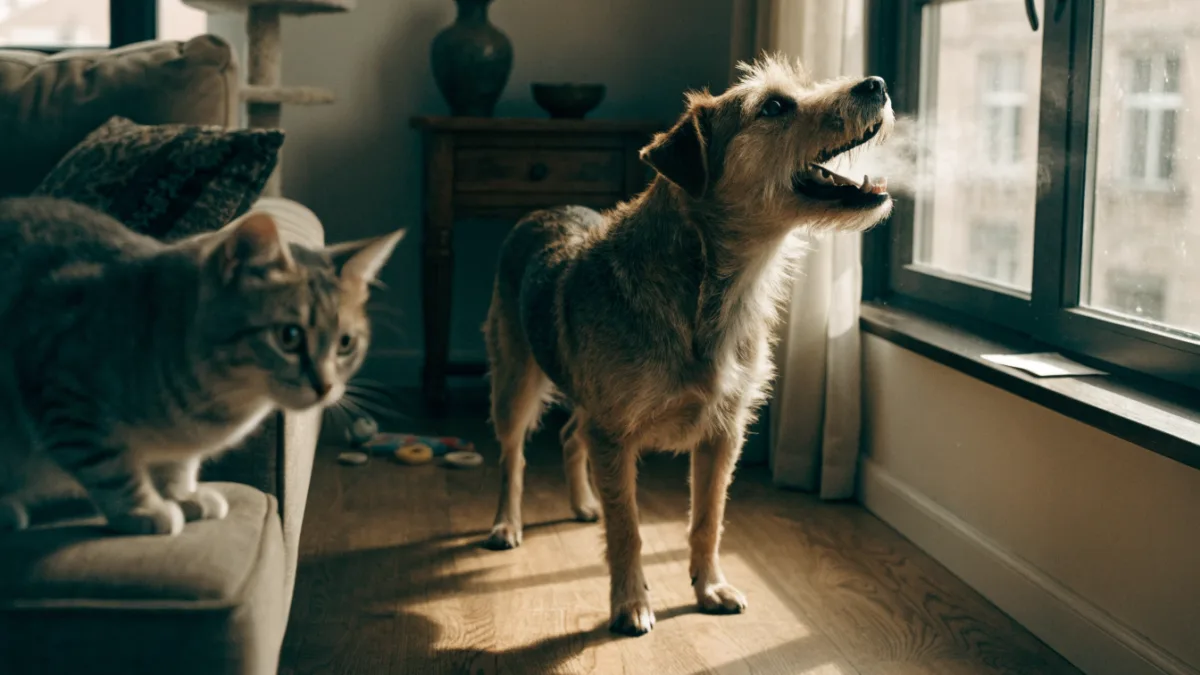
The other afternoon, a perfectly innocent poodle mix walked past my living room window. What followed was a canine opera. Barnaby—a dog I adore deeply but who has the impulse control of a toddler hopped up on birthday cake—launched himself at the glass, barking with the urgent intensity of someone sounding a four-alarm fire bell. Half a second later, my tuxedo cat, Mochi, who had been blissfully asleep on her favorite velvet armchair, launched herself off the furniture and vanished into the dark abyss of my bedroom closet. She didn’t come out for three hours. That was the exact moment I realized Barnaby’s reactivity wasn’t just embarrassing; it was actively ruining my cat’s peace of mind.
The Chaos Behind the Curtains
We throw the word “reactive” around a lot in the pet world, but it helps to understand what is actually happening in those chaotic moments. Canine reactivity is essentially an overreaction to specific stimuli in the environment. The trigger doesn’t even have to be real to the dog—it just has to be perceived. A shadow passing by, a dog walking across the street, or the jingle of a leash two blocks away can set off a chain reaction.
Many owners, myself included in the early days, try to excuse this behavior. We say the dog is “just being friendly” or is “just blowing off steam.” But if you actually look at the mechanics of it, reactivity isn’t a cheerful greeting. It’s a full-body systems override. The dog becomes severely overstimulated. Their adrenaline spikes, their heart rate rockets, and they completely lose their focus and self-control. They might pull intensely toward the window—sometimes out of frustration, sometimes out of fear. They spin, they whine, they growl, and eventually, they bark.
The house doesn’t just get loud; the energy fundamentally shifts. When a dog goes from zero to a hundred in a matter of seconds, the entire environment becomes unpredictable.
Why Your Cat is Paying the Price
Cats are, at their core, creatures of meticulous routine and profound territoriality. They need to know that every corner of their indoor kingdom is secure. Mochi doesn’t care that Barnaby saw a neighborhood stray; she only knows that the creature she shares a living room with suddenly started making aggressive, loud, unpredictable noises in the middle of the afternoon. Her home suddenly felt like a danger zone.
This is the hidden ripple effect of dog reactivity. We spend so much time worrying about how to manage the dog that we completely overlook the silent observer on the cat tree. When a dog erupts into a barking fit, it shatters the feline’s sense of security. A dog’s sudden, aggressive-sounding outburst makes the cat feel threatened, triggering their fight-or-flight response. And because cats are incredibly adept at hiding discomfort, you might not immediately connect the dots when your cat starts acting “off.”
I recently read a discussion from apartment dwellers dealing with a similar issue, and the consensus was glaringly obvious: it’s not just your own dog that causes stress. Even reactive neighbor dogs barking through shared walls can negatively affect a cat’s stress levels. The constant, unpredictable noise keeps them on edge.
Decoding Feline Stress
How does this stress actually manifest? It’s rarely dramatic. You won’t usually see your cat dramatically fainting from fright. Instead, feline stress trickles out in subtle, frustrating ways. If your dog has been having a particularly reactive week, pay close attention to your cat. You might notice:
- Increased hiding: Suddenly spending all day under the bed or in closet corners.
- Litter box avoidance: A stressed cat will often refuse to use a box that feels too exposed or is located too close to the dog’s chaos zone.
- Redirected aggression: The cat gets startled by the dog’s barking, gets overwhelmed, and lashes out at the nearest moving thing—which might be your ankle.
- Excessive grooming: Licking their belly or legs bald as a self-soothing mechanism.
The “Aggressive Dog” Myth and What to Do Instead
There is a massive misconception in the pet community that a reactive dog is inherently “vicious” or aggressive. This simply isn’t true. A major debate in modern animal behavioral science focuses on the difference between normal behavior and reactive behavior. Many dogs that act like absolute monsters at the window or on a leash are completely calm, gentle, and non-reactive in other environments. The behavior is highly situation-specific.
Because the lunging and growling look so scary, some owners resort to punitive measures—yelling, scolding, or using harsh corrections to shut the dog up. But here is the problem: reactivity is usually born from anxiety or overstimulation. If your dog is barking because they are terrified of the approaching Labrador, yelling at them just confirms that the Labrador brings trouble. You are punishing the outward action while pouring gasoline on the underlying emotion.
I will be the first to tell you that I do not give dog training advice. That is strictly my friend Jake’s department—he’s the professional dog trainer I call when Barnaby decides to forget every command he knows. But even I know that the modern, science-backed approach to reactivity is about building the dog’s confidence, not punishing their fear.
Restoring the Peace in a Multi-Pet Home
Fixing this dynamic isn’t an overnight process. It requires patience, environmental management, and an understanding that your pets rely entirely on you to regulate their home environment. There is a beautiful shift happening right now in the pet care industry, moving away from outdated dominance theories and toward specialized, confidence-building management tools.
Managing Your Dog’s Environment
The most effective way to stop a dog from reacting is to prevent the reaction from happening in the first place. Every time your dog practices the barking-and-lunging routine, it reinforces the behavior. Distance is your best friend here. Many normally reactive dogs can walk with zero reactivity if they are kept far enough away from their triggers. If you are walking your dog and see another dog approaching, cross the street, pivot, and put as much distance between you and the trigger as possible. If your dog is alert but not barking, reward them. If they are over the threshold, you are too close.
At home, block the visual triggers. Frosted window films, closing the blinds during high-traffic walking hours, or moving the dog’s favorite resting spot away from the front window can drastically reduce the number of outbursts. If the dog doesn’t see the trigger, the trigger doesn’t exist.
Creating Feline Safe Spaces
While you are working on managing your dog’s behavior, you absolutely must give your cat a sanctuary. This is non-negotiable. Your cat needs a place to retreat that is entirely dog-free. This means utilizing vertical space. Cats feel safest when they are up high, surveying their territory from a vantage point where they cannot be cornered.
- Install sturdy wall shelves that lead up to a high cat tree.
- Set up a dedicated “cat room” with a baby gate or a cat door that the dog cannot fit through.
- Ensure your cat’s litter boxes and food bowls are in quiet, low-traffic areas where they won’t be ambushed by a sudden burst of canine energy.
When Barnaby has a moment where he gets overstimulated by a passing squirrel and Mochi gets spooked, I make sure she has a clear, unobstructed path to her top shelf in the office. She knows it’s her space. He knows he can’t reach her. The tension drops almost immediately.
Navigating life with a reactive dog and a sensitive cat is a delicate balancing act, but it gets easier when you stop viewing the barking as a standalone nuisance. Our domestic animals—descended from wild canids and felids who relied on these very instincts to survive in unpredictable environments—are just doing their best to process a loud, complex human world. By understanding the mechanics of their behavior and taking actionable steps to manage their shared spaces, we aren’t just stopping the noise. We are honoring their natural needs and helping them feel safe together under our roofs.