

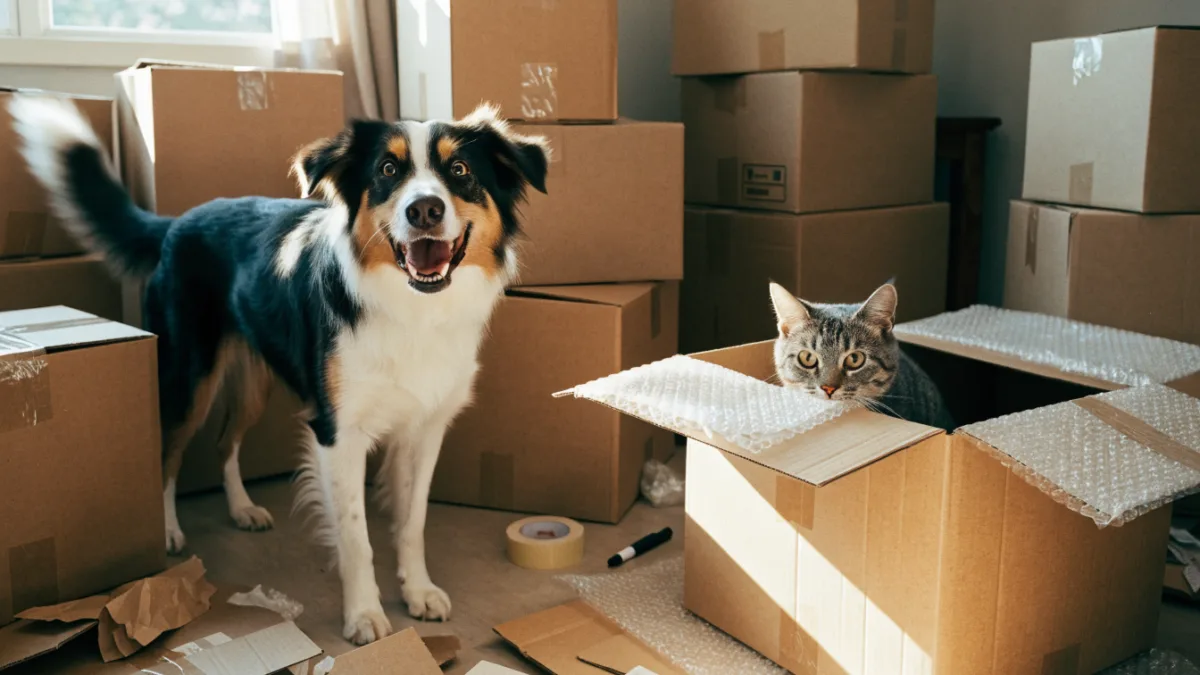
Moving day. There I was, standing in my half-empty apartment, surrounded by a fortress of cardboard boxes, while my cat Mochi had wedged herself so deeply behind the refrigerator that I was genuinely calculating whether I could leave her there and still live with myself. Meanwhile, my dog Biscuit was doing laps around the movers like he’d been waiting his entire life for this entertainment. The cat carrier sat open and completely empty on the kitchen counter. It was 7 AM. This was going to be a very long day.
If you’re planning a move with both a dog and a cat, let me save you some of the chaos I lived through. Because here’s the thing that nobody tells you: your pets are experiencing this move in completely different ways, and treating them the same will backfire spectacularly.
Why Moving Hits Cats and Dogs So Differently
Dogs are pack animals. They care about where you are, not necessarily where they are. As long as their human family is intact and the routine feels familiar, most dogs can adapt to a new space with surprising ease. Biscuit treated our new house like a theme park — new smells! New corners! A yard he’d never peed in before!
Cats, on the other hand, are deeply territorial. Your home isn’t just where Mochi lives — it’s her kingdom, mapped out scent by scent, corner by corner. Every piece of furniture carries her pheromones. Every windowsill is a known vantage point. When you pack all of that into a truck and drive away, you’re not just changing her address. You’re dismantling her entire sense of security. This is why the ASPCA identifies moving as one of the most common reasons pets end up surrendered to shelters — the stress triggers behavioral issues that overwhelm unprepared owners.
So when I tell you that Mochi spent the first three days in our new house hiding inside a box spring, I need you to understand: that wasn’t her being dramatic. That was her genuinely grieving the loss of her territory.
The Packing Phase: Start Before You Think You Need To
Introduce the Boxes Early
About two weeks before you start seriously packing, bring a few empty boxes into your home and just… leave them there. Let your cat sniff them, rub against them, maybe claim one as a napping spot. Let your dog investigate at their own pace. By the time the boxes multiply and furniture starts disappearing, the visual chaos won’t feel quite so apocalyptic.
I made the mistake of packing an entire room in one day while Mochi was napping. She woke up to find her favorite hiding spot — a gap behind the bookshelf — just gone. The look of betrayal on her face was something I’ll never forget.
Protect the Routine Like Your Sanity Depends On It
Because it does. Feed your pets at the same times. Walk your dog on the usual schedule. Keep the litter box where it’s always been until the absolute last minute. Pets track time through routine, and when the routine shatters, their anxiety spikes. During our packing weeks, I maintained Biscuit’s morning walk schedule even when I was drowning in bubble wrap, and I’m convinced it’s the reason he stayed relatively calm throughout the process.
Moving Day: The Strategy That Saved My Sanity
Designate a Safe Room
This is non-negotiable. Before the movers arrive — or before you start hauling boxes yourself — set up one room with the door firmly closed. Put your cat in there with her litter box, food, water, a bed, and a hiding spot. Tape a sign to the door that says “DO NOT OPEN — CAT INSIDE” in letters large enough for tired, distracted humans to actually read.
For your dog, consider a similar setup or have them stay with a trusted friend, at doggy day care, or on a long adventure with someone they know. The chaos of moving day — doors propped open, strangers walking through, furniture being carried out — is a recipe for escape attempts and injury. Even the most well-trained dog can bolt when stressed, and a cat can slip through a gap you didn’t even know existed.
Mochi stayed in our bathroom with a pheromone diffuser plugged in. These synthetic pheromone products mimic the calming facial pheromones cats naturally produce when they feel safe, and many veterinarians recommend them for stressful transitions. I’m not saying they’re magic. I’m saying Mochi went from panting and hiding to at least eating her breakfast, and I’ll take that win.
The Car Ride
Your cat needs to be in a secure carrier. Period. Not loose in the car “because she hates the carrier.” I promise you she’ll hate being loose under your brake pedal a lot more. Cover the carrier with a light blanket to reduce visual stimulation, and line it with a towel that smells like home.
For dogs, a crash-tested harness or travel crate is the safest option. And please, talk to your vet about any travel anxiety — there are calming aids and, in some cases, medications that can help. Many veterinary behaviorists actually advise against heavy sedation during travel because it can interfere with temperature regulation and breathing, so this is definitely a conversation to have with a professional rather than something to figure out on your own.
The First 48 Hours: Two Very Different Playbooks
For Your Cat: Slow Expansion
When you arrive at the new house, do not open the carrier and let your cat “explore.” That’s the equivalent of dropping someone in the middle of a foreign city with no map and no phone and saying “have fun.”
Instead, set up one room — ideally a bedroom or bathroom — with everything she needs: litter box, food, water, bed, hiding spots. Keep her in there for at least three to five days, visiting often, talking softly, letting her acclimate to the new smells and sounds at her own pace. Once she’s eating normally, using the litter box, and showing curiosity about the door, you can gradually open up more of the house to her.
Mochi spent four days in our spare bedroom before I cracked the door open. She sat in the doorway for two hours just… observing. Then she did a slow perimeter check of the hallway and retreated. It took her almost two weeks to confidently explore the whole house. Patience isn’t optional here. It’s the whole strategy.
For Your Dog: Leashed Introductions
Dogs need structure in a new space, too. Before letting Biscuit loose in the yard, I walked him around the perimeter on leash, letting him sniff and mark and understand the boundaries of his new territory. This establishes the space as “his” in a controlled way and helps prevent him from bolting after a squirrel into an unfamiliar neighbor’s yard.
Inside, keep your dog leashed for the first hour or two so you can guide them away from off-limits areas and redirect any anxious chewing or marking. Once they’ve settled, let them explore freely — but supervise closely for the first few days.
When Things Go Sideways
Expect setbacks. Mochi stopped using her litter box for two days after the move. Biscuit developed a sudden fascination with chewing baseboards. These are stress behaviors, not personality flaws. If litter box issues persist beyond a few days, call your vet — urinary problems can be triggered by stress and can become serious quickly.
Invest in a GPS tracker collar if your budget allows. I did, and the peace of mind was worth every penny. Biscuit bolted through an open gate on day four — a gate the previous owners had left faulty — and within minutes I had his exact location on my phone. In an unfamiliar neighborhood, that technology can be the difference between a happy reunion and a lost pet.
Moving with pets is messy, exhausting, and occasionally heartbreaking. But watching Biscuit claim his new sunny spot on the rug and seeing Mochi finally relax enough to nap on the windowsill of her new favorite room — those small victories made every chaotic moment worth it. Your pets will adjust. They just need you to go at their pace, not yours.