

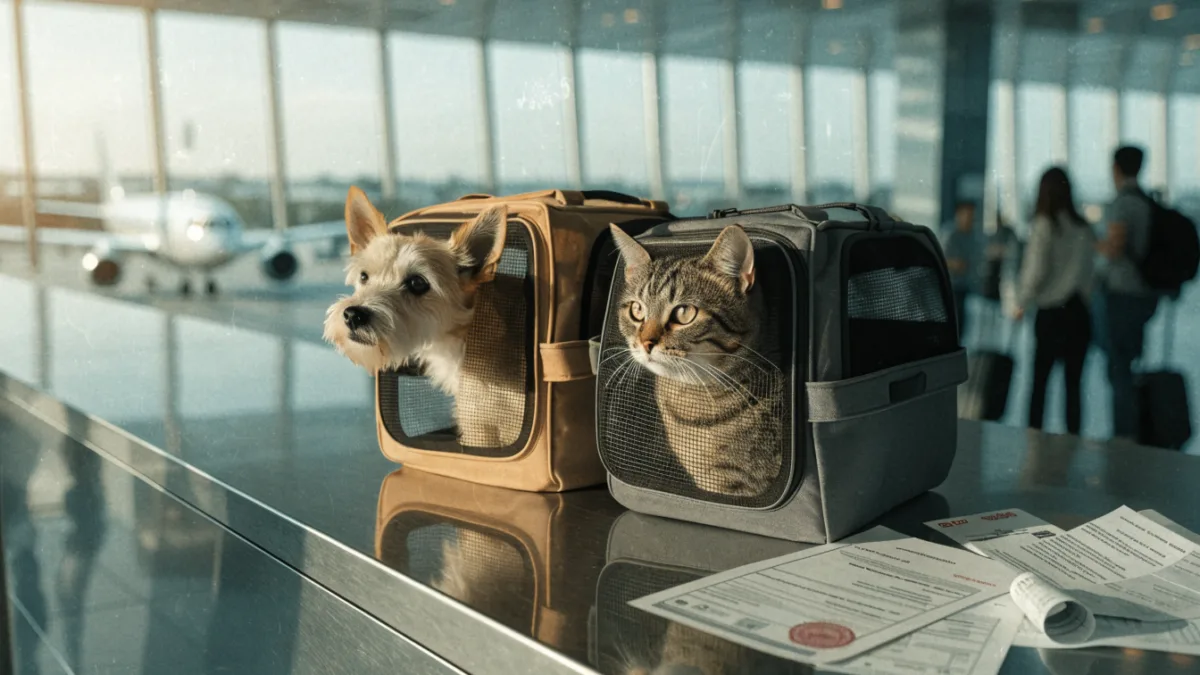
When I booked Mochi’s first flight, I budgeted exactly $125 for the privilege of shoving my twelve-pound tabby into a sherpa-lined prison and stuffing her under an airplane seat. That number was adorable. Adorable and completely wrong. By the time we touched down in Portland, I had spent closer to $600 — and that was before the emergency lint roller purchase at baggage claim because she’d shed an entire second cat’s worth of fur onto my blazer in protest.
The cabin fee is the sticker price airlines want you fixating on. It’s the decoy. The real cost of flying with a pet — whether you’ve got a scruffy terrier mix or a self-possessed calico — involves vet visits, specialized gear, timing your entire departure around paperwork expiration dates, and accepting that layovers will bleed you dry. Here’s what nobody explains until you’re already three hundred dollars in.
The Base Fee Is a Starting Line, Not a Finish Line
Let’s talk numbers. The standard in-cabin pet fee for most major airlines runs between $125 and $350 one-way. Sounds manageable, right? Here’s the catch that airlines bury in their terms and conditions: those fees are often charged per flight segment. If you’re flying from Denver to Boston with a connection in Chicago, you’re not paying once. You’re paying twice. That $125 just became $250 for a single one-way trip. Round-trip? You’re looking at $500 before you’ve bought a single treat.
Projections for 2026 show these costs climbing even higher, with some travelers reporting total pet travel expenses exceeding $700 for a single round-trip flight once all the hidden costs pile up. And pile up they do.
What You’re Actually Paying For Beyond the Ticket
- The carrier itself. Airlines have specific dimension requirements — usually something close to 18″ x 11″ x 11″ for soft-sided carriers. It needs to fit under the seat, be ventilated on multiple sides, and be leak-proof. A flimsy discount carrier won’t pass the gate agent’s inspection. Expect to spend $40 to $120 on something that meets every requirement.
- Health certificates. Most airlines require a veterinary health certificate issued within 10 days of travel. That’s a separate vet appointment, typically $50 to $150, and it must include proof of current vaccinations. Some states and countries require additional documentation.
- Microchipping and updated vaccinations. If your pet isn’t current on rabies or other required vaccines, you’ll need to factor in those costs and the lead time — some vaccines require multiple doses weeks apart.
- Calming aids, travel pads, and disposable liners. You’ll want absorbent pads, wipes, and possibly calming treats or pheromone sprays. None of these are covered by the airline fee.
Dogs vs. Cats: Two Very Different Logistical Nightmares
The economics of flying with a pet diverge sharply depending on species, and the fundamental issue is size. Cats are beautifully uniform in this context — most adult domestic cats weigh between 8 and 12 pounds, which means nearly every cat qualifies for in-cabin travel without question. Mochi, my tabby, fits in her carrier like she was designed for it. She wasn’t — she was designed for knocking glasses off tables — but the physics work in her favor.
Dogs are a different story. Airlines typically cap in-cabin pets at around 20 pounds including the carrier, which means the dog itself usually needs to be under 16 pounds. If you have a medium or large dog, you’re looking at cargo travel, which is exponentially more expensive, requires different (and more stringent) crate specifications, and comes with a whole different set of welfare considerations.
I love dogs. I grew up with a golden retriever named Biscuit who would have eaten his own weight in tennis balls given the chance. But flying Biscuit in cargo would have cost more than my plane ticket and required a specialized crate the size of a small dresser. The math gets brutal fast when your dog doesn’t fit in a tote bag.
The Small Dog Advantage — and Its Limits
A small dog — think Yorkshire terrier, French bulldog, or a particularly compact poodle mix — can fly in-cabin just like a cat. But here’s where behavior enters the equation, and where things get politically charged. Cats are, statistically, much quieter travelers. They tend to curl up, hide, and wait it out. Some small dogs do the same. Others… do not.
If you’ve ever sat through a four-hour flight next to a Yorkshire terrier who believed, with every fiber of his being, that the engine noise was a threat to his family, you understand why some passengers have started questioning the pricing model.
The Great Equal-Pricing Debate
Here’s where opinions get heated. Airline pet fees are flat — a cat and a small dog cost the same to bring onboard, regardless of how either animal actually behaves during the flight. This has sparked real frustration among cat owners, who argue they’re subsidizing the disruption caused by anxious or vocal dogs.
The counterpoint, of course, is that airlines can’t exactly run behavioral assessments at the gate. A calm Chihuahua and a panicky Siamese cat are both possibilities. The fee structure reflects logistics — weight, space, administrative processing — not personality.
Still, the resentment simmers. And it’s worth noting that the fee model itself is under scrutiny from consumer advocates who question whether airlines are pricing pets to reflect actual costs — cleaning, liability, cabin management — or whether they’ve identified pet fees as a lucrative revenue stream that travelers will pay because the alternative is leaving their animal behind.
The Service Animal Loophole That Closed
For years, there was a workaround. Emotional Support Animals — ESAs — flew free. The system was generous, occasionally exploited, and eventually overhauled. Following regulatory changes from the Department of Transportation, airlines can now distinguish between trained service animals (which still fly without charge and have legal protections) and emotional support animals (which are now treated as standard pets).
The practical impact was enormous. Animals that previously traveled at no cost suddenly fell under standard pet fees, which meant more animals in the cabin — and more revenue for airlines. If you have a legitimate service dog, your pathway is different: you’ll need documentation of training and the dog’s tasks, but you won’t pay the pet fee. ESAs no longer receive that accommodation.
If you’re considering claiming your pet is a service animal to avoid fees, I’ll be blunt: don’t. The documentation requirements are stricter now, misrepresenting a pet as a service animal is illegal in many jurisdictions, and it undermines access for people who genuinely depend on service dogs for daily functioning.
Does Your Pet Even Want to Fly?
Here’s the question I sat with before Mochi’s flight, and honestly, it’s the one I keep returning to. The cabin of a commercial airplane is loud, pressurized, full of unfamiliar smells, and completely outside an animal’s control. For some pets, it’s tolerable. For others, it’s genuinely distressing.
Before booking any flight, ask yourself whether travel is necessary for the animal or just convenient for you. A cat who hides under the bed when visitors arrive is not going to have a great time at 36,000 feet. A dog with noise sensitivity — and there are dogs who lose their minds over a kitchen timer — may struggle profoundly with engine noise and cabin announcements.
Talk to your vet about whether your pet is a good candidate for air travel. They can assess temperament, health status, and whether any calming strategies might help. They can’t make your cat enjoy flying — nothing can make a cat enjoy anything she hasn’t personally chosen — but they can help you make an informed decision.
The Island Exception: When Conservation Shapes Pet Policy
Most of this article covers domestic travel within the United States, but if you’re flying to Hawaii, the United Kingdom, Australia, New Zealand, or other island nations with unique native ecosystems, the logistics shift dramatically. These destinations have strict quarantine requirements designed to protect native wildlife — endangered birds, marsupials, reptiles — from diseases and predators that traveling pets might carry.
Hawaii’s animal quarantine program, for instance, requires multiple blood tests, specific vaccination timing, and documentation submitted weeks in advance. Skip a step, and your pet faces a quarantine hold that can last months and cost thousands. These rules exist because introduced species and diseases have devastated island ecosystems worldwide — feral cats alone have contributed to the extinction of dozens of island bird species. The strictness isn’t bureaucratic pettiness; it’s conservation in action.
So if you’re planning to bring your pet somewhere with sensitive native wildlife, budget for the quarantine process the same way you’d budget for the flight itself — and consider whether your companion truly needs to make the trip.
The Bottom Line
Flying with a pet in 2026 is expensive, logistically complex, and — let’s be honest — occasionally stressful in ways that regular travel already is, except now there’s a living creature depending on you to have remembered the health certificate. Budget conservatively. Assume the final cost will be at least double the advertised cabin fee. Prepare your paperwork early, invest in a quality carrier, and have an honest conversation with your vet about whether your specific animal is suited for air travel.
And if your cat gives you that particular look — the one that says she’d rather stay home and judge you for leaving — consider whether she might be right. Some trips are better taken alone, with regular photo updates sent to the pet sitter and a slightly guilty conscience as your only extra baggage.