

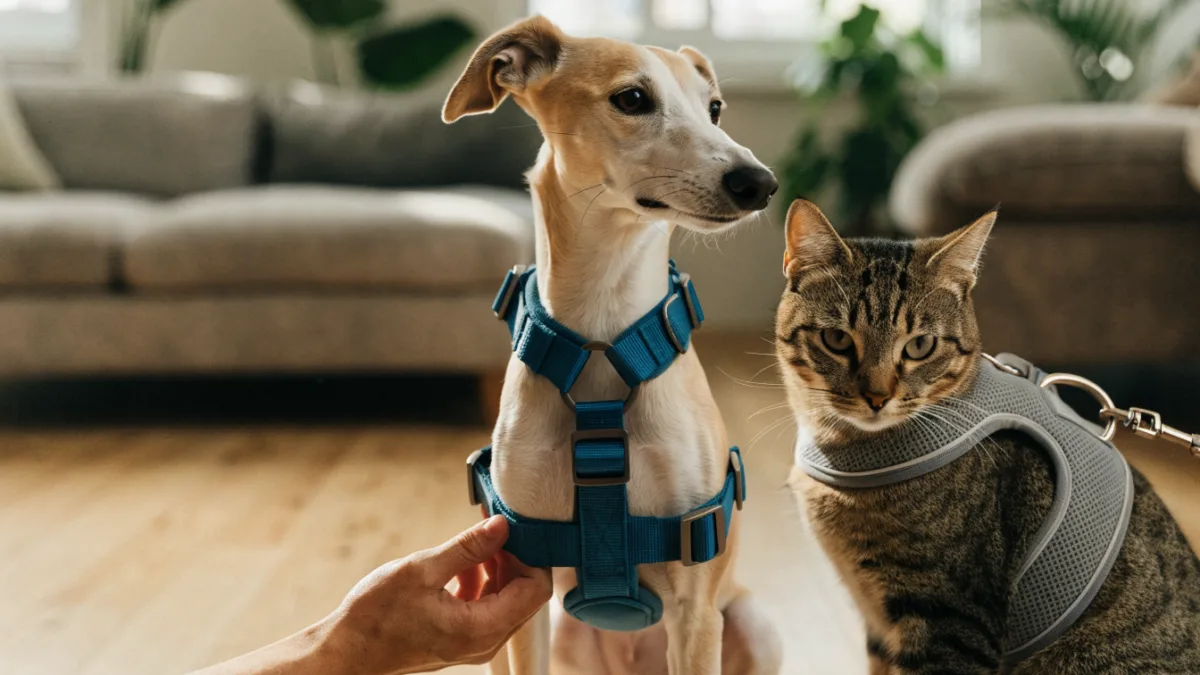
If you’ve ever watched your dog shimmy backward out of a harness in the parking lot of a pet store, you know that particular feeling of helplessness. One second they’re walking nicely beside you, the next they’ve pulled their front legs together, shrugged off the straps, and they’re standing there looking pleased with themselves. Cats do it too, but somehow worse — a fearful cat can collapse their body to the consistency of water and pour themselves through a gap you didn’t think existed. I’ve spent more time than I care to admit crawling under porches and coaxing panicked animals out of bushes. The right harness changes the game. The wrong one practically invites disaster.
The Anatomy of an Escape
Before we talk about what to buy, you need to understand what’s actually happening when an animal backs out of a harness. It’s not magic, and it’s not necessarily a flaw in the product. It’s biomechanics.
When a dog or cat wants out, they do the same thing: they stop forward momentum, reverse, pull their front legs tight against their chest, and shrug their shoulders through the neck opening. The harness slides forward, the front legs pop free, and the whole thing hangs there uselessly around their belly. It takes about two seconds. A determined husky can do it faster than you can react.
I once worked with an Australian Shepherd mix named Ruby who could back out of a harness in under a second. Her owner had tried four different models, all highly rated online, all defeated by the same maneuver. Ruby wasn’t being bad or stubborn — she’d learned that backing up got her free from something uncomfortable. The harnesses kept failing because they all shared the same design flaw.
Why Most “Top-Rated” Harnesses Fail
Here’s where a lot of people go wrong, and I did too for years. You go online, you search for “escape-proof harness,” you sort by highest rating, and you buy whatever shows up first. The problem is that those ratings reflect general satisfaction — comfort, ease of use, how cute it looks — not actual escape prevention.
The most popular harness style right now is the short, Y-shaped chest design. You’ve seen it everywhere. It looks clean, allows great shoulder mobility, and sits comfortably on most dogs. It’s also the easiest style in the world to back out of. The reason is simple geometry: the harness doesn’t extend far enough down the body to create what I call a “tunnel.” There’s barely any length between the front leg openings and the belly strap, which means once the animal shrugs their shoulders forward, there’s nothing holding them.
A short harness is like a t-shirt with the bottom cut off — there’s nothing anchoring it once the shoulders clear the opening.
So you can read thousands of five-star reviews and still end up with a harness that your particular Houdini can defeat in seconds. The ratings tell you about comfort and style. They don’t tell you whether the design actually prevents the backing-out maneuver.
The Second Strap: What Actually Works
The single most effective design feature for preventing escapes — in both dogs and cats — is a second belly strap positioned further back on the body. This creates that longer tunnel I mentioned. Instead of one strap behind the front legs, you have a second one closer to the waist, which means the animal has to clear both points of contact to get free.
Think about it like this: if you’re wearing a vest with one button, you pop it and you’re done. If it has three buttons spaced down your torso, you’ve got to work through each one. The second belly strap works on the same principle. The animal can’t just shrug their shoulders — they’d have to compress their entire ribcage and midsection simultaneously to clear both straps, and that’s not something most animals can physically do.
What to Look For in the Design
- Extended body coverage: The harness should reach well past the ribcage, ideally toward the hindquarters. Longer is better.
- Dual belly straps: Two points of contact around the torso, not one. This is non-negotiable for a serial escape artist.
- Multiple adjustment points: You want at least four — neck, chest, and both belly straps. A harness that only adjusts in two places will never fit precisely enough.
- A rear attachment point: Some newer dog harnesses include a clip or handle near the back that serves as an extra security anchor. Not essential, but helpful.
Dogs: Brute Force and Persistence
Dogs who back out of harnesses usually fall into a couple categories. There’s the reactive puller — the dog who sees a squirrel, hits the end of the leash hard, feels the harness shift, and instinctively backs up to relieve pressure. Then there’s the anxious dog who wants to escape the whole situation and figures out that backing up equals freedom.
I had a client with a young Belgian Malinois who fit both descriptions. Gorgeous dog, tons of drive, but he’d panic on walks in busy areas and back right out of his harness. His owner was at her wits’ end — she’d almost lost him in traffic twice. What worked wasn’t just a better harness, though that was part of it. We switched him to a multi-point harness with dual belly straps and a rear security clip, and we also addressed the anxiety driving the escape attempts. The harness gave his owner the physical security she needed while we worked on the behavior underneath.
For dogs, prioritize padded materials across the chest plate, reinforced stitching at every stress point, and heavy-duty hardware. Plastic buckles are fine for a calm dog on a casual walk, but if you’ve got a strong, determined dog who’s going to test every weak point, look for metal hardware at the critical junctions.
Cats: Liquid Bodies and Panic Responses
If dogs are brute-force escape artists, cats are something else entirely. A dog backs out with purpose and muscle. A scared cat just… melts. Their flexibility is genuinely astonishing — they can rotate their shoulders in ways that seem to defy anatomy, and when they’re frightened, they’ll compress themselves into shapes you wouldn’t believe if you hadn’t seen it.
The challenge with cats is that many of them freeze or panic when they’re scared on a leash. A dog might try to bolt, but a cat often drops flat, trembles, and then makes a sudden, explosive move to escape. That freeze-then-freak-out sequence catches owners off guard. You think the cat is calm, and then suddenly they’re gone.
I talked to a woman last year who had been working on harness training her rescue cat, Miso. Everything was going well — Miso was walking around the backyard, relaxed and curious. Then a car backfired. Miso dropped, twisted, and was out of the harness before my client could even process what happened. They found Miso under the deck three hours later. The harness was a popular, well-reviewed model with a single belly strap and a Y-shaped chest. It looked secure. It wasn’t.
For cats, the extended body design with a second belly strap matters just as much as it does for dogs, but you also need exceptional adjustability. Cats come in a wider range of body shapes relative to their size than most people realize — some are long and slender, some are compact and dense. A harness that fits one cat perfectly might be laughably loose on another of the same weight. Look for designs that let you fine-tune the fit at the neck, behind the front legs, and around the belly independently.
Material matters too. Cats have sensitive skin and thin fur in some areas, so rough webbing that a dog wouldn’t notice can chafe a cat raw. Soft, smooth materials against the body with a secure outer structure is the sweet spot.
Gear Alone Isn’t Enough
Here’s where I’ll be honest with you: no harness is truly, absolutely, 100% escape-proof on its own. I know some manufacturers claim it, and I understand the temptation to believe it. But a determined animal combined with a poorly fitted harness will eventually find a way out. The answer isn’t just buying the right product — it’s the combination of the right harness, fitted correctly, combined with training that reduces the motivation to escape in the first place.
For dogs, that means working on loose-leash skills and addressing whatever anxiety or reactivity is driving the backup behavior. For cats, it means slow, patient desensitization to the harness and the outdoors, building confidence so that a startling noise doesn’t trigger a panic escape.
The harness is your safety net. The training is the real fix. You need both.
Measuring Matters More Than Brand
I can’t tell you which specific harness to buy because what works depends entirely on your animal’s body and behavior. What I can tell you is how to evaluate one. Measure your pet carefully — girth behind the front legs, girth at the widest part of the ribcage, neck circumference, and body length from base of neck to base of tail. Compare those measurements to the sizing chart of any harness you’re considering, and pay attention to the adjustment range within each size. If your animal falls at the extreme end of a size range, size up and use the adjustment points to create a snug fit.
When you put the harness on, you should be able to fit two fingers between the strap and your pet’s body — snug enough that they can’t shrug out, loose enough that it doesn’t restrict breathing or chafe. Check the fit every time. Straps shift, animals gain and lose weight, and a harness that fit perfectly last month might be loose enough to escape from today.
The bottom line is this: escaping isn’t a character flaw in your pet. It’s a problem with the interaction between the equipment, the fit, and the animal’s emotional state. Get a harness with extended body coverage and dual belly straps. Fit it properly. Do the training work that reduces the urge to bolt. That’s how you keep your escape artist safe — and how you stop spending your evenings crawling under porches.