

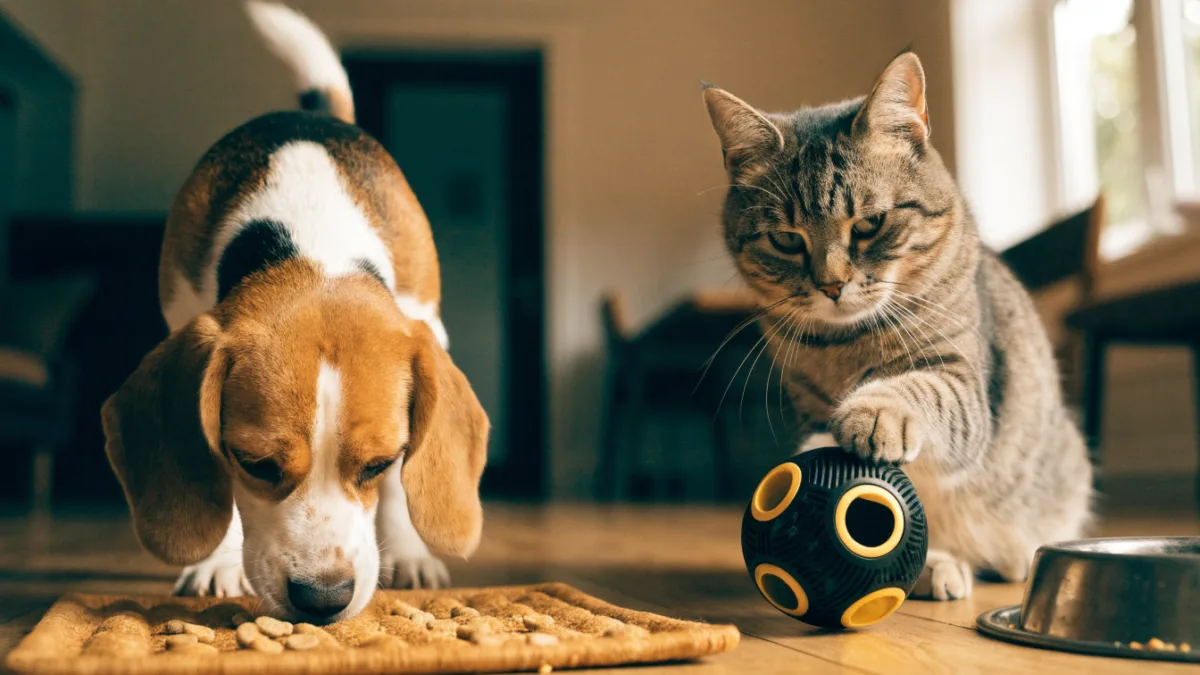
Barnaby, my tuxedo cat, treats mealtime like a competitive sport. Left to his own devices, he will inhale his entire daily ration of kibble in under forty-five seconds, only to dramatically redeposit it onto my favorite rug ten minutes later. We call this the “scarf-and-barf” cycle, and it is exactly as glamorous as it sounds. Meanwhile, my partner Jake’s terrier mix, Pickle, approaches her bowl with the unearned confidence of a wolf who just took down an elk, despite the fact that her food appears magically from a bag twice a day.
Watching them eat made me realize how fundamentally bored our pets are by standard food bowls. In the wild, a dog or cat would spend a massive portion of their waking hours tracking, sniffing, stalking, and foraging. By handing them a free buffet in a ceramic dish, we are entirely bypassing their biological imperatives. I used to feel guilty about the idea of making my pets “work” for their meals, but the reality is that a free bowl of food is a modern invention that shortchanges their brilliant little brains. Puzzle feeders bridge the gap between domestic convenience and primal instinct.
The Psychology of the Puzzle: Why Free-Feeding Falls Short
There is a lingering debate in the pet world about whether it is somehow “cruel” to make our pets solve puzzles for their food. I strongly disagree with that premise. As feline behaviorist Jackson Galaxy points out, [1] we have. Every animal is hardwired to expend energy to acquire food. When we remove that effort, we create a vacuum that often gets filled with destructive habits, anxiety, or straight-up obesity.
And boy, is obesity a problem. With over 50% of dogs and cats in the US classified as overweight by the Association for Pet Obesity Prevention, slow-feeder puzzles are no longer just a fun enrichment activity—they are a vital weight-management tool. By forcing pets to eat slower, their brains actually have time to register satiety before they’ve consumed an entire day’s worth of calories in a minute and a half.
We are also seeing a massive shift in veterinary medicine. Board-certified behaviorists are now formally prescribing food puzzles to treat clinical issues ranging from separation anxiety and canine dementia to feline idiopathic cystitis (a stress-induced bladder condition). It turns out that mental enrichment is just as critical to their physical health as a good diet.
Decoding the Foraging Dog
If you want to understand what kind of puzzle your dog needs, you have to look at their ancestors. Dogs evolved alongside humans as opportunistic scavengers. Their brains are wired to root through refuse, sniff out discarded scraps, and use their powerful noses to locate calories. For a dog, the act of sniffing is inherently calming. I’ve seen Jake’s high-energy terrier turn into a puddle of zen just by spending twenty minutes rooting through a blanket for treats.
Fun fact: canine behaviorists note that just fifteen minutes of active sniffing and foraging can tire a dog out as much as a thirty-minute brisk walk. Mental exhaustion is highly underrated.
What to look for a dog:
- Scent-driven designs: Look for snuffle mats—rubber-backed fabrics with long strips of fleece where you can hide kibble. These satisfy their urge to root around in brush.
- Licking mechanisms: Licking is a self-soothing behavior for dogs. Look for durable rubber toys with hollow centers or grooves that you can smear with wet food or peanut butter. (Pro-tip: freeze them overnight to make the licking last longer).
- Push-and-roll toys: Hard plastic orbs that dispense kibble as the dog bats and pushes them around the floor tap right into their scavenging instinct.
- Durability and washability: Dogs have strong jaws and lots of drool. Whatever you buy needs to survive being chewed on and be easy to throw in the top rack of the dishwasher.
Decoding the Hunting Cat
Cats are a completely different beast. While a dog is a scavenger, a cat is an apex predator. They sleep 12 to 16 hours a day so they can store up energy for short, intense bursts of hunting. When they are awake, they want to stalk, bat, and use their incredibly precise paws. Barnaby doesn’t want to stick his nose into a pile of fleece; he wants to slide a lever with his paw and extract his prize like a furry little safe-cracker.
If you have a cat that eats too fast or exhibits behavioral issues (like attacking your ankles at 3 AM), introducing food puzzles can be a total game-changer. They provide an outlet for that predatory drive without requiring you to swing a feather wand at midnight.
What to look for in a cat:
- Tactile engagement: Skip the mats and look for puzzle boards. These are flat trays with sliding pegs, flipping lids, or spinning compartments that require the cat to use their paws and claws to reach the food.
- Weight-appropriate moving parts: Cats love things that move. Slim, weighted feeders that wobble when batted but don’t roll away entirely under the sofa are fantastic.
- Clear visibility: Cats are visual hunters. They need to see the food moving inside the puzzle to stay motivated. Opaque toys often frustrate them because they can’t track their “prey.”
- Shallow, easy-clean reservoirs: Cat saliva gets surprisingly gross, and raw or wet diets can spoil quickly. Look for puzzles with shallow grooves that can be easily scrubbed with a bottle brush or wiped out with a sponge.
The Messy Reality of Multi-Pet Homes
If you have a multi-pet household, introducing food puzzles requires a bit of strategy. We made the mistake early on of giving Barnaby a complex cat puzzle on the floor while Pickle was working on her rubber toy. Within two minutes, Pickle had abandoned her toy and was happily hoarding Barnaby’s puzzle, while Barnaby sat on the counter looking deeply offended.
Introducing high-value food into a group setting can absolutely trigger resource guarding or bullying. A dog stealing a cat’s puzzle isn’t just annoying—it’s dangerous, especially if the dog ingests small plastic cat-toy parts in the process.
You have to manage the environment. I highly recommend physical separation. Put the cat’s puzzle on a raised surface the dog can’t reach, or use baby gates to create separate enrichment zones. You should always supervise your pets when they are using puzzles, at least until you are 100% confident they aren’t going to fight over the goods.
Frustration vs. Enrichment: Setting Them Up to Win
One of the biggest controversies in the animal behavior world right now is the difficulty level of these puzzles. Should they be easy, or should they push the animal to the point of mild frustration to build resilience? I lean heavily toward the “easy does it” side of the fence. A puzzle that is too hard ceases to be enriching and just becomes a source of severe stress. If your dog is barking relentlessly at a toy, or your cat is trying to pick the puzzle up and body-slam it onto the tile floor, the difficulty is set way too high.
You have to introduce these games gradually. Show them how it works. Put the food right on the edge of the puzzle the first few times so they get a quick, easy win. They need to experience the joy of solving it before you start making them work for it.
And if you are away from home for long stretches, you might look into the new wave of “smart” puzzles. These app-controlled feeders and automated toys let you trigger treat drops, set playtimes, and even track caloric intake from your office. I’m slightly suspicious of anything that requires my Wi-Fi to function properly, but the technology is genuinely changing the way we provide daytime enrichment for working pet parents.
Ultimately, whether you are living with a scavenger or a hunter, providing environmental enrichment isn’t just about keeping them occupied. It is about honoring the wild ancestors that still live inside their DNA. Dogs and cats haven’t lost the hardware of the wolf or the African wildcat—they’ve just been handed an easier life. By giving them a puzzle to solve, we aren’t punishing them with hard work; we are giving them a safe, satisfying way to just be animals.
Sources
- food puzzles are one of the most underused tools — facebook.com