

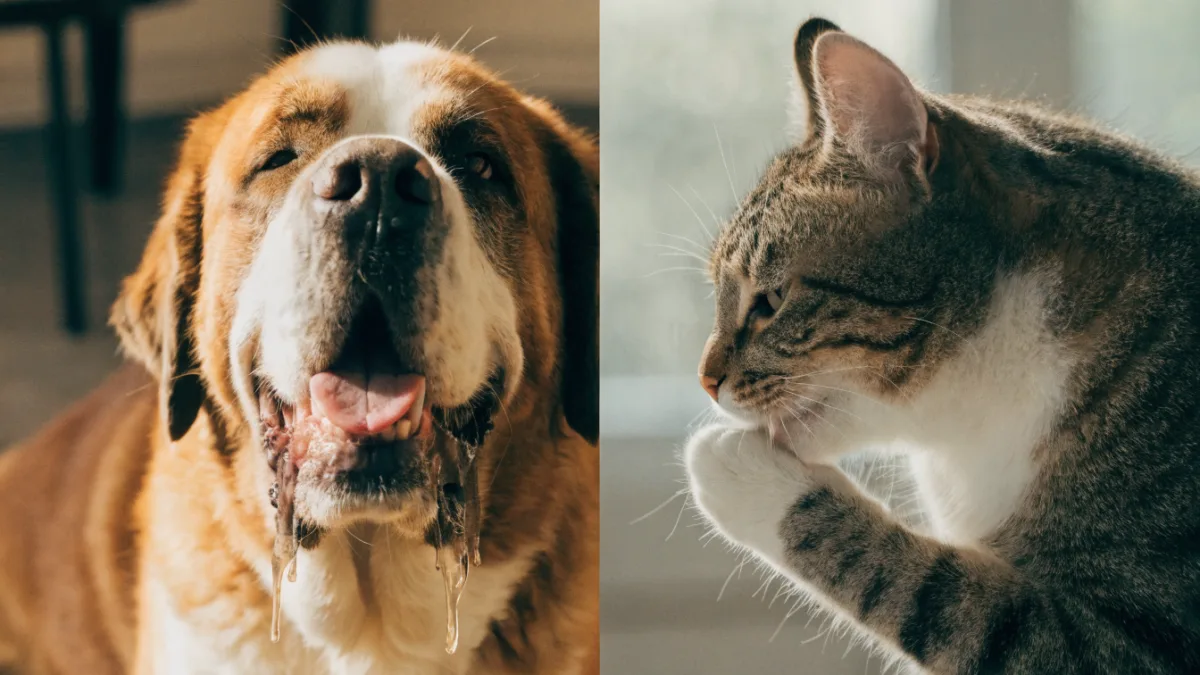
Just last week, I was examining a wonderfully stoic six-year-old Saint Bernard named Barnaby. His owner, Mark, sat in the corner of the exam room armed with a hand towel, periodically wiping long, glistening strings of drool from Barnaby’s jowls. “Is there a pill to turn this off, Dr. Mitchell?” he asked, only half-joking. “I love this dog, but my house looks like a crime scene.”
I had to smile. In the exam room next door, I was about to see a fastidious, twelve-pound Russian Blue cat named Whiskers, who spent half her waking hours meticulously grooming herself into a state of sparkling perfection. The contrast got me thinking about saliva. It’s easy to view dog drool as a messy nuisance and cat spit as a magical cleaning elixir, but the reality is a fascinating tale of evolution, anatomy, and biology. Let’s pull back the curtain on the secret life of saliva and explore why drool is actually a dog’s greatest tool—while being a cat’s absolute worst nightmare.
The Anatomy of a Slobber Factory
Before we can understand why some dogs leave puddles wherever they go, we have to look at what saliva actually is. Whether it belongs to a dog, a cat, or a human, saliva is about 98% water. That remaining 2% is a highly specialized biological cocktail. It contains electrolytes, mucus, and antibacterial enzymes.
But contrary to popular belief, a dog’s saliva doesn’t actually digest their food. If you remember your high school biology, human saliva contains an enzyme called amylase that starts breaking down starches the moment you start chewing. Dogs don’t have this. Their saliva acts purely as a lubricant. It’s there to help kibble, meat, and whatever questionable things they found in the yard slide safely down their esophagus.
So, why do some dogs drool so much? It all comes down to simple fluid dynamics and anatomy. Drooling happens because of an overflow. Excess saliva pools in the mouth faster than the dog can swallow it. Breeds like Bloodhounds, Mastiffs, and Newfoundlands have what we in the veterinary field call “non-slick lips.” Their lips are heavy, loose, and fleshy. They quite literally act like water balloons. When they shake their heads, lower their heads to eat, or get excited, the saliva simply spills over the brim. Dogs with tight, slick lips—like Golden Retrievers or German Shepherds—naturally hold all that fluid in.
A Dog’s Best Multi-Tool
Even if you’re constantly mopping up after your gentle giant, that drool is actually doing hard work. I like to think of saliva as a dog’s biological multi-tool.
Built-In Air Conditioning
Dogs don’t sweat the way we do. They have a few sweat glands on their paw pads, but their primary method of cooling down is panting. When a dog pants, moisture rapidly evaporates off their tongue and the lining of their mouth. Saliva is the crucial fluid that makes this evaporative cooling system work. However, this means that sudden, excessive drooling can sometimes be an early warning sign that your dog is overheating. If the faucet suddenly turns on while you’re out on a hot day, it’s time to find shade and offer cool water.
Bandages in a Bowl
You’ve probably noticed that when a dog gets a minor cut on their leg, their first instinct is to lick it. There’s a persistent belief that dog saliva has magical healing properties, and there is a grain of truth here. Dog saliva contains enzymes like lysozyme, which can help kill certain types of bacteria. It also contains histatins, compounds that encourage the migration of skin cells to close a wound. While I never recommend letting a dog obsessively lick a surgical incision or a deep wound (because they will quickly cause more damage and introduce new bacteria from their mouths), it’s a fascinating evolutionary holdover from their wild ancestors who had to heal themselves without human intervention.
Is a Dog’s Mouth Really Cleaner Than a Human’s?
This is one of the most common debates I hear in the clinic, usually sparked by a client whose dog just gave them a big, wet kiss right after eating something awful outside. Let’s settle it: the idea that a dog’s mouth is inherently “cleaner” than a human’s is a pervasive myth.
I’ll admit, early in my career, I was pretty dismissive of the dangers of dog kisses. But as veterinary science has evolved, I’ve changed my mind. Thanks to recent breakthroughs in mapping the oral microbiome—the vast community of bacteria that live in the mouth—we now know that a dog’s oral bacteria is simply different from ours, not necessarily cleaner.
Dogs use their mouths the way we use our hands. They greet other dogs by licking their faces, they sniff and eat garbage, and they groom their own backsides. If you have a compromised immune system, or if you have a baby or toddler in the house, it’s best to discourage face-licking. You aren’t being a bad pet parent by setting boundaries; you’re just practicing good hygiene.
When the Faucet Won’t Shut Off
Most of the time, a string of drool hanging from a Mastiff’s lip is just breed-standard biology. But as a veterinarian, I’m trained to look for the abnormal. When does drooling signal a medical problem?
If your tight-lipped dog who never drools suddenly turns into a slobber machine, it’s a red flag. I recently treated a three-year-old Labrador mix named Bella who came in because she was “foaming at the mouth.” Her owner thought she had ingested a toxin. Upon examination—gently opening her jaw by grasping it securely behind her big canine teeth, checking the top and bottom teeth all the way around—I found the culprit: a piece of a wooden stick wedged diagonally across the roof of her mouth. Once we removed the splinter, the drooling stopped almost immediately.
Sudden, excessive drooling can indicate several issues:
- Dental disease: A painful cracked tooth or severe gum inflammation will cause a dog to drool because it hurts to swallow.
- Nausea: Just like humans get “waterbrash” before throwing up, dogs hypersalivate when they feel sick to their stomachs. This is often accompanied by loud stomach gurgling and lip-smacking.
- Toxin ingestion: If a dog chews on a toxic plant or catches a toad, drooling is often the very first symptom as the body tries to flush the irritant away.
If the drooling is paired with pacing, drooping eyes, or a refusal to eat, call your vet immediately. Conditions like bloat (gastric dilatation-volvulus) are life-threatening emergencies where excessive drooling is a hallmark symptom.
Why Drool is a Cat’s Worst Nightmare
Now, let’s talk about the other side of the household. If Barnaby the Saint Bernard represents the messy, beautiful reality of dog drool, a cat represents the opposite extreme. Cats are meticulous groomers. Their tongues are covered in tiny, backward-facing hooks called papillae, which act like a built-in comb. Cats use very precise, minimal amounts of saliva to distribute natural oils across their fur, pull out loose hair, and regulate their body temperature.
To a cat, saliva is a highly controlled, precious resource meant strictly for themselves. When a well-meaning, slobbery dog tries to groom a cat, it’s the equivalent of someone dumping a bucket of cold, dirty water over you right after you’ve stepped out of the shower. A dog’s copious, sloppy drool completely ruins a cat’s painstakingly clean coat. It mats the fur, introduces unfamiliar dog bacteria, and destroys the carefully layered oils. When your dog tries to show the family cat affection with a big, wet kiss, and the cat retaliates with a swift swat to the nose, the cat isn’t being mean. From their perspective, they are fiercely defending hours of hard hygiene work.
Living with the Slobber (and What We Can Learn)
With the recent surge of large, jowly breeds taking over social media, there’s been a massive boom in drool-management products. You’ll find heated debates online between owners who swear by physical barriers like drool bibs and bandanas, and those who prefer just modifying their home environment.
If you have a heavy drooler, my advice is simple: embrace the reality of the breed. You don’t necessarily need a wardrobe of fancy bandanas. Instead, look for machine-washable throw blankets to protect your sofa, invest in dog-safe mouth wipes to gently clean their jowls after they eat, and keep a dedicated stack of cheap microfiber cloths by the front door for wiping mouths before walks.
Whether it’s acting as a biological air conditioner, a swallowing lubricant, or an evolutionary defense mechanism, drool is an incredible piece of canine engineering. Our domestic pets are a fascinating bridge between the wild and our living rooms. So the next time you have to wipe a long string of spit off your favorite jacket, don’t cringe. Take a second to appreciate the millions of years of evolution that went into creating that magnificent, messy tool.