

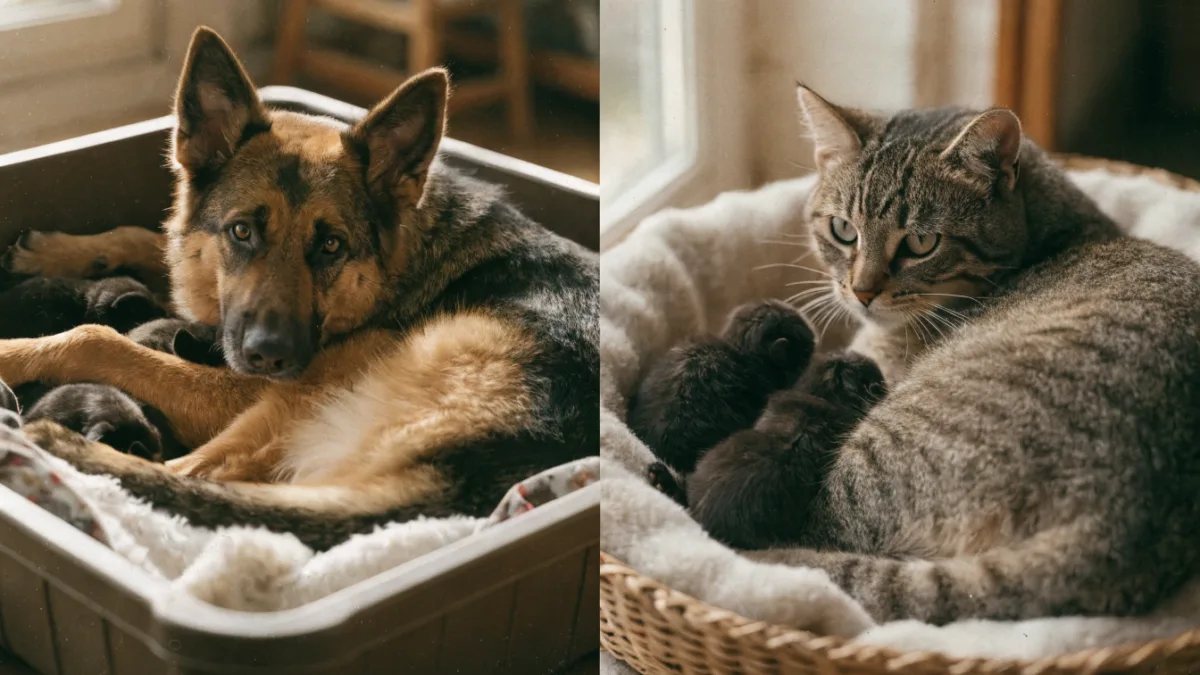
You’ve got this golden retriever, right? Sweetest dog on the block. She’d lick a burglar’s face and show him where you hide the good silver. Then she has a litter of puppies. Suddenly, she’s growling at your husband for walking past the laundry basket she claimed as her bed. She’s lunging at the family cat. You’re standing there thinking, “Who is this dog, and what did she do with my sweet girl?”
Relax. You don’t have a villain on your hands. You have a mother.
Maternal aggression is one of the most jarring things a pet owner can experience, mostly because it feels so out of character. One day your pet is a goofball, the next she’s a bodyguard. But here’s the deal: this isn’t a behavioral flaw or a sudden onset of meanness. It’s a highly specialized, temporary, and biologically hardwired survival mechanism. And while dogs and cats both get the memo to protect their young, they run very different software when it comes to how they do it.
The Biology of the Fierce Mother
Let’s get the terminology straight before we go any further. A mother dog is called a bitch. A mother cat is called a queen. It sounds a bit old-school, but those are the correct biological terms, and they matter because the maternal instincts in both species are driven by a massive shift in hormones.
When a dog or cat gives birth, her body is flooded with oxytocin. People call oxytocin the “love hormone” because it facilitates bonding. But oxytocin doesn’t just make a mother love her babies; it makes her hyper-focused on keeping them alive. Combine that oxytocin spike with the hormone prolactin, which drives milk production, and you get a chemical cocktail that essentially hijacks the mother’s brain. Her baseline for what constitutes a “threat” drops to zero.
This behavior is heavily.[1] In the wild, vulnerable neonates are basically snacks for predators or rival animals. A mother has to be fierce, and she has to be willing to back it up with violence if necessary. When your sweet lab growls at you, she isn’t being a jerk. In her mind, you’re a giant predator circling her helpless pups. She’s doing exactly what millions of years of evolution told her to do.
Nursing Dogs: Guarding the Whelping Box
In dogs, maternal aggression is usually very spatial. It’s all about the nest. Most mothers will set up shop in a specific corner—hopefully, the whelping box you prepared for her—and that area becomes a fortress.
I remember working with a first-time dog owner who had a normally submissive Vizsla. The dog had just had a litter of eight, and the owner was freaking out because the dog was growling every time someone entered the room. We set up an x-pen (exercise pen) around the whelping box. Instantly, the aggression stopped. Why? Because the pen created a buffer zone. The dog didn’t actually want to fight; she just wanted to control who got close. As long as people stayed on the outside of the pen, she was relaxed.
Dogs will usually give you plenty of warning before they bite. You’ll see stiff body language, hard staring, and lip-licking before the growl even starts. If you push past those signals, you’re asking for a snap.
The Cross-Species Household Problem
If you have a multi-pet household, this is where things get dicey. A nursing bitch will often redirect aggression onto other dogs in the home, even if they’ve been best friends for years. The other dogs aren’t stupid; they usually get the memo and give the whelping box a wide berth. But if you have a clueless adolescent dog or a rambunctious toddler, you’re going to have a problem.
Management is simple but non-negotiable: separate them. Give the mother a room to herself. Don’t test her patience by forcing “pack harmony” while she’s nursing.
Nursing Cats: A Different Beast Entirely
If dogs are focused on the nest, nursing cats are focused on everything. Queens take maternal protection to a whole different level.
I’ve seen cats who were absolute sweethearts turn into absolute terrors the second they had kittens. A.[2] She doesn’t just sit in her box and growl; she’ll leave the kittens to launch a preemptive strike on a dog walking down the hallway. I once had a client whose laid-back tabby spent three weeks actively hunting their senior Labrador. The cat would hide under the sofa and swat the dog’s ankles every time he walked by. It wasn’t fair to the dog, but it was pure instinct.
Cats are both predators and prey in the wild. A mother cat has to be vigilant against larger predators, but she also has to protect her kittens from tomcats, who will sometimes kill kittens. This means her aggression can be more active, more unpredictable, and sometimes more severe than what you see in dogs.
With a cat, you’ll want a queening box in a quiet, low-traffic area, but you also need to manage her environment. If she feels she has to “patrol” the house, keep her confined to a single room with her kittens until she starts to chill out.
Myth Busting: She Isn’t Spoiled or Jealous
One of the most common misconceptions I hear is that a mother acting aggressively is “jealous” of the attention the babies are getting, or that she’s been “spoiled” and is just being a diva. This is anthropomorphic garbage. We’re projecting human psychology onto an animal running on pure instinct.
As the,[3] this behavior is tied directly to the complex hormonal shifts of pregnancy, birth, and lactation. It is most commonly observed in intact females. You cannot “train” this instinct out of a dog or cat with treats. The only cure is time. Once the babies start weaning and the mother’s prolactin levels drop, the fierce protectiveness naturally fades away.
What Not to Do: Never Punish the Growl
Here is the biggest mistake you can make: punishing the mother for growling or snapping.
Traditional, outdated training methods might tell you to “correct” the dog for showing aggression. If you do that, you’re playing with fire. If you punish a mother for growling, you don’t stop the aggression; you just silence the warning system. Next time, she might skip the growl and go straight to a bite.
Worse, punishing her causes immense stress. It can break her trust in you, and in severe cases, it can cause her to reject or even attack her own young. If she feels she can’t protect her babies from you, she might decide they’re a liability.
The modern, universally accepted approach is management, not punishment. Respect the growl. When she growls, back off. Give her the space she’s asking for. If you need to check on the babies, toss her a high-value treat (like a piece of plain boiled chicken) away from the nest to distract her, or better yet, wait until she steps out for a bathroom break.
Surviving the Nesting Phase
Surviving a mother’s nesting phase is all about setting up the environment for success. Here’s the game plan:
- Location, Location, Location: Set up the whelping or queening box in a low-traffic area. A spare bedroom or a quiet corner of a finished basement works great. Avoid hallways or high-traffic family rooms.
- Barrier Up: Use baby gates or exercise pens to create a buffer zone around the nest. This lets the mother see out but keeps intruders at a safe distance.
- Hands Off: Avoid unnecessary handling of the newborns during the first couple of weeks. Let the mother do her job.
- Pheromone Power: Many fosters and breeders swear by synthetic pheromones (like dog-appeasing pheromones or feline facial pheromones) diffused in the room to help modulate maternal stress.
- Read the Room: Watch for stiff body language, staring, and lip-licking. If you see those signs, you’re too close.
The good news is that this phase doesn’t last forever. Maternal aggression is temporal. It peaks during the early nursing phase and naturally subsides as the offspring grow, become mobile, and start eating solid food. Your sweet, goofy pet will come back. You just have to give her the space and respect to be the fierce mother she needs to be for a few weeks.
And while you’re waiting for her to return to normal, take a moment to appreciate that fierce instinct. It’s the exact same drive that keeps the young of endangered wild canids, like the Ethiopian wolf, and felids, like the Amur leopard, alive against all odds. It’s not a flaw; it’s one of nature’s most powerful and necessary superpowers.
Sources
- documented in veterinary literature — pmc.ncbi.nlm.nih.gov
- nursing queen will often actively seek out threats — petplace.com
- veterinary behaviorists at Tri-County Animal Hospital note — tricountyah.com