

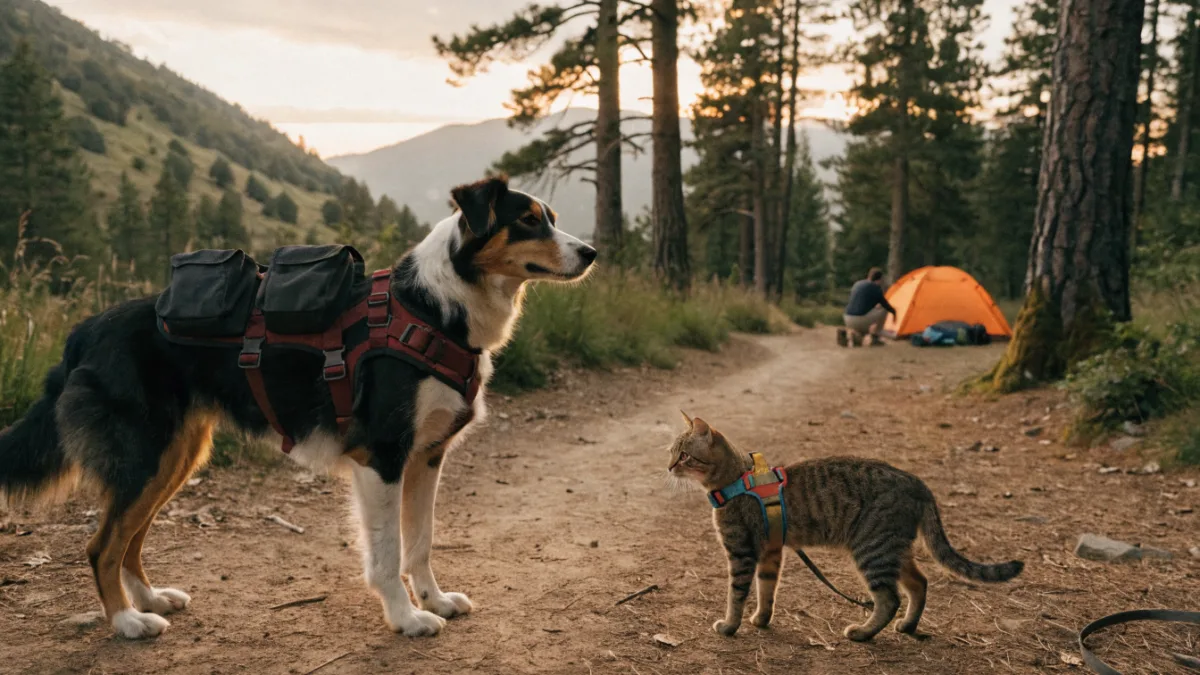
A cat has thru-hiked the entire Appalachian Trail — all 2,190 miles of it. Sit with that for a second, because my cat Miso once staged a multi-day protest (staring, tail flicks, strategic hairballs) after I moved her food bowl three feet to the left. And yet the adventure cat movement is very real: scroll any hiking hashtag and you’ll find cats riding in backpacks along ridgelines like they were born for it. Dogs, meanwhile, have been our trail buddies for thousands of years and mostly come pre-installed with enthusiasm. If you’re standing at the trailhead wondering which pet should come along — or whether both can — here’s the honest breakdown of hiking with dogs versus camping with cats: the gear, the rules, the water situation, and the harness conditioning marathon that stands between your sofa cat and the summit.
Two Trail Philosophies: Enthusiasm vs. Negotiation
My dog Moose treats every trail like a gift made specifically for him. New smells, streams to splash in, sticks of ambiguous ownership — he’s a yes creature. That’s the dog advantage in a nutshell: most dogs want to hike. The work is channeling that energy, which means solid leash manners and reliable recall before you hit anything with elevation change. That’s training-land, and honestly, Jake has written about trail recall far better than I ever could.
Cats operate on a different operating system entirely. Everything happens on their terms, at their pace, and often while making direct eye contact to confirm you understand who’s in charge. The humans behind hiking cats like [1] will tell you straight up: getting a cat trail-ready takes a lot more effort than dog training. We’re not talking a weekend of practice. We’re talking weeks to months of patient conditioning, and some cats will still decide the whole endeavor is beneath them.
The trade-off? Cats are generally cheaper and logistically lighter travel companions — they eat less, their gear is smaller, and a cat in a backpack takes up less campsite real estate than a 70-pound dog who thinks the tent is his now ([2] rages on, but cost is one place cats quietly win). And [3] about whether cats belong on trails at all — meanwhile, the adventure cat community just keeps posting summit photos.
Before You Leave the Parking Lot: Leash Laws and Trail Rules
This is the least glamorous section and possibly the most important one. Pet rules vary enormously depending on country, land agency, and even individual trail, so checking before you go isn’t optional — it’s the difference between a great day and a ranger politely ruining it.
In the U.S., the general pattern looks like this: national parks are the strictest, with dogs banned from most backcountry trails entirely. National forest and BLM land tend to be far more permissive, often allowing leashed dogs nearly everywhere. Where pets are allowed, a maximum 6-foot leash is the most common rule you’ll encounter — so that retractable leash can stay home.
The reasons behind restrictions are usually legitimate: sensitive wildlife habitat, ground-nesting birds, protected plant communities, or aggressive wildlife in the area. And here’s the part multi-pet households need to hear — a cat counts as a pet under these rules, and if you’re bringing both a dog and a cat, the trail has to work for both animals’ comfort levels, not just the law. A dog-friendly trail with heavy foot traffic might be a nightmare for a cat. Some campgrounds also ask for rabies vaccination documentation, so keep those records handy (and current — ask your vet what’s recommended for your area).
The Gear: Two Very Different Packing Lists
Dog trail gear
- A well-fitting harness (collar-plus-leash on a pulling dog is a throat problem waiting to happen)
- A standard 6-foot leash, plus a longer line for campsites where it’s allowed
- Paw protection — booties or paw balm for rough terrain, rocky scrambles, or hot surfaces; check pads at every break
- A dog pack so your buddy can carry their own water and food — start with barely any weight and build up slowly
- Collapsible bowls and more water than you think you need
- A pet first aid kit (gauze, vet wrap, tweezers for ticks and thorns)
- Poop bags, and the willingness to pack those bags out. Yes, all the way out.
- Something reflective or light-up for dusk — Moose wears a collar light and it’s saved us more than once
Adventure cat gear
- An escape-proof harness — this is the single most important piece of adventure cat gear. Look for an H-style or vest-style harness with multiple adjustment points; you should barely fit two fingers under it, and test it indoors before trusting it outdoors. Cats are Houdinis.
- A lightweight leash attached to the harness, never a collar — a startled cat can slip a collar in about half a second
- A backpack carrier, which doubles as the cat’s mobile safe room and panic bunker
- Canned wet food — this one’s a safety item, not a luxury. More on why below.
- A travel litter box and a scoopable amount of litter for overnight trips
- A towel or blanket that smells like home, for the tentmeltdown hours
- ID tag and microchip, updated before the trip
Water, Giardia, and the Hydration Problem Nobody Warns You About
Dogs will drink from anything. Moose has sampled alpine streams, mud puddles of questionable ancestry, and one memorable cow trough — which is exactly why filtered water isn’t just for humans anymore. Giardia and other waterborne nasties live in backcountry streams, and dogs who gulp untreated water can pick them up just like we can. Plenty of thru-hikers simply filter extra water for their dogs at every stop. If your dog has gastrointestinal unpleasantness after a trip, that’s a vet conversation, not a wait-and-see situation.
Cats present the opposite problem, and it’s the one that genuinely surprises people. The short version from experienced trail-cat humans:
“Cats don’t drink like we do, or dogs do on a hike.”
A dog will tank up at a stream. A cat, faced with a strange water source in a strange environment, will often just… not drink. At all. Which turns dehydration into a real risk on warm days.
The fix is elegant: pack canned wet food. It delivers moisture along with calories, and most cats will eat when they won’t drink. Bring more water than seems reasonable, offer it often in a familiar bowl, and know your cat’s normal behavior well enough to notice when something’s off.
Turning a Housecat Into a Trail Cat
This is where I tell you about Miso’s harness training, which began with what I can only describe as the flop: harness goes on, legs retract, cat becomes a rug. This is normal. This is, in fact, the famous first act of every harness conditioning story ever told. Here’s the general roadmap, and I won’t pretend Miso sprinted through it:
- Indoor harness time. Put the harness on during good things — meals, play, treats. Keep sessions short. Ignore the flop entirely; drama requires an audience.
- Indoor leash dragging. Attach the leash and let the cat drag it around under supervision, so the weight stops being a plot twist.
- Controlled outdoor exposure. A porch, a backyard, a quiet patch of grass. Let the cat explore at their pace while you stand there like a bodyguard.
- Short, boring trail sessions. Quiet trails, low traffic, ten to twenty minutes. The backpack carrier comes along as home base whenever it gets overwhelming.
- Real hikes, gradually. Distance and terrain build slowly, always with the carrier as an exit strategy.
Expect this to take weeks at minimum, more realistically a few months. Never drag a cat on a leash, never force distance, and always leave an escape hatch — physical and psychological. The reward, according to nearly every trail-cat human I’ve come across, is a bond that’s hard to describe: a cat who chooses to adventure with you is trusting you in a way that floored me the first time Miso walked a whole quarter mile without demanding to be carried. She still demands to be carried. But she earns the view first.
One last thing, because it matters more than any gear on these lists: the leash rules and trail closures exist to protect the places we love. Free-roaming cats are devastating hunters of songbirds and small mammals, and an off-leash dog chasing wildlife — even playfully — stresses animals that can’t afford it. Keep your pets leashed, pack out all waste (dog poop is not fertilizer, and cat waste definitely isn’t), respect closures, and leave the trail the way you found it. Whether your trail buddy is a Moose or a Miso, the best adventurers are the ones the forest never knew were there.
Sources
- Cleatus the trail cat — facebook.com
- the cats-vs-dogs travel debate — medium.com
- traditional backpacking forums still argue — reddit.com