

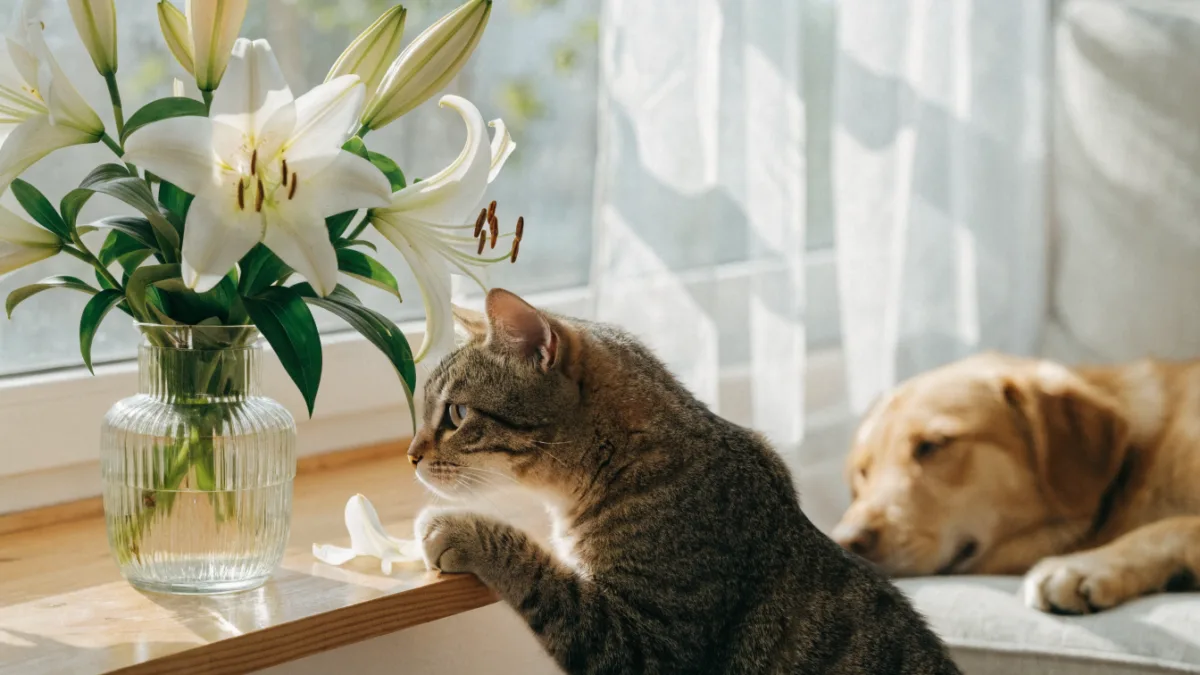
Every year, in the week before Easter, I brace for the phone calls. Someone brought home an elegant white bouquet, left it on the dining room table, and came back to find chewed leaves, a scatter of orange pollen, and a cat looking entirely too pleased with itself. That’s genuinely all it takes. One petal of an Easter lily — even pollen licked off a paw, even a few laps of water from the vase — can trigger acute kidney failure in a cat. And here’s the part that stops people cold: the same flower that can kill a small cat will usually give a large dog nothing worse than an upset stomach.
A post I saw recently from a plant lover captures the moment perfectly — she.[1] of her lily. Her immediate alarm and quick action were exactly the right instincts. Let’s talk about why they were necessary, and why dogs get a pass that cats never will.
Why Lilies Break Cats and Bounce Off Dogs
When clients ask which lilies are toxic to cats, my answer is blunter than they expect: all of them — if they’re true lilies. Only two plant groups cause the deadly kidney damage: true lilies (Lilium species) and daylilies (Hemerocallis species, which aren’t true lilies at all but are every bit as dangerous). Every part is poisonous — petals, leaves, stem, pollen, even the vase water, which is why cat welfare advocates repeat each spring that [2] Cats have died simply from grooming pollen off their own fur.
The species gap comes down to feline metabolism. Cats are missing several of the liver enzymes that make up the glucuronidation pathway — in plain terms, the liver’s chemical tagging system that flags toxins for disposal. Dogs and humans carry it; cats run on a skeleton crew. The lily toxin slips through that gap and is taken up by the cat’s renal tubular cells, the kidney’s microscopic sorting machinery, which it then destroys. Dog kidneys simply don’t take the bait the same way.
Here’s the strange part: for decades, nobody knew what the toxin actually was. Only since around 2019 have researchers isolated compounds called steroidal glycoalkaloids from Easter lily tissue that reproduce the kidney damage in feline cells — the first real break in one of veterinary toxicology’s slowest mysteries, though the full mechanism is still being pieced together.
Gus, a Labrador I treated a few springs ago, hoovered half a bouquet of Stargazers off a counter. His owner spent one messy night with him, and by morning his kidney values were pristine. “He’s a goat with a collar,” she told me, which was fair. But I still don’t recommend lilies even for dog-only households, and I’ll explain why below.
The 72-Hour Timeline of an Easter Lily Emergency
If you learn one thing about lily poisoning, learn this timeline —,[3] and the second act is where well-meaning owners get fooled.
Hours 0–2: The First Wave
Drooling, vomiting, lethargy, refusing food. Some cats paw at their mouths. It looks like a garden-variety stomach upset, which is precisely the problem.
Hours 12–24: The Cruel Trick
The cat seems to recover. Appetite returns, energy picks up, and many owners cancel the vet visit. Meanwhile, the toxin is quietly killing tubular cells inside the kidneys. This deceptive window is where fatal delays happen.
She seemed completely back to normal by morning. I honestly thought we’d dodged it.
That’s what Kiki’s owner told me — an eight-year-old Siamese who arrived at my clinic roughly thirty hours after chewing an Easter lily leaf. By then her kidney values were already climbing. We fought hard for her, and she survived, but her kidneys never fully recovered, and she now needs long-term management. Cats who arrive after that first day face a much poorer prognosis, and cats who stop producing urine altogether may need referral for hemodialysis.
Hours 24–72: The Kidneys Fail
Drinking and urinating dramatically — the kidneys lose their ability to concentrate urine — followed by dehydration, then urination slows or stops entirely. Blood work shows waste products climbing as the filtering system dies. When a cat stops making urine, we’re in the gravest territory.
If Your Cat Touches a Lily, Do This Now
I’ll admit to something I’ve changed my mind on. Early in my career, if a cat had merely brushed against pollen and seemed fine, I’d sometimes suggest watching and waiting. I don’t anymore — not after learning that “fine” is exactly what a poisoned cat looks like at hour eighteen. Treatment started within the first six to eighteen hours carries a good prognosis. Beyond twenty-four hours, it often doesn’t.
- Call first, ask questions later. Ring your veterinarian or a pet poison hotline the moment you suspect contact — don’t wait for symptoms. In the US, that’s the ASPCA Animal Poison Control Center (888-426-4435) or Pet Poison Helpline (855-764-7661). If you’re elsewhere, look up your national animal poison line tonight and save the number; you won’t want to be searching mid-crisis.
- Decontaminate the fur. If there’s pollen anywhere on your cat, wash it off immediately with dish soap or carefully clip the fur — otherwise your cat will ingest it grooming.
- Bring the plant, or a clear photo of the tag and flowers, so it can be identified.
- Skip home remedies. Milk, butter, olive oil — I understand the impulse to do something, but there’s no home antidote for this toxin, and you should never induce vomiting or give any medication unless a veterinarian directs you to.
Know Your Lilies: Deadly, Painful, and Just Pretending
Any list of poisonous plants for cats should put lilies at the top — but “lily” is a junk-drawer word, and the confusion is genuinely dangerous. Here’s the honest breakdown.
The killers (kidney failure in cats)
- Easter lily (Lilium longiflorum)
- Tiger lily (Lilium lancifolium)
- Asiatic and Oriental hybrids, including Stargazer
- Rubrum or Japanese show lily (Lilium speciosum)
- Wood lily (Lilium philadelphicum)
- All daylilies (Hemerocallis species)
The impostors
- Peace lily and calla lily: these carry insoluble calcium oxalate crystals — microscopic needles that cause intense mouth pain, drooling, and pawing. Miserable, but not kidney failure. Still call your vet, but it’s a different kind of emergency.
- Lily of the valley: a cardiac glycoside plant that affects the heart and is dangerous to dogs and cats. Don’t be lulled by the sweet bells.
- Peruvian lily (Alstroemeria): causes only mild stomach upset, not kidney damage. I used to recommend it as a safe swap; I’ve cooled on that, because it looks close enough to true lilies that florists and recipients mix them up — and mix-ups are how tragedies happen.
- Glory lily (Gloriosa superba): no impostor here — genuinely toxic to both species, with multi-organ damage.
Safe Swaps for a Cat-Friendly Spring
You don’t have to give up flowers. You just have to choose differently — and read botanical names on the tag rather than common names.
Bouquet-safe blooms
- Roses (thorns trimmed)
- Gerbera daisies
- Snapdragons
- Sunflowers
- Moth orchids (Phalaenopsis)
Cat-safe houseplants
- Spider plants
- Boston ferns
- Calatheas
- Peperomias
- African violets
- Cat grass — a deliberate, safe sacrifice for the chewers among us
When in doubt, check a plant’s botanical name against a reputable animal-poison database before it comes home. And while we’re doing spring safety: Easter basket grass can cause dangerous intestinal blockages if swallowed, and chocolate deserves its own warning — neither belongs within paw’s reach.
There’s real movement on this issue, too. Animal welfare groups, notably in the UK, have pushed for “toxic to cats” warning labels on lilies and mixed bouquets, and some retailers now include them — progress worth asking for at your own florist. There’s a bittersweet irony underneath it all: the wild wood lily is quietly declining across parts of northeastern North America, browsed back by deer and squeezed out by habitat loss, while its cultivated cousins flood our homes each spring. So here’s my takeaway after years of these cases: lilies are lovely, and cats are cats — curious, indiscriminate, and fast. Until the science is complete and every bouquet carries a label, the safest arrangement in a cat household is the one without a single Lilium or Hemerocallis in it. One bite can cost a kidney; one question at the flower counter can save one.
Sources
- came home to find Miss Kitty had chewed two leaves — reddit.com
- every part of a lily is poisonous — facebook.com
- the signs unfold in three acts — petmd.com