

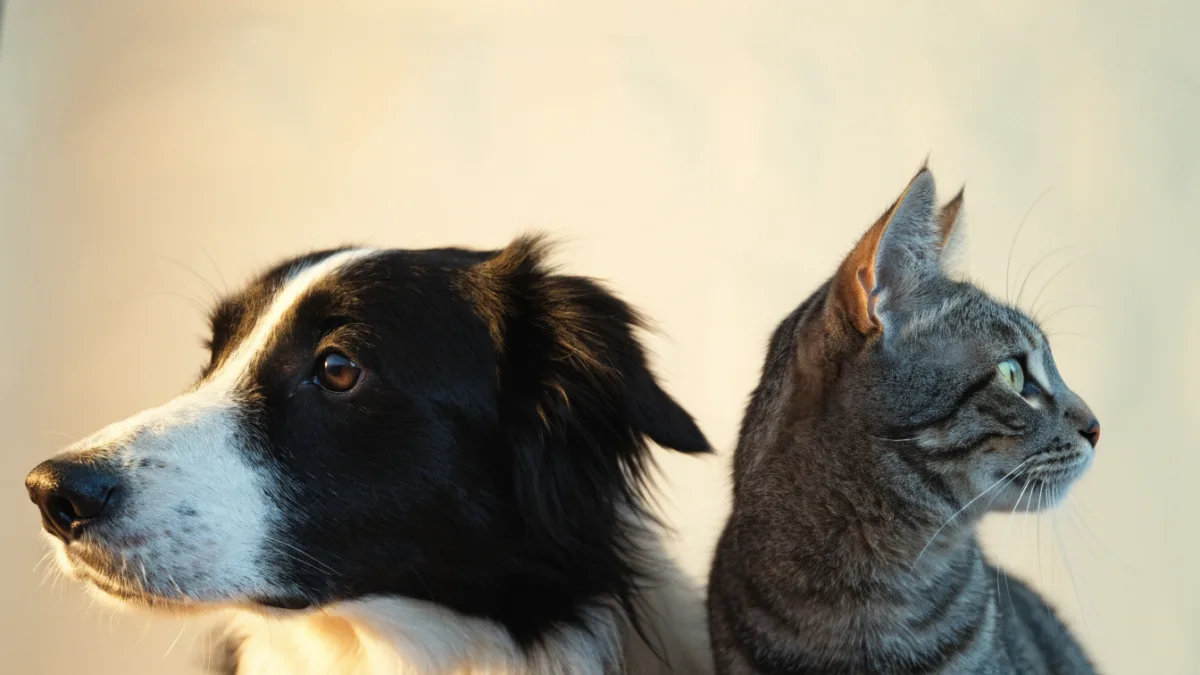
My dog Biscuit and my cat Mochi have completely different operating systems. Last Tuesday, Biscuit spent twenty minutes carefully burying a dental bone under a throw pillow with surgically precise nose-taps. Mochi watched from the bookshelf, then dropped a toy mouse directly onto Biscuit’s head. Same living room, two entirely different evolutionary programs running side by side.
The longer I live with both species, the more I realize most of us understand dogs and cats at a surface level — they’re furry, they’re cute, one fetches, one knocks things off tables. But the biology underneath those behaviors? It’s wildly different, and honestly, way more interesting than the memes suggest. So here’s a deep dive into the science that actually separates Canis familiaris from Felis catus, and why understanding it makes you a better roommate to both.
Sensory Worlds: They’re Experiencing a Completely Different House
The most profound difference between dogs and cats isn’t visible — it’s perceptual. You and your pets are technically sharing the same living room, but they’re interacting with entirely different sensory environments.
The Hearing Gap
Humans max out at around 20,000 Hz. Dogs? They’re catching frequencies up to 45,000–67,000 Hz. Cats blow everyone out of the water at 64,000–85,000 Hz. This is why your cat suddenly stares at a wall looking deeply disturbed — she might be hearing electrical wiring, rodent activity inside the walls, or high-frequency emissions from your electronics that are completely invisible to your experience.
It also explains fireworks phobia in both species. Those explosions produce frequencies that aren’t just loud to them; they’re physically painful at ranges your ears can’t even access. When Mochi vanishes under the bed on New Year’s Eve, she’s not being dramatic. She’s being biologically honest.
Eyes That Glow Different Colors
You’ve noticed those eyeshine photos — dogs reflecting green or yellow, cats flashing back bright green or blue. That’s the tapetum lucidum, a reflective membrane behind the retina that bounces light back through photoreceptors for a second pass. It’s the reason both species see in conditions we’d consider pitch black.
But cats have dogs beat on efficiency. Felines need only one-sixth the light humans require to see clearly. Their tapetum is more structurally refined for low-light detection, which tracks when you remember that cats are crepuscular predators — evolved to hunt at dawn and dusk when light is minimal and prey is abundant.
The color difference comes down to composition. Riboflavin and zinc concentrations vary between species, producing different reflective wavelengths. Dog eyes lean yellow-green. Cat eyes tend toward blue-green or bright green. Same biological mechanism, slightly different chemical recipe.
Purring vs. Sighing: Different Frequencies, Different Functions
Cat purring isn’t just contentment — it’s a biological mechanism operating between 25 and 150 Hertz. That specific frequency range has documented therapeutic effects: promoting bone density, reducing inflammation, and easing respiratory distress. Cats purr when they’re happy, but also when they’re injured, frightened, or giving birth. The vibration appears to function as an internal healing tool.
Dogs don’t have an equivalent. Their contented sigh — that deep exhale where they drop their chin onto their paws — signals genuine relaxation, but it carries no physiological recovery mechanism. It’s emotional communication, not cellular repair. I love Biscuit’s post-walk sighs, but Mochi’s purring is literally doing science inside her body.
Behavioral Instincts: Evolutionary Leftovers in Modern Homes
The weird things your pets do usually have ancient explanations. Understanding the evolutionary origin doesn’t always make the behavior less annoying, but it does reframe it from “my pet is broken” to “my pet is running ancient software.”
Why Dogs Bury and Cats Bunt
Biscuit’s pillow-bone ritual is textbook food caching — a wolf survival behavior. Wild canines bury surplus food to hide it from scavengers, preserving it for leaner periods. Your dog doesn’t need to survive winter, but his genetic programming doesn’t know that.
Cats handle territory differently. Mochi rubs her cheeks on furniture corners, doorframes, and my laptop screen with obsessive dedication. This is bunting — depositing pheromones from scent glands around her mouth and chin. She’s not being affectionate (though it’s lovely when she does it to my ankle). She’s maintaining a scent map that confirms this is her territory and everything in it belongs to her.
The Mirror Question
Neither dogs nor cats pass the traditional mirror mark test for visual self-recognition. Show most dogs a mirror and they’ll investigate behind it, try to initiate play, or lose interest entirely. Cats typically glance, flatten their ears, and walk away with visible contempt.
But animal behaviorists debate whether this actually means they lack self-awareness. Dogs and cats process identity primarily through olfactory information — scent markers — rather than visual appearance. A dog who ignores his reflection might still recognize his own urine markers, his own bedding smell, his personal territory boundaries. The mirror test was designed by humans for a visually-dominant species. Expecting scent-based animals to ace it might be the real failure of methodology.
Genetic Architecture: Why Size and Coats Diverge So Dramatically
The IGF-1 Gene and Why Your Cat Isn’t 200 Pounds
Dogs possess extraordinary genetic plasticity, largely driven by the IGF-1 (Insulin-like Growth Factor 1) gene. This single genetic variation allows dogs to range from a 4-pound Chihuahua to a 200-pound Mastiff — a fiftyfold size difference within one species. Humans spent thousands of years selectively breeding for size extremes, and canine genetics accommodated every request.
Cats? Not even close. Domestic cats stay remarkably consistent, typically 8–18 pounds regardless of breed. The feline genome simply doesn’t carry the same size-variation toolkit. You can breed for coat length, face shape, or ear folding, but you can’t engineer a giant housecat because the underlying genetics refuse to cooperate. Thank goodness, honestly. I love Mochi, but I would not survive a 150-pound version of her 3 AM zoomies.
The Hypoallergenic Reality Check
Here’s where it gets complicated. “Hypoallergenic” is one of the most misunderstood terms in pet ownership. Allergies aren’t triggered by hair length — they’re caused by specific proteins. Cats produce Fel d 1; dogs produce Can f 1. These proteins live in saliva, urine, and skin cell secretions, not the fur itself.
Curly-coated dogs and Rex-type cats may distribute less dander into the environment because their coat texture traps shed skin cells closer to the body. But they still produce the allergen. Some individual animals naturally produce less Fel d 1 or Can f 1, which is why one specific cat might bother your allergies while another doesn’t. But no breed is truly hypoallergenic. If someone tells you otherwise, they’re selling something.
Health Myths That Need to Die
The Dry Nose Panic
A friend once called me at midnight because her dog’s nose felt warm and dry. She was convinced he had a fever. He’d been sleeping in a heated room for three hours.
Nose moisture fluctuates constantly based on humidity, activity level, sleep cycles, and ambient temperature. A dry nose means… the air is dry, or your pet just woke up. It is not a reliable health indicator. What actually matters: energy levels, appetite, gum color, breathing patterns, and bathroom habits. If those are normal, the nose is irrelevant.
When Panting Means Something Different
Dogs pant constantly — after walks, during play, in warm weather. It’s their primary thermoregulation system, evaporating moisture from the tongue and respiratory tract to cool the bloodstream.
Cats? A panting cat is usually an emergency. Felines cool themselves primarily through their paw pads and grooming (evaporating saliva from their fur). When a cat open-mouth pants, it typically indicates severe cardiovascular distress, extreme heat exhaustion, or acute respiratory crisis. If your cat is panting and hasn’t been exercising intensely in extreme heat, call your vet immediately.
Same behavior, completely different biological meaning depending on the species. This distinction genuinely saves lives.
The Bigger Picture: What Wild Instincts Mean for Wildlife
Understanding where your pets’ behaviors come from — the hunting drives, the territorial marking, the scent-tracking compulsions — also means recognizing that cats, in particular, haven’t fully left their wild origins behind.
The International Union for Conservation of Nature lists feral and free-roaming domestic cats among the world’s most destructive invasive species. Outdoor cats are responsible for the extinction of dozens of bird and small mammal species globally. When Mochi deposits a toy mouse on my pillow, she’s performing a redirected hunting behavior that, in an outdoor context, has genuine ecological consequences.
Keeping cats indoors — or in enclosed outdoor spaces like catio structures — protects both wildlife and the cats themselves from vehicles, predators, parasites, and disease. Biscuit’s evolutionary impulses get channeled into fetch and structured walks. Mochi’s hunting instincts get satisfied with puzzle feeders and wand toys. Neither animal needs to actually hunt to live a fulfilled, instinctively rich life.
The more we understand about what makes dogs and cats biologically unique — their sensory ranges, their genetic histories, their evolutionary hardwiring — the better equipped we are to provide environments that honor those differences. Not by treating them like small humans in fur coats, but by meeting them on their own terms, in the worlds they’re actually built to perceive.