

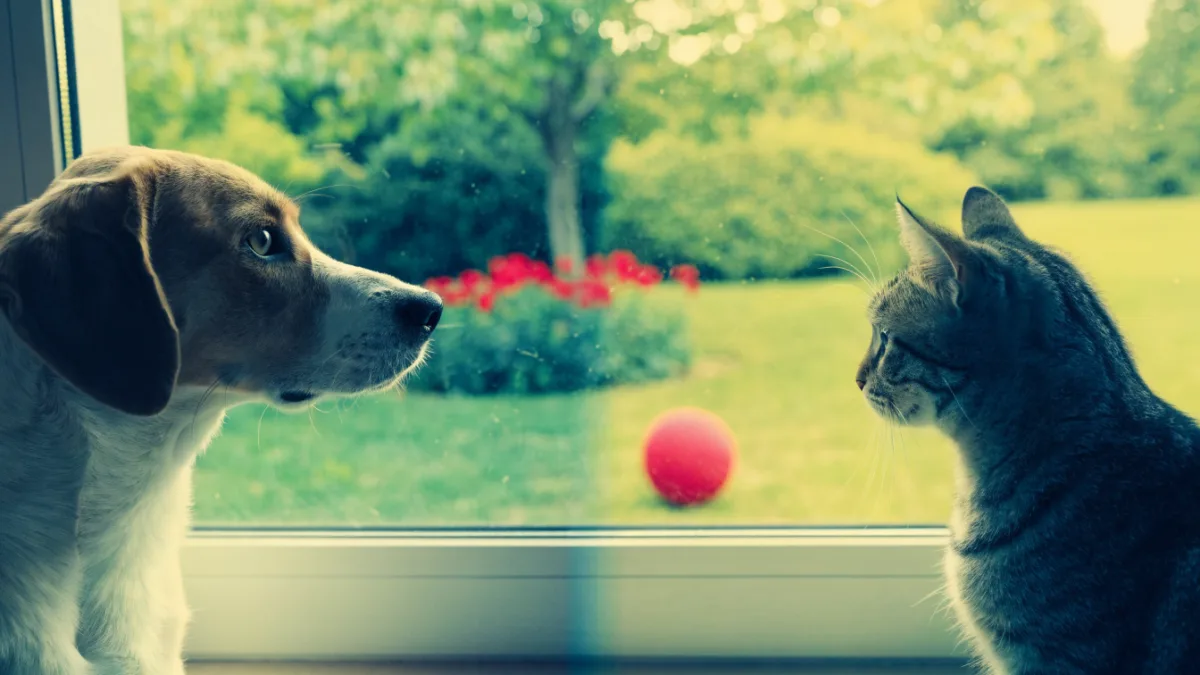
I spent three years buying my cat Mochi bright red mice. She loved them — batted them under the fridge, lost them in sofa cushions, screamed at me until I fished them out. Then I learned how cats actually see color, and I realized I’d been handing her a toy that basically vanished into our green rug the moment she set it down. I felt like a monster. A well-intentioned, slightly oblivious monster.
Once you understand what dogs and cats are actually looking at when they look at you, a lot of baffling pet behavior suddenly clicks into place. The ignoring-you-from-across-the-dog-park thing. The 3 a.m. zoomies. The way your cat stares at seemingly nothing on the wall and you convince yourself your apartment is haunted. It’s not ghosts. It’s rods and cones.
No, the World Isn’t a Vintage Television
Let’s clear this up right now because it’s the myth that will not die: dogs and cats do not see in black and white. I don’t know who started this rumor, but it’s been lurking in playground conversations and Facebook comments for decades, and it needs to stop.
Here’s what’s actually happening. Human eyes have three types of cone cells — the photoreceptors responsible for color vision — which lets us detect red, blue, and green light. Dogs and cats only have two types. This means their world is built primarily from blues, yellows, and grays. Red and green? Those collapse into muddy browns, dark yellows, and grays. It’s similar to red-green color blindness in humans, which affects about 8% of men (and a smaller percentage of women).
That bright red squeaky ball you tossed onto the green lawn? To your dog, it basically turned invisible. You’ve been playing an accidental magic trick this whole time.
So Mochi wasn’t ignoring her red mice out of spite. She genuinely had trouble spotting them against our forest-green carpet. The second I switched to a yellow crinkle ball, her “hunting” success rate went through the roof. She went from squinting and pawing randomly to actual precision pounces. Small change, huge difference.
The Blur Is Real (and Explains a Lot)
Acuity: They’re Not Reading Eye Charts Anytime Soon
Color aside, the sharpest thing about your pet’s vision is probably their sense of smell. Visual acuity — the crispness and detail of what they see — is significantly lower than ours. If you have 20/20 vision, you’re seeing the world in high definition. A dog typically has around 20/75 vision, meaning what you can read clearly at 75 feet, they need to be 20 feet away to see with the same clarity. Cats are even blurrier, somewhere in the 20/100 to 20/200 range, though there’s genuine debate among veterinary ophthalmologists about the exact number since cats famously refuse to cooperate with standardized testing. (Relatable.)
What this means in practice: when you’re standing still across a field and your dog isn’t coming, or your cat is staring blankly past you, they might genuinely not recognize you. Your silhouette isn’t enough. They need your scent carried on the breeze, or they need you to move.
Why Movement Trumps Everything
Dogs can spot a waving hand from up to half a mile away. A still human at 50 feet? Basically a bush. This is why my dog Pepper — a scruffy terrier mix I adopted five years ago — would lose her mind with joy when I waved frantically at the dog park but barely reacted when I stood still calling her name. She wasn’t being stubborn. She literally couldn’t see me well enough to know it was me.
This preference for motion over detail is hardwired from thousands of years of evolution. Cats evolved as crepuscular ambush predators — most active at dawn and dusk — hunting small, fast-moving prey in low light. They didn’t need to read the fine print on a mouse. They needed to detect the twitch of a mouse. Dogs evolved as pack hunters on open plains, tracking prey across vast distances. Spotting the gallop of a deer from far away mattered more than noting its exact shade of brown.
Night Vision That Puts Us to Shame
Where dogs and cats absolutely demolish humans visually is in the dark. It’s not even close.
The secret starts with rod cells — the photoreceptors that handle low-light vision and motion detection. Humans have roughly 120 million rods. Cats? Around 250 million. Dogs also out-rod us significantly. Then there’s the tapetum lucidum, a mirrored layer behind the retina that bounces light back through photoreceptor cells a second time, essentially giving every photon a second chance to be detected. It’s why your pet’s eyes glow like tiny headlights when a flashlight hits them in the dark. That eerie green reflection isn’t supernatural — it’s an evolutionary advantage.
Combined, these features mean cats can see in light levels about six times dimmer than what humans need. Not total darkness — the “cats can see in pitch black” claim is a slight exaggeration — but close. This is why Mochi navigates our apartment at 2 a.m. with zero hesitation while I’m stubbing my toe on every piece of furniture I own.
Those Vertical Pupils Aren’t Just for Aesthetics
Cat pupils are engineering marvels. Those vertical slits can dilate into enormous round circles in dim light, letting in maximum illumination. In bright sunlight, they can close down to near-invisible lines, protecting their sensitive retinas from overexposure. Dog pupils are round like ours, but they still dilate and contract significantly more than human pupils do.
The wide-set placement of their eyes also gives both species a broader field of view than we have. Dogs see about 240 degrees around them. Cats manage roughly 200 degrees. Humans sit at 180. Your pet literally has eyes in the back of their head — almost.
Practical Takeaways for the Vision-Aware Pet Parent
Toy Shopping Actually Matters
Knowing the blue-yellow spectrum thing should genuinely change how you shop. Blue and yellow toys provide maximum contrast against green grass, brown dirt, and most household surfaces. Red toys — the most common color in every pet store — are basically camouflage.
I now buy exclusively blue and yellow toys. It feels slightly absurd to be color-coordinating enrichment items based on dichromatic vision research, but Pepper finds her ball in tall grass about ten times faster now, and the payoff is worth looking like someone who takes fetch a little too seriously.
Does the TV Actually Entertain Them?
This is where it gets genuinely interesting and a little controversial. Older CRT televisions refreshed images at around 60Hz, which looked like a flickering strobe light to dogs (who process visual flickers at 70-80Hz). They weren’t really “watching” — they were seeing a slideshow of uncomfortable flashing.
Modern 4K televisions and high-refresh-rate screens have changed the equation. Many veterinarians now believe contemporary pets can perceive TV images far more clearly than we previously thought. There’s even a growing market for pet-specific visual enrichment — videos designed with blue-yellow color palettes, specific motion speeds, and refresh rates calibrated to animal vision. Whether your cat actually enjoys the “Bird TV” compilation you left playing or just likes the sound is still up for debate. But the visual component is more real than we once assumed.
When Vision Fails: Hope on the Horizon
Some dogs inherit degenerative retinal diseases that lead to blindness — conditions that have historically been untreatable. But recent breakthroughs in veterinary ophthalmology are genuinely remarkable. Gene therapies originally developed for rare human blindness conditions like Leber congenital amaurosis are now being successfully adapted for dogs with similar inherited disorders. We’re talking about treatments that can restore vision to animals that would have gone permanently blind just a decade ago. If your pet is dealing with vision issues, talk to your vet — there are more options now than ever.
And please, if you have a cat with access to the outdoors, consider what those superpowered eyes are actually for. That same night vision and motion detection that makes cats such phenomenal hunters also makes them one of the most ecologically destructive invasive species on the planet. Free-roaming outdoor cats kill billions of native birds and small mammals annually. Mochi is strictly indoor — partly for her safety, partly because the local sparrows don’t stand a chance against 250 million rod cells and a set of claws she maintains with unsettling dedication. A good window perch gives her all the visual enrichment without the body count.
Understanding how our pets see the world doesn’t just satisfy curiosity. It makes us better companions. Once you know their world is blurrier, bluer, and more motion-obsessed than yours, you stop expecting them to process things the way you do — and start meeting them where they actually are.