

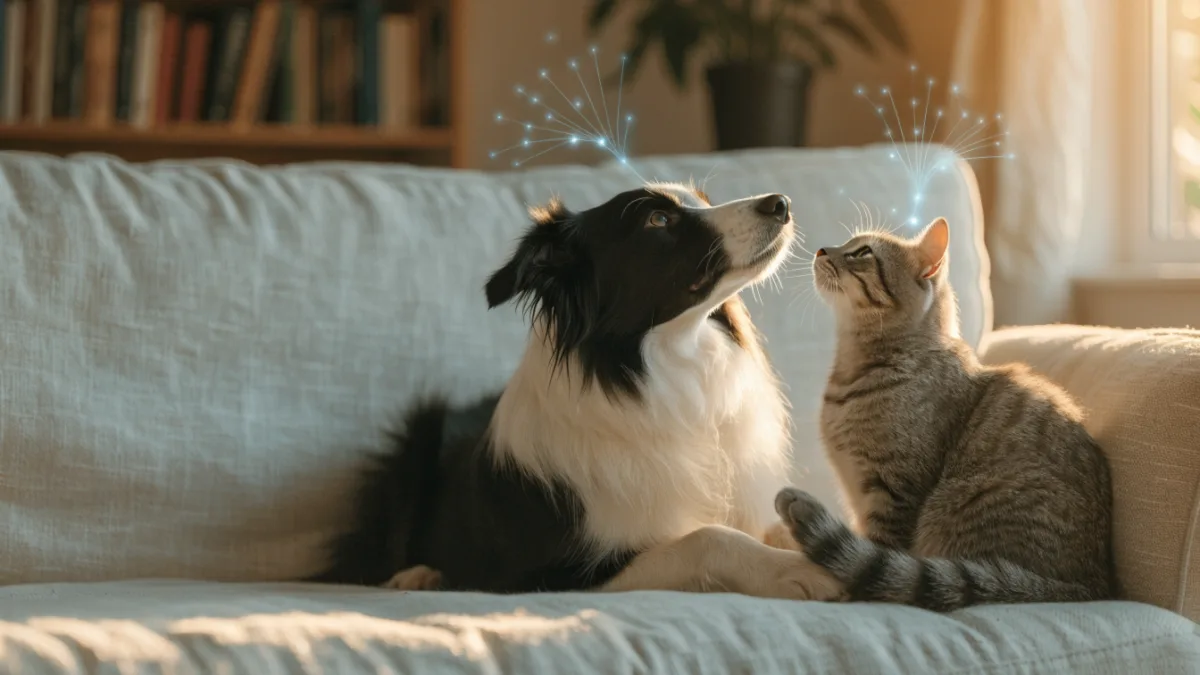
I’ve got a buddy, Mark, who swears up and down that his dog loves him, but his cat is just using him for free rent and a steady supply of kibble. He’ll drop that old cliché every time we hang out in his garage: “Dogs have owners, cats have staff.”
I used to nod along with him. For a long time, a lot of us accepted that dogs were the affectionate ones, and cats were just aloof, independent roommates who tolerated our existence. But the science tells a completely different story. And once you dig into the neurological differences in how dogs and cats form attachments to humans, you realize that comparing dog affection to cat affection is like comparing a loud, sweaty rock concert to a quiet, handwritten poem. They’re both art, but they use entirely different mediums.
The “Love Hormone” Isn’t Just for Dogs
When we talk about love and bonding—whether it’s between two humans or a human and a pet—we have to talk about oxytocin. It’s a neuropeptide produced in the hypothalamus, and it’s the exact same neurochemical responsible for bonding human mothers to their newborn babies.
For a long time, researchers focused almost exclusively on dogs when studying the human-animal bond. And the results were pretty wild. Studies showed that dogs can experience up to a 60% increase in oxytocin levels just from interacting with their owners. That sustained eye contact your dog gives you? It literally floods their brain with the same chemical that bonds a mother to her child.
But here’s where the old narrative falls apart. Modern neuroimaging and behavioral studies show that cats experience significant oxytocin spikes, too. The underlying brain chemistry is fundamentally the same. When your cat curls up in your lap, their brain is releasing the exact same “love hormone” as a dog’s does. They aren’t just opportunistically trying to steal your body heat; they are experiencing genuine chemical attachment to you.
Why Feline Affection Looks So Different
So, if the brain chemistry is practically identical, why do cats act so differently? Why is a Golden Retriever practically dragging you across the sidewalk to say hello, while a cat might just stare at you from the top of a bookshelf?
It all comes down to evolution and survival strategies.
Dogs evolved as pack animals. They survived by cooperating to hunt, raise young, and protect each other. For a pack animal, communication needs to be loud, highly visible, and obvious. A dog that jumps, barks, and wags its entire body is speaking a language that evolved to be seen and heard across a wide distance.
Cats, on the other hand, evolved as solitary hunters. In the wild, a cat’s survival depends on stealth. Being overt, loud, and visibly emotional is a massive disadvantage when you’re trying to avoid predators or sneak up on prey. Because of this, the feline “love language” became highly nuanced. To a cat, shouting “I love you” from the rooftops is basically asking to get eaten. They show affection, but they do it quietly, through subtle micro-expressions and body language that you have to learn to read.
Cracking the Feline Love Code
If you don’t know what to look for, it’s easy to assume your cat is just indifferent. But once you decode their specific behaviors, you’ll realize they are constantly telling you they care. There are some great resources out there—from animal behaviorists breaking down feline body language to online communities dedicated to,[1]—but here are the core behaviors to watch for:
The Slow Blink
If your cat looks at you and slowly closes and opens their eyes, they are giving you a “cat kiss.” In the wild, closing their eyes around a potential threat is incredibly dangerous. Doing it to you indicates ultimate trust and relaxation.
And it’s not just a cute theory. A breakthrough 2020 study from the University of Sussex scientifically validated this behavior. They proved that cats are more receptive to humans who perform the slow blink back. It marked the first quantitative evidence of this specific feline-human communication channel.
Bunting and Head-Rubbing
Cats have specialized scent glands located all over their heads—around their mouths, on their chins, and at the base of their ears. When they rub their face against your leg or bonk their head into your hand, they are depositing pheromones. This isn’t just marking territory; it’s depositing a chemical signature that identifies you as part of their safe, familial group. They are claiming you as their own.
Making Biscuits
You know the drill. Your cat hops onto your lap and starts rhythmically pressing their paws into your stomach, alternating left and right. This is a leftover behavior from kittenhood, used to stimulate milk flow from their mother. When an adult cat does this, it signifies extreme comfort and safety. They literally associate you with the unconditional care of their mom.
Purring
Cats purr for a few reasons, including self-soothing when they are stressed or injured. But when they are curled up next to you and purring at specific frequencies, it’s a direct expression of contentment and affection.
Reading Canine Affection (Without the “Alpha” Nonsense)
Now let’s shift back to the dogs. We usually don’t struggle to notice when a dog loves us—they make it impossible to ignore. But it’s important to actually understand what those behaviors mean, because there’s been a lot of bad information floating around for years.
I used to buy into the old dominance theory stuff early in my career. I thought a dog leaning against your leg was trying to assert themselves, or that excited greetings were a dog trying to show submission to the human “pack leader.” I was completely wrong, and modern behavioral science has moved entirely away from that outdated thinking.
A dog’s physical closeness is about secure attachment, not submission.
Sustained eye contact is a massive display of trust for a dog. While you definitely want to avoid hard, prolonged staring at a strange dog, the soft, relaxed eye contact your own dog gives you is driving that oxytocin loop we talked about earlier. It builds the bond.
And the lean. When a dog walks over and puts their entire body weight against your leg, they aren’t pushing you. They are actively seeking physical contact and comfort. It’s the canine equivalent of a hug.
The Secure Attachment Breakthrough
If you still have doubts about feline affection, the most compelling evidence comes from recent behavioral studies on attachment styles.
For a long time, a debate raged in the scientific community: do cats actually love their owners, or are they just manipulative opportunists securing food and shelter? Early ethologists argued that cats were just using us.
But recent studies, notably from Oregon State University, put this debate to rest. Researchers found that cats display the exact same “secure attachment” styles to their owners as human babies and dogs do.
What does secure attachment look like? In the studies, a cat is placed in an unfamiliar room with their owner. The cat uses their human as a base of psychological safety to explore the new environment. When the owner leaves, the cat shows signs of stress. But crucially, when the owner returns, the securely attached cat’s stress levels drop, and they return to exploring. They aren’t just using you for a bowl of food; they are using your presence to regulate their own nervous systems. That is the literal definition of emotional attachment.
How to Talk Back
Understanding this science isn’t just trivia. It gives you a playbook for strengthening your bond with your pets. If you want to see [2] you have to learn to speak their language.
If you have a cat, try the slow blink. The next time you catch your cat staring at you, don’t walk over and try to scoop them up right away. Just look back, slowly close your eyes, keep them closed for a second, and slowly open them. You’ll be amazed at how often the cat will slow blink back at you. It’s a powerful way to build mutual trust without forcing physical interaction they might not want. Cat experts, like,[3] often emphasize that meeting a cat where they are is the key to unlocking their affection.
If you have a dog, lean into the eye contact. When they look at you with those soft, relaxed eyes, smile back and hold the gaze. Let them lean on you. You don’t need to ignore them to establish boundaries, and you definitely don’t need aversive tools like shock collars or prong collars to “show them who’s boss.” Just be the safe space they already think you are.
Whether you share your home with a loud, tail-wagging goofball, or a stealthy, biscuit-making panther, the love is absolutely real. The chemistry doesn’t lie. Understanding the behavioral needs and emotional capacities of our domestic pets isn’t just about having a well-behaved animal; it’s about domestic welfare. It’s our responsibility to ensure that the creatures we brought into our homes experience the emotional and psychological well-being they deserve. Once you learn to decode their unique love languages, you realize that the old adage is completely backwards. You aren’t just a staff member to your cat, and you aren’t just an owner to your dog. You are their family.
Sources
- understanding your cat's love language — facebook.com
- exactly how your cat says "I love you" — instagram.com
- Jackson Galaxy — tiktok.com