

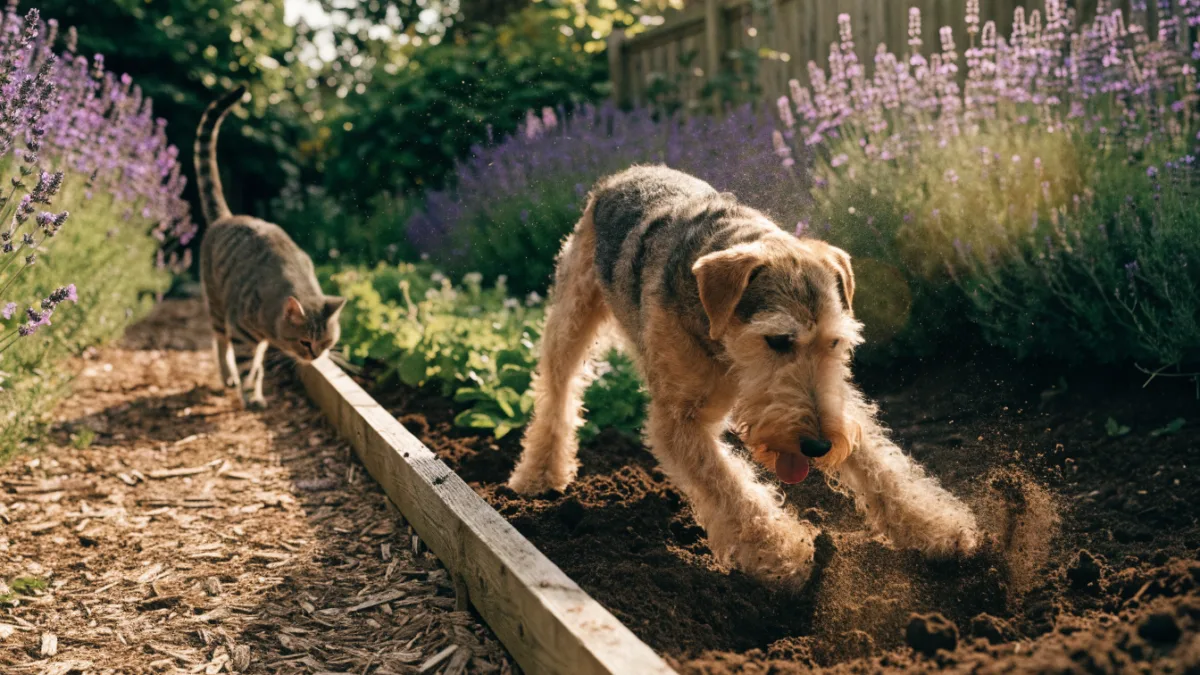
If you’ve ever spent a weekend carefully planting tomatoes only to find your cat using the raised bed as a personal litter box by Tuesday, you already know that animals operate on an entirely different wavelength than gardeners. My cat Mochi treats my herb garden like an all-you-can-sniff buffet, and the neighbor’s terrier has claimed one specific patch of mulch as his archaeological dig site. They’re not being jerks — they’re being dogs and cats. Your yard is basically a sensory amusement park, and understanding why they’re drawn to it is the first step toward redirecting that enthusiasm somewhere less destructive.
The Nose Knows: Your Yard Is a Scent Map
Here’s the thing that’s easy to forget when you’re standing in your backyard admiring your hydrangeas: you’re seeing maybe one percent of what your dog or cat is experiencing. The other ninety-nine percent is invisible to you, and it’s all happening at nose level.
Dogs and cats experience the world primarily through their olfactory systems. A single patch of yard can contain scent trails left by mice traveling along the fence line, a raccoon that cut through at 3 AM, or the neighborhood cat who marked your garden gate last week. To an animal with millions of scent receptors, your yard isn’t just grass and soil — it’s a constantly updating newspaper. As one,[1] animals are naturally drawn to spaces where their behaviors are rewarded, and following an interesting scent trail is deeply rewarding to a predator.
This is why your dog might fixate on one corner of the lawn and ignore the rest. There’s a story happening in that soil — maybe a vole tunnel, maybe remnants of last fall’s buried acorn — and your dog needs to know how it ends.
Why That Specific Garden Bed Keeps Getting Destroyed
The Digging Instinct
Dogs dig. It’s not a character flaw; it’s biology. Loose, freshly aerated garden soil is basically a canine spa treatment. It’s soft enough to move quickly, cool underneath (which helps with body temperature regulation), and often full of interesting smells from the compost you worked in last month. My friend’s husky once excavated an impressively deep hole in a single afternoon because she’d buried a chew bone there three weeks earlier. The memory was flawless. The petunias were not.
The Feline Litter Box Alternative
Cats have their own logic, and it’s equally frustrating for gardeners. Loose, dry soil or sand mimics the texture cats instinctively seek for elimination — it’s easy to dig in, easy to bury in, and feels an awful lot like the litter they’ve been using indoors. A freshly mulched garden bed doesn’t read as “carefully curated landscape” to a cat. It reads as a luxury bathroom facility, thoughtfully provided.
This isn’t stubbornness or spite. Cats are hardwired to seek out diggable substrate for their waste, and your herb garden happens to be the premium option in the neighborhood.
Building the Invisible Fence: Scent Deterrents That Actually Work
Since animals are following their noses into your garden, the most effective deterrents work through that same channel. The goal isn’t to punish — it’s to make your yard less interesting than the alternatives.
- Citrus peels: Scatter orange and lemon rinds around vulnerable plants. Most cats and dogs find citrus overwhelming and will avoid the area. Plus, you have an excuse to eat more oranges.
- Coffee grounds: Sprinkle used grounds around garden perimeters. The bitter scent is unappealing to many animals, and it doubles as a mild fertilizer.
- White vinegar: As,[2] undiluted white vinegar creates a temporary scent barrier that neutralizes the attractive odors drawing animals in. Spray it around borders, but avoid direct contact with plant leaves.
A word of caution: skip the cayenne pepper. I’ve seen this recommended constantly, and I understand the impulse, but it can actually burn an animal’s mucous membranes. Some essential oils, particularly tea tree, citrus, and pine oils, are also toxic to cats — so don’t go pouring those around your beds either. Natural doesn’t automatically mean safe.
Physical Barriers and High-Tech Solutions
Scent deterrents work best as part of a layered approach. Sometimes you need something more immediate.
Motion-activated sprinklers are one of my favorite options because they’re humane, effective, and slightly hilarious. When an animal crosses the sensor, they get a quick burst of water — startling but completely harmless. It’s the equivalent of getting sprayed with a hose, which most dogs and cats find memorable without being traumatic.
The newer ultrasonic deterrents — solar-powered stakes that emit a high-frequency sound when triggered by motion — are increasingly popular. They’re inaudible to most humans, which makes them appealing for suburban yards. However, animal welfare groups rightly point out that these devices should be positioned thoughtfully. They can cause stress to your own pets, and there’s concern about their impact on local wildlife. I’d use them as a last resort rather than a first line of defense.
For physical barriers, consider what:[3] hardscaping elements like decorative rocks, low fences, or thorny plant borders can make certain areas simply less pleasant to walk through. If the path of least resistance leads elsewhere, most animals will take it.
The Redirect: Give Them What They Actually Want
This is the part that changed my entire approach to coexisting with pets in the yard. Modern animal behaviorists consistently emphasize that aversive techniques alone — spraying water, yelling, using sonic devices — don’t actually teach an animal what to do instead. They just create anxiety and erode trust.
The principle of “repulsion versus attraction” is simple: make the garden less appealing and make an alternative space more appealing. You have to offer a deal they want to take.
If your dog is a digger, build them a designated digging zone. A simple sandbox or corner filled with loose soil, partially buried toys, and high-value treats becomes the obvious choice. Reward them for digging there. Make it the most interesting square footage in the yard. For dogs specifically, I’d defer to a qualified trainer for guidance on reinforcing this — my colleague Jake has forgotten more about canine behavior than I’ll ever know — but the underlying principle is giving them a legal outlet for a natural drive.
If neighborhood cats are the issue, eliminating attractants matters as much as adding deterrents. Secure your trash bins. Clean up fallen fruit. And please, don’t leave pet food outdoors — you might as well put up a neon sign that says “free buffet, all welcome.”
The Wild Card: Your Yard Exists in an Ecosystem
Here’s where I get a little serious, because this matters more than most people realize. Free-roaming cats — both pets and ferals — are responsible for the deaths of billions of songbirds and small mammals every year. Free-roaming dogs harass wildlife, spread disease, and disrupt local ecosystems. When we talk about keeping animals out of our yards, we’re not just protecting our tomatoes. We’re reducing the footprint of domestic pets on vulnerable wildlife populations.
If neighborhood cats are a persistent issue, look into whether your community has a Trap-Neuter-Return (TNR) program. These initiatives humanely reduce feral populations over time without the ethical problems of culling or relocation. They’re not an instant fix, but they address root causes in ways that no amount of citrus peels ever will.
The bigger picture is this: the same instincts that draw animals into our yards — curiosity, hunting drive, territorial marking, the search for comfort and safety — are what make them who they are. We can redirect those instincts without fighting them. We can protect our gardens and our local wildlife simultaneously. We just have to work with animal nature instead of against it, and accept that our yards were never really ours alone to begin with.
Sources
- discussion on animal behavior explains — pets.stackexchange.com
- this collection of deterrent methods notes — facebook.com
- pet-aware landscaping resources suggest — turffactorydirect.com