

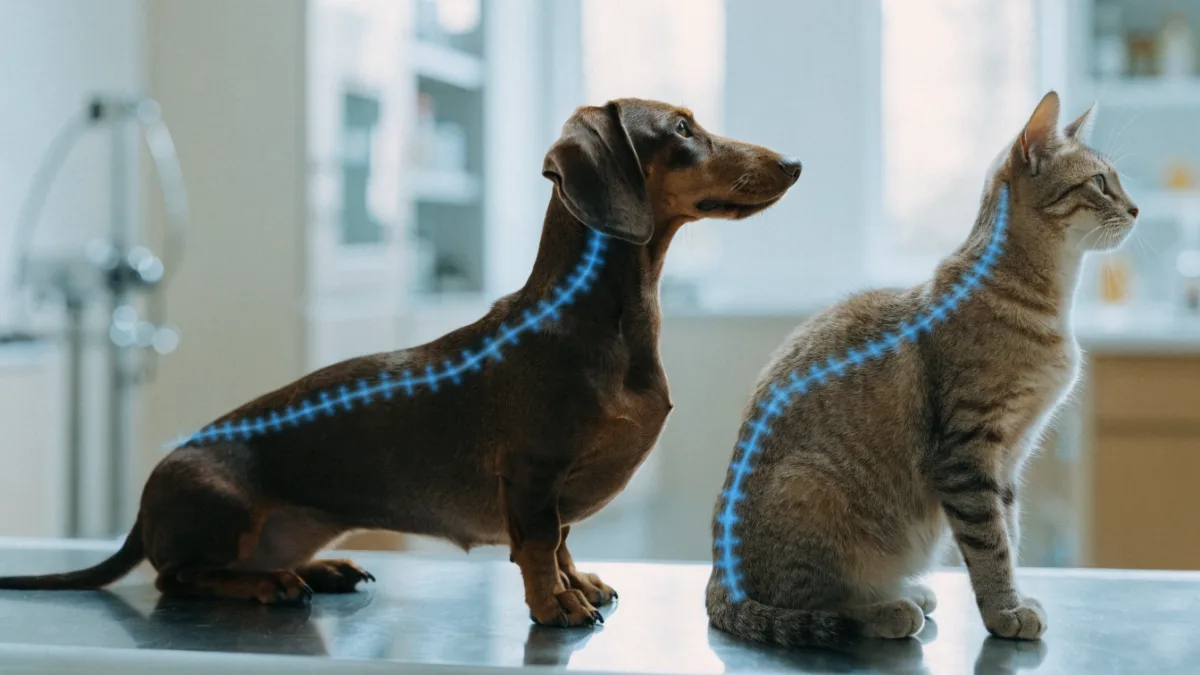
Just last week, I had a frantic call from a client named Sarah. Her four-year-old Dachshund, Jasper, had jumped off the couch, let out a sharp yelp, and was suddenly refusing to walk. When she brought him in, Jasper was standing with his back arched like a cat, trembling. On the exact same day, I saw an eleven-year-old domestic shorthair named Luna. Her owner noticed she was dragging her left hind leg and crying when picked up. Both owners asked the same frantic question: “Did my pet slip a disc?” The answer highlights a fascinating, and sometimes frustrating, reality in veterinary medicine. A slipped disc in pets is a frequent, almost expected phenomenon in certain dog breeds, but an incredibly rare anomaly in cats. Let’s walk through why these two species respond so differently to spinal wear and tear, and what you need to know if you share your home with a low-slung dog.
The Anatomy of a “Slipped Disc”
Before we dive into why Dachshunds and cats have such different spinal destinies, it helps to understand what a slipped disc actually is. Medically, we call this Intervertebral Disc Disease (IVDD). Between the bones of your pet’s spine (the vertebrae) are tiny, rubbery cushions called intervertebral discs. Think of each disc as a jelly donut. The tough outer layer (the pastry) is called the annulus fibrosus, and the squishy, gel-like center (the jelly) is the nucleus pulposus.
When a disc “slips”—which, by the way, is a bit of a misnomer since the disc doesn’t actually slide out of place—it either bulges or ruptures. That jelly-like material escapes and presses painfully against the delicate spinal cord and the surrounding nerves. Whether you call it a herniated, ruptured, bulging, or slipped disc, the result is the same: a painful pinching of the nerves.
Not All Discs Are Created Equal
In veterinary neurology, we generally categorize IVDD into two main types, and knowing the difference helps explain why symptoms vary so much:
- Hansen Type I: This is the classic, sudden rupture. The “jelly” inside the disc becomes brittle and hardens prematurely. One day, a simple jump or twist causes the outer layer to tear, and the hardened material shoots upward into the spinal canal. This causes intense, sudden pain and can lead to rapid paralysis.
- Hansen Type II: This is a slower process. The outer layer of the disc simply weakens and bulges outward over months or years, pressing against the spinal cord. It’s less dramatic than Type I but causes chronic, progressive pain and weakness.
The Dachshund Dilemma: Why Dogs Are Prone to IVDD
If you own a Dachshund, Corgi, Beagle, or Basset Hound, you probably already know the statistics. Up to 25% of Dachshunds will experience a spinal injury in their lifetime. When Jasper the Dachshund jumped off that couch, he was succumbing to a genetic reality.
Dogs with long backs and short legs have a condition called chondrodystrophy. This is just a fancy medical term for abnormal cartilage development. In these dogs, the cartilage in their spinal discs begins to degenerate and calcify (turn to bone-like material) while they are incredibly young—often by the time they are one or two years old. Instead of acting like squishy shock absorbers, their discs become brittle time bombs waiting for the wrong twist or jump. This makes Hansen Type I injuries incredibly common in these breeds.
Recent advancements in canine genetics have actually isolated the specific DNA markers—specifically the FGF4 retrogene—responsible for this chondrodystrophy. This means we can now test dogs to see if they carry the genetic predisposition for early disc degeneration.
The Stair and Sofa Debate
When it comes to preventing dog IVDD, I’ve seen my share of well-meaning but extreme advice. In the exam room, I often have to mediate between partners arguing over whether the dog is allowed on the furniture. I’ll be honest: I’ve changed my mind on this over the years. Early in my career, I told all my clients with long-backed breeds to carry their dogs up and down stairs and ban them from the couch entirely.
However, while keeping your dog lean and preventing reckless, high-impact jumping is universally recommended, there’s ongoing debate over whether wrapping them in bubble wrap actually prevents the genetic inevitability of disc degeneration. Some researchers and breeders argue that because the discs are degenerating at a cellular level from birth, environmental limits only restrict the dog’s quality of life without truly changing the underlying risk. My current advice? Use ramps for high places, keep your dog at an ideal weight to reduce strain on the spine, and use a harness instead of a neck collar on walks. But don’t be afraid to let your dog be a dog.
The Feline Exception: Why Cats Are Spared
Now, let’s talk about cats. Why is a cat back injury so much less common? Simply put, cats are not bred for chondrodystrophy. Their genetics dictate a normal, resilient spinal structure. Their discs act like proper shock absorbers well into their senior years.
Because their discs are so healthy, when a cat does come into my office with sudden back pain or paralysis, a spontaneous slipped disc is the last thing on my radar. In cats, acute spinal issues are almost always the result of severe physical trauma. They’ve fallen from a balcony, been hit by a car, or gotten their tail caught in a door, fracturing a vertebra. When Luna the tabby came in dragging her leg, we didn’t immediately assume her discs had given out; we had to rule out trauma and other feline-specific emergencies.
That said, cats aren’t completely immune. When we do see spontaneous IVDD in cats, it usually looks very different. It tends to happen in older cats and mimics Hansen Type II in dogs—a slow, gradual bulging of the disc rather than a sudden explosion of disc material. A major, newly published 2025 systematic review by R. Ebeling and colleagues has brought much-needed attention to this exact topic, confirming that while rare, feline IVDD does happen and presents identically to canine IVDD.
The Danger of Misdiagnosis in Cats
Because feline IVDD is so rare, there’s an ongoing discussion in the veterinary community about how often it is missed. When a cat suddenly can’t use its back legs, our minds immediately jump to a aortic thromboembolism—a devastating blood clot that blocks blood flow to the hind limbs, which is unfortunately common in cats. It also looks very similar to a pelvic fracture from an unwitnessed fall.
If we assume it’s a blood clot and it’s actually a ruptured disc, the cat isn’t getting the right treatment. This is why advanced imaging, like an MRI, is absolutely crucial for cats presenting with sudden hind-end weakness. We can’t just assume; we have to look.
Recognizing a Spinal Crisis
Whether you have a genetically predisposed Dachshund or a spry domestic cat, recognizing the signs of a spinal injury early is the best thing you can do for them. Dogs will often give you very clear signs. They might cry out or yelp when touched or lifted, tremble, walk with a hunched posture, or develop what we call a “drunken sailor” walk—where their back legs wobble and cross over each other (a clinical sign we call ataxia, meaning incoordination).
Cats, true to their nature, are much harder to read. Felines are evolutionary masters at hiding pain and vulnerability. A cat with a spinal injury won’t usually yelp. Instead, they might simply hide under the bed, stop jumping onto their favorite perches, refuse to eat, or stop using the litter box because posturing to urinate hurts too much. If you notice a sudden change in your cat’s mobility or hiding habits, it’s always worth a check-up.
Red Flags That Require Immediate Care
Regardless of the species, there are specific symptoms that constitute a true medical emergency. If you see any of the following, don’t wait for an appointment—head to the nearest emergency vet:
- Sudden weakness (paresis) or complete inability to move the hind legs.
- Complete paralysis.
- Urinary or fecal incontinence (a sign that the nerves controlling the bladder have been compromised).
- A loss of “deep pain perception,” meaning the pet doesn’t feel it when you pinch their toes. This is the most severe stage of spinal cord compression.
Treatment Avenues: From Rest to Surgery
If your pet does suffer a slipped disc, the treatment path depends entirely on the severity of the injury. For mild cases where the pet is in pain but can still walk, we start with strict cage rest and anti-inflammatory medications. I cannot stress the “strict” part enough. I always tell my clients that crate rest means carrying the dog outside to pee, carrying them back in, and keeping them confined. No walking around the house, no jumping, no stairs. Please never give your pet over-the-counter human pain medications like ibuprofen or acetaminophen, as these are highly toxic to dogs and cats. Always consult your vet for appropriate prescriptions.
For severe cases involving paralysis, surgery is often required. The procedure, called a hemilaminectomy, involves removing a small portion of the bone over the spinal cord to relieve the pressure and scoop out the ruptured disc material. Within the veterinary community, there is ongoing debate over the best course of action when a dog loses deep pain perception. Some surgeons advocate for immediate surgical decompression to give the pet the fastest shot at recovery, while others argue that aggressive medical management, specialized nursing care, and physical therapy can yield excellent long-term outcomes without the risks of invasive neurosurgery.
The good news is that neurosurgery has advanced significantly. The use of 3D CT mapping and less invasive endoscopic spinal surgeries has drastically improved recovery times and long-term outcomes for both dogs and cats suffering from herniated discs.
Ultimately, navigating spinal health in our pets is about balancing proactive care with an understanding of their unique anatomy. While we can’t change the genetics that make a Dachshund’s back so precarious, we can manage their weight, provide safe environments, and act quickly when the warning signs appear. As we continue to learn more about these conditions—both through new feline research and canine genetic testing—our ability to protect these incredible animals only grows. We owe it to our long-backed companions to keep them moving comfortably, ensuring they can enjoy their lives to the absolute fullest, no matter how many legs they’re walking on.