

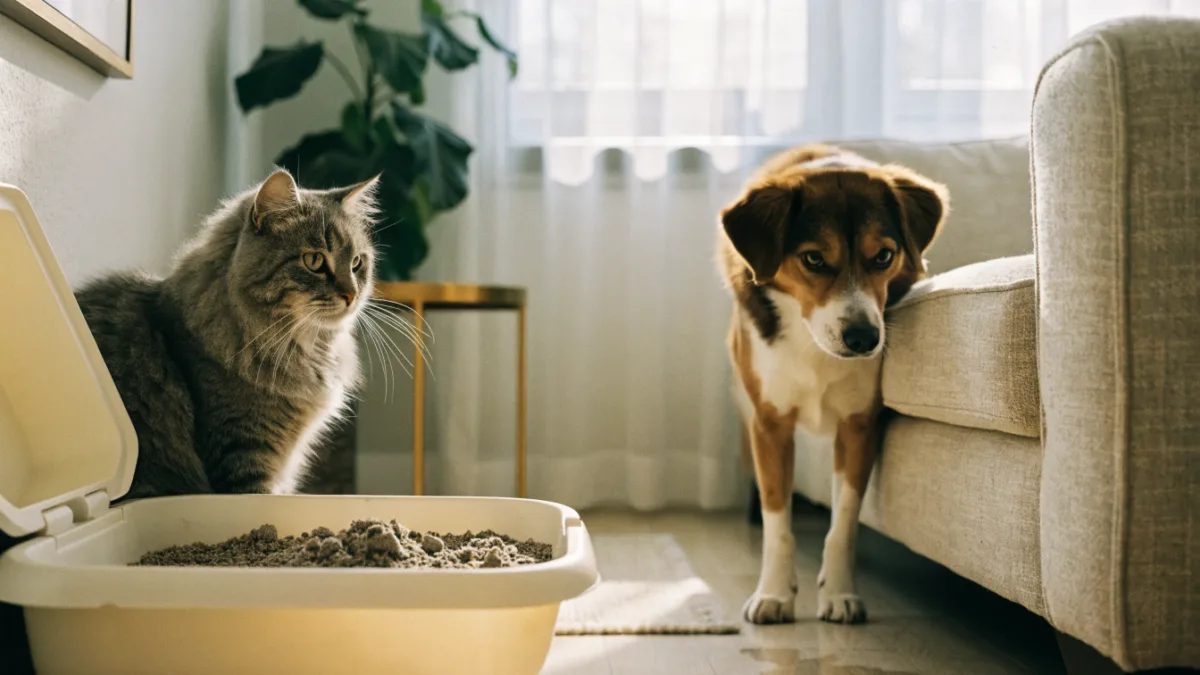
Finding a puddle on the living room rug is a surefire way to ruin your morning. When inappropriate pet elimination starts, it’s easy to take it personally. I’ve talked to plenty of owners who swear their pet is doing it out of spite. I get it. You come home from a long day, there’s pee on the couch, and it feels like a personal attack.
But spite isn’t in an animal’s vocabulary. When you’re dealing with a cat peeing outside box boundaries, or a dog marking inside the house, you’re looking at a medical issue, a communication breakdown, or an environmental problem. Pets don’t act out of anger. Let’s break down exactly why this happens and how to fix it without losing your mind.
Cat Peeing Outside the Box: The Litter Box Aversion
If you have a cat, dealing with house soiling is incredibly common. In fact, it’s the number one behavior problem reported by cat owners. But it’s never a revenge plot. Feline house soiling usually boils down to either a medical issue or the fact that they hate their bathroom setup.
Ruling Out Medical Issues First
Before you even look at the litter box, look at your cat’s health. Urinating in strange places almost always points to a physical problem first. Urinary tract infections, crystals in the urine, or bladder stones make peeing feel like fire. Your cat steps into the box, feels the pain, and decides the box is causing it. So, they start looking for softer, cooler places to go, like your bathtub, a pile of laundry, or the living room rug. Always take your cat to the vet’s office to rule out physical pain before you assume it’s behavioral.
The Environment and the Box Itself
If the vet gives the all-clear, we have to look at the box. Cats are incredibly fastidious, and they have strong preferences. If the box is too small, covered, or filthy, they’ll find somewhere else to go.
I had a client with a Maine Coon who was consistently going in the bathtub. The owners were furious, convinced the cat was just being bad. Turns out, the litter box was a tiny, covered one in the corner of a noisy laundry room. The cat literally couldn’t turn around inside, and the hood trapped all the unpleasant smells. We switched to a large, open storage tote, moved it to a quiet hallway, and the problem vanished overnight.
Location matters. You also need to follow the golden rule for multi-cat homes: you need one litter box per cat, plus one extra. If you have two cats, you need three boxes in different spots. And think about the litter itself. Scented litter might smell like a pine forest to you, but it’s overwhelming to a feline nose. Stick to unscented, clumping litter.
Dog Marking Inside: Claiming Territory
With dogs, inappropriate pet elimination usually means something entirely different. We are typically looking at urine marking. This isn’t a housetraining failure. It’s communication. Dogs mark to claim territory, out of overstimulation, or because they are feeling anxious.
Relieving vs. Marking
How do you tell the difference? Normal bladder emptying leaves a large puddle on a horizontal surface, like the floor or a pee pad. Marking usually involves a small amount of urine deposited on a vertical surface, like a chair leg, a curtain, or a doorway. The dog sniffs, lifts a leg, and leaves a quick scent mark.
Why Dogs Mark Inside
Intact dogs are heavily driven by hormones. If your unneutered male or unspayed female is marking, hormones are likely the culprit. But fixed dogs mark, too.
Changes in the home are the primary trigger. A new roommate, a new pet, or even construction like remodeling a kitchen can throw a dog off balance. If a dog smells a stray animal outside the window, he might decide to “claim” the living room sofa to feel more secure.
I remember working with a rescue Dachshund who started marking the baby’s crib a few weeks before the parents brought their newborn home. The dog wasn’t being mean or jealous. He was stressed about the new furniture, the changing routines, and the new smells. He was trying to make the house smell like him again to calm himself down. By recognizing that anxiety was the root cause, we were able to manage the behavior without stressing the dog out further.
The Cleaning Mistake Everyone Makes
Whether you’re dealing with cat pee or dog urine, how you clean it dictates whether the behavior stops. This is the step where almost everyone messes up.
Standard household cleaners mask the smell for human noses. They do absolutely nothing for the pet. Urine contains uric acid crystals. These crystals are non-soluble and act like tiny neon signs that scream, “pee here again.” Even if the spot looks clean to you, if you used bleach or a standard carpet shampoo, your pet can still smell the uric acid perfectly.
You must use a high-quality enzymatic cleaner. These products contain specific enzymes that actually break down and consume the uric acid crystals. You saturate the soiled area, let it sit according to the bottle’s instructions, and let it dry naturally. Don’t wipe it up right away. The enzymes need time to do their job. Only when the scent is entirely destroyed will the pet stop being attracted to that specific spot.
Fixing the Problem: Management and Correction
Let’s talk about how to stop the behavior in its tracks.
Drop the Punishment
First and foremost, never punish your pet. Rubbing a dog’s nose in his mess or yelling at a cat does not work. Modern behavioral science strictly opposes this. Punishment just increases your pet’s anxiety. A punished cat won’t learn to use the litter box; she’ll just learn to hide and pee under the bed where you can’t find it. A punished dog won’t learn not to mark; he’ll just learn not to mark while you’re in the room.
Helping Your Cat
For cats, the focus is on environmental management. Provide more boxes, experiment with different litter textures, and reduce household stress. If outside cats are visible through the window, close the blinds to remove the visual trigger. You can also plug in synthetic feline facial pheromones. These diffusers mimic the calming scent cats leave when they rub their cheeks on furniture, signaling to them that the environment is safe and familiar.
Managing Your Dog
For dogs, you have to manage access and reward heavily for going outside. If your dog targets the guest room, keep the door closed. When you’re home, keep a leash on him inside so he can’t sneak off to mark a corner.
Watch him closely. If you catch him sniffing intensely around a chair leg, interrupt him before the leg goes up. Say his name, clap your hands, and immediately take him outside. When he pees out in the yard, throw a party. Give him a high-value treat. You want to make the outside infinitely more rewarding than the inside.
If the dog is intact, talk to your vet about neutering or spaying. It drastically reduces marking behavior in a lot of dogs, especially when combined with consistent management.
Dealing with inappropriate pet elimination is frustrating, but it’s totally fixable. The biggest takeaway here is to step back and look at the world from your pet’s perspective. They aren’t trying to make you angry. They are reacting to their environment, their health, or their instincts. Understanding the natural, instinctual behaviors behind these issues is the key to living peacefully with the animals in our care. When you respect their biology and address the root cause—whether it’s a painful UTI, a tiny covered litter box, or anxiety over a new baby—and clean up the right way, you give them the best chance to thrive in our human world. Take a breath, grab the enzyme cleaner, and start decoding what your pet is trying to tell you.