

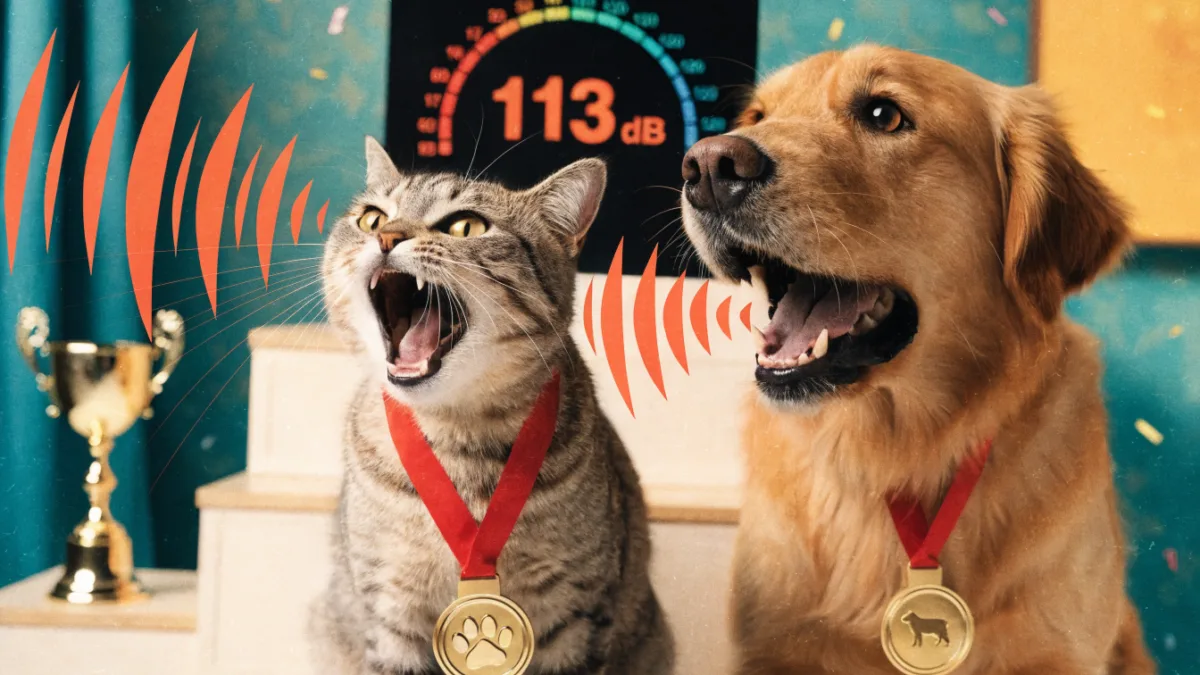
My cat Mochi has this habit of deciding 3 AM is the perfect time to test her vocal range. She’ll sit in the hallway, between the bedroom and the living room — acoustically ideal, obviously — and just go for it. One night, half-asleep and mildly delirious, I found myself wondering: could this be record-breaking? Could my tiny, loud-mouthed tabby be a contender?
So I went down a rabbit hole. Or maybe a cat-and-dog hole. What I found was that the pet world records scene is absolutely unhinged in the best possible way. Guinness World Records and similar organizations track everything from the loudest purr to the longest frisbee catch, and the contrast between feline and canine achievements is pretty entertaining. It’s like the eternal cats-versus-dogs debate, but with official documentation.
The Loudest Purr: When Contentment Becomes a Noise Complaint
Let’s start with cats, because of course I am. The current Guinness World Record for the loudest purr by a domestic cat goes to a British cat named,[1] who clocked in at an astonishing 54.6 decibels. For context, that’s roughly the volume of a running refrigerator humming in your kitchen. Imagine that sound emanating from a small furry creature curled on your lap.
But here’s where it gets wild — the historical record was held by a cat named Merlin, also from the UK, who purred at a staggering 67.8 decibels. That’s washing-machine loud. That’s “sorry, can you turn that down?” loud. Merlin’s owner reportedly couldn’t even watch television properly without subtitles because his purring drowned out the dialogue. I genuinely do not know how that’s livable, but also? I respect it.
What’s interesting about purr records is the science behind them. Cats purr through rapid twitching of their laryngeal muscles — roughly 25 to 150 times per second. The volume varies based on individual anatomy, vocal cord thickness, and possibly even sinus structure. Some cats are just built like tiny amplifiers. There’s also some debate about whether especially loud purring serves an evolutionary purpose. Some researchers think domestic cats may have developed louder, more insistent purrs specifically to communicate with humans — essentially a “pay attention to me” frequency that hits right at the range we’re biologically wired to notice.
Mochi, for the record, does not break any decibel records. She’s just strategically loud. There’s a difference.
Athletic Dogs: Speed, Air, and the Frisbee Gods
Now let’s give dogs their moment, because while cats are out here breaking sound barriers from a seated position, dogs are doing things that require actual cardio.
One of the most impressive records in the canine athletic category belongs to Rob McLeod and his dog, Davy Whippet. Together they hold the record for the longest flying disc catch by a dog — a throw-and-catch that covered a genuinely ridiculous distance. What makes this record remarkable isn’t just the physical feat. It’s the timing, the communication, the absolute trust between a dog and his person that says, “I’m going to sprint at full speed and launch my entire body into the air, and I trust that disc will be exactly where it needs to be.”
Whippets, for those unfamiliar, are essentially greyhounds in compact form. They’re sight hounds built for explosive speed — lean, aerodynamic, deep-chested, and capable of reaching 35 miles per hour in short bursts. They’re genetically optimized for exactly this kind of record. You’re not going to see a Bulldog out there setting frisbee distance records, and that’s fine. Bulldogs have other talents, mostly involving napping and looking dignified.
What I love about athletic records like Davy’s is that they represent something collaborative. A loudest purr is a solo achievement. A longest frisbee catch is a partnership. It takes months or years of training, mutual trust, and presumably a very large open field with no squirrels in it.
Size Extremes: When Genetics Goes to Eleven
The Longest Cats
If you’ve ever met a Maine Coon, you know they’re not so much cats as small lions with better customer service skills. The record for the longest domestic cat — measured from nose to tail tip — has historically been held by Maine Coons, and these animals routinely exceed four feet in length. That’s longer than most toddlers. Stewie, a Maine Coon from Nevada, held the record for years at 48.5 inches before passing the torch to other enormous, magnificent fluffballs.
Maine Coons are North America’s oldest natural breed, and their size likely developed as an adaptation to harsh New England winters. Bigger body, more surface area relative to volume, better heat retention. Also, possibly, an evolutionary strategy of being too large for their humans to easily move them off the laptop keyboard.
The Smallest Dogs
On the opposite end of the spectrum — and I mean the very opposite end — we have the record for the smallest dog. These records are almost exclusively held by Chihuahuas, and the numbers are borderline absurd. The smallest dogs on record have measured just under 4 inches tall and weighed less than a bag of sugar. Less than two pounds, in some cases. A decent-sized lemon weighs more.
Chihuahuas, as a breed, already represent the extreme small end of canine domestication. Selective breeding has pushed the limits of how small a mammal can get while still, you know, being a functional mammal. Record-setting Chihuahuas are often on the edge of what’s biologically viable, which brings us to an important and slightly uncomfortable conversation.
The Awkward Question: Should All Records Exist?
Here’s where I have to be honest about the messier side of pet world records, because it’s not all adorable and it’s worth thinking about.
Records for extreme size — smallest, shortest, heaviest, longest — raise real animal welfare concerns. Critics, including veterinarians and breed welfare advocates, have pointed out that celebrating these extremes can encourage unhealthy breeding practices. Breeding specifically for runts, for genetic anomalies, for the tiniest possible dog or the longest possible cat can concentrate harmful genes. It can produce animals with shortened lifespans, fragile bones, heart defects, and breathing problems.
There’s also the issue of measurement stress. For vocal records especially, some animal behaviorists have questioned whether record attempts are authentic. Is that cat purring because she’s genuinely content, or is she being overstimulated or stressed to elicit a louder response? Is that dog being pushed past a comfortable physical limit to achieve a distance record? These are legitimate questions that don’t have clean answers in every case.
Guinness World Records has actually responded to these concerns in recent years. They’ve shifted toward favoring athletic and positive behavioral records — tricks performed, distances caught, skills demonstrated — over passive genetic ones like weight or unusual proportions. They also require extensive documentation: video evidence, independent witnesses, veterinary confirmation. They’ve gotten more careful, and honestly, that’s a good thing.
My opinion, for what it’s worth, is that the athletic records feel different. When you watch a well-trained dog nail a frisbee catch at full sprint, you’re watching an animal do something it was bred to love doing, in partnership with a human who has clearly invested time and care into that relationship. That feels like celebration. A record for the shortest snout on a dog feels more like a medical chart.
The Weird and Wonderful: Buddy the Sable
I’d be doing you a disservice if I didn’t mention what might be the strangest entry in the pet records conversation. Meet Buddy the sable — a small carnivorous mammal in the weasel family — who has gained attention for an unusual talent: he can both purr like a cat and bark like a dog.
This cross-species vocal mimicry is genuinely fascinating from a biological perspective. Mustelids (the family that includes sables, ferrets, badgers, and otters) have surprisingly versatile vocal apparatuses. They produce a range of sounds that, to the human ear, can closely resemble the vocalizations of animals they’re not related to at all.
But Buddy also highlights an important caveat I want to be real about. Sables are not domesticated animals. They’re wild animals, native to forests across Asia and parts of Europe. While domestic ferrets have been companions to humans for thousands of years, sables have not undergone that same domestication process. The exotic pet trade raises serious ethical and conservation questions, and an animal going viral for cute vocalizations shouldn’t obscure the fact that wild species belong in wild ecosystems whenever possible.
If you’re curious about mustelids, domestic ferrets — who are plenty weird and wonderful on their own — are the appropriate pet equivalent. They dook. They hiss. They do the weasel war dance. It’s incredible content without the ecological baggage.
So yes, the pet records world is a strange and often delightful place. But if a record makes you want to acquire an animal, please ask yourself whether that animal’s needs can genuinely be met in a home environment. Some can. Some really, really cannot.
What I Take From All This
After spending way too long reading about record-breaking pets, here’s what I’ve landed on. The records that feel best — the ones that make me genuinely smile — are the ones that celebrate what animals do naturally, just taken to an extraordinary level. A whippet sprinting. A Maine Coon being magnificently, absurdly large. A cat whose purr happens to be built like a small appliance.
What bothers me are the records that seem to exist for human spectacle at the animal’s expense. The tiniest dog who can barely regulate her own body temperature. The exotic mammal kept in captivity because internet content. Those aren’t achievements. Those are situations.
And as for Mochi? She’s not breaking any records. She’s a perfectly average-sized cat with a perfectly average purr and an above-average talent for sitting on whatever I’m trying to read. But I think that’s the real takeaway from all this. Most of our pets aren’t record-holders, and that’s exactly right. They don’t need to be extraordinary to be worth our time, our attention, and our 3 AM wake-up calls.
The record I care about is the one we build together — the years of trust, the ridiculous inside jokes that only exist between a person and their animal, the quiet companionship on an ordinary Tuesday. That doesn’t get a certificate. But if you’ve ever loved a pet, you already know it’s the only record that matters.
Want to learn more about the incredible animals in the record books? Check out this,[2] explore more,[3] or revisit [1] for yourself.
Sources
- Bella — tiktok.com
- cats vs. dogs record-breaking showdown — youtube.com
- pet world records — chewy.com