

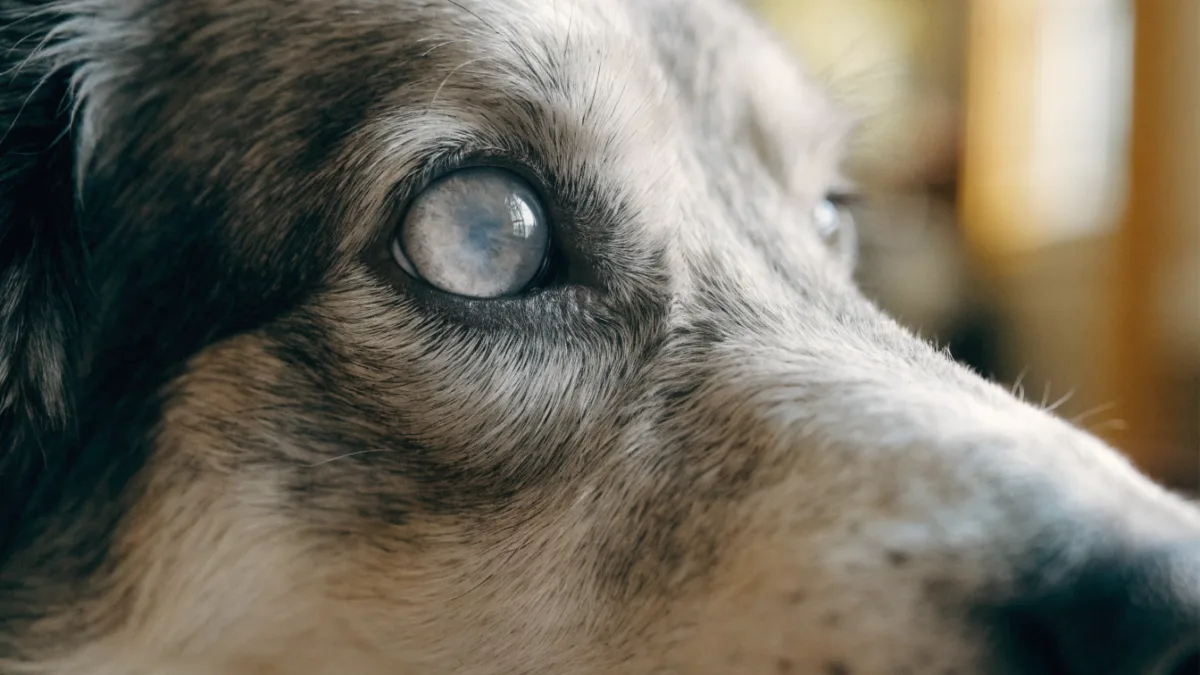
Picture a panicked owner named Sarah rushing her twelve-year-old Beagle, Buster, into a clinic. As she sets him on the exam table, she’s fighting back tears. “He’s going blind,” she says, her voice shaking. “His eyes turned completely cloudy overnight, and he keeps bumping into the coffee table.” Buster’s eyes did indeed have a distinct haze to them, almost like a piece of sea glass had slipped over his pupils. But a quick exam with an ophthalmoscope delivered the best news Sarah had heard all week. Buster wasn’t going blind. He had nuclear sclerosis, a perfectly normal part of aging.
If you share your home with a senior dog or cat, noticing a sudden cloudiness in their eyes is enough to stop your heart. Our minds immediately jump to the worst-case scenario: cataracts and irreversible vision loss. While cataracts are absolutely a possibility, they are frequently confused with nuclear sclerosis. Understanding the difference between the two can save you a lot of sleepless nights—and ensure your pet gets the exact care they need.
The “Gray vs. White” Rule: What Are You Actually Seeing?
When you look closely at your pet’s eyes in natural light, you can often play detective at home. The easiest way to differentiate between a normal aging eye and a diseased one is what I call the “Gray vs. White” rule.
Nuclear Sclerosis: The Gray Haze of Aging
Nuclear sclerosis (sometimes called lenticular sclerosis) is a normal, hardening of the lens inside the eye as a pet gets older. Throughout a dog or cat’s life, new lens fibers are continuously produced. Since the eye is a closed structure, the older fibers get pushed toward the center—the nucleus—and become densely packed. This compression causes the center of the eye to take on a cloudy, gray, or bluish tint. If you see a blue-gray haze, you are likely looking at nuclear sclerosis.
Think of it like presbyopia in humans—the completely natural reason many of us end up needing reading glasses in our forties. While it can cause mild blurriness or make it difficult for your pet to focus on close objects, it rarely causes major vision loss. For Buster the Beagle, his nuclear sclerosis meant he had trouble seeing the exact kibble in his bowl, which explained the minor scavenge spills, but he could still spot a squirrel in the yard from fifty feet away.
Cataracts: The White Wall
Cataracts, on the other hand, are a physical disease of the eye. A cataract forms when the normally clear lens becomes opaque, creating a physical blockage that prevents light from reaching the retina. If the cloudiness looks distinctly white—like crushed ice, frosted glass, or white chalk—you are likely looking at a cataract.
Because light cannot penetrate this white barrier, cataracts cause diminished vision and can eventually lead to complete blindness. The progression can be slow, or in cases related to underlying conditions like diabetes, it can happen in what feels like the blink of an eye.
Why “Dr. Google” Gets It Wrong (and Why It Matters)
One of the biggest debates I see in the exam room isn’t between me and the owner; it’s between the owner and the internet. There is a massive issue with self-diagnosis in the pet community when it comes to eye health. Many pet owners see a slight blue tinge and mistakenly assume their dog is “just going blind from old age,” assuming it’s a severe cataract. Others look directly at a stark white, mature cataract and dismiss it as harmless nuclear sclerosis.
This misdiagnosis is dangerous. I once treated a sweet nine-year-old Poodle mix named Winston. His owners had noticed a white cloud in his left eye for months but assumed it was just part of getting older. By the time they brought him in, the cataract had fully matured. Worse, the leaky proteins from the damaged lens had triggered a condition called lens-induced uveitis—a severe, painful inflammation in the eye. The inflammation had raised the pressure in Winston’s eye so high that he had developed secondary glaucoma, permanently damaging his optic nerve.
If we had caught Winston’s cataract early, we could have managed the inflammation and potentially saved his vision in that eye. Waiting too long on a true cataract doesn’t just mean blindness; it can mean chronic, agonizing pain.
Behind the Scenes: What We Look For in the Exam Room
While the “Gray vs. White” rule is a great starting point, it’s worth remembering that you cannot make a definitive diagnosis in your living room. It takes a trained professional to look deep into the structures of the eye.
When I examine a pet, I use a tool called a slit lamp, which allows me to look at the eye in three dimensions under high magnification. I’ll also apply special diagnostic drops. These drops dilate the pupil, widening the window so I can see the entire lens and the retina at the back of the eye. With these tools, it becomes immediately obvious if the lens is simply hardened (sclerosis) or if there is a true, structural breakdown of the lens fibers (cataract).
For complex cases, I won’t hesitate to refer a patient to a board-certified veterinary ophthalmologist. These specialists have even more advanced imaging tools to map the exact topography of your pet’s eye.,[1] a thorough exam is the only way to accurately stage a cataract and determine if a pet is a good candidate for surgery.
Modern Treatments and Hope for Aging Eyes
Let’s say you get the diagnosis, and it is a cataract. Take a deep breath. The treatment pathways for cataracts have advanced incredibly in recent years, and a diagnosis is no longer an automatic sentence to blindness.
The Surgical Route
If your pet is otherwise healthy, a veterinary ophthalmologist will likely recommend a procedure called phacoemulsification. This is the exact same surgery performed on humans. Using high-frequency ultrasound waves, the surgeon breaks the cloudy lens into tiny fragments, suctions them out, and replaces them with an artificial acrylic lens. The success rate of this surgery is exceptionally high, often sitting well over 90%. Pets wake up with their vision restored, and they don’t even know they have a plastic lens in their eye!
Managing the Underlying Cause
Sometimes, surgery isn’t the right fit—perhaps the pet is too old for anesthesia, or the retina is too damaged to support vision. In these cases, we focus on managing the underlying cause. Diabetes, for instance, is a massive driver of cataracts in dogs. I recall treating Bella, an eight-year-old Miniature Schnauzer. Her cataracts developed rapidly due to unregulated diabetes. By working closely with her owners to get her insulin levels tightly managed, we were able to halt the rapid progression of her cataracts, making her comfortable and preventing the painful secondary inflammation that Winston experienced.
The Future of Eye Drops?
I frequently have owners ask me if they can just use eye drops to dissolve the cloudiness. I’ve changed my mind on this over the years. For a long time, I told owners that drops were a myth. However, there is currently fascinating, ongoing research into topical eye drops containing a molecule called lanosterol. In laboratory settings, these drops have shown promise in dissolving certain types of cataract proteins. While we aren’t quite ready to replace surgery with a daily drop just yet, the future of veterinary ophthalmology is looking incredibly bright.
Helping Your Senior Pet Adapt
Whether your senior companion has mild blurriness from nuclear sclerosis or vision loss from a cataract, they can live a full, incredibly happy life. Pets are incredibly resilient and rely heavily on their senses of smell and hearing to navigate the world.
If your pet’s vision is declining, the best thing you can do is provide environmental consistency. Avoid rearranging your furniture. Keep their food bowls, beds, and favorite toys in the exact same spot. If you have stairs, consider putting baby gates at the top and bottom, and always use a leash on walks to keep them safe from unseen hazards like curbs or approaching cars.
Seeing your beloved pet’s eyes change as they age is an undeniable reminder that their time with us is finite. But it doesn’t have to be a tragedy. By understanding the difference between normal aging and actual disease, you can advocate for their health, relieve their pain, and ensure their golden years are just as vibrant—even if they are a little bit blurry.
Sources
- According to the Veterinary Information Network — veterinarypartner.vin.com