

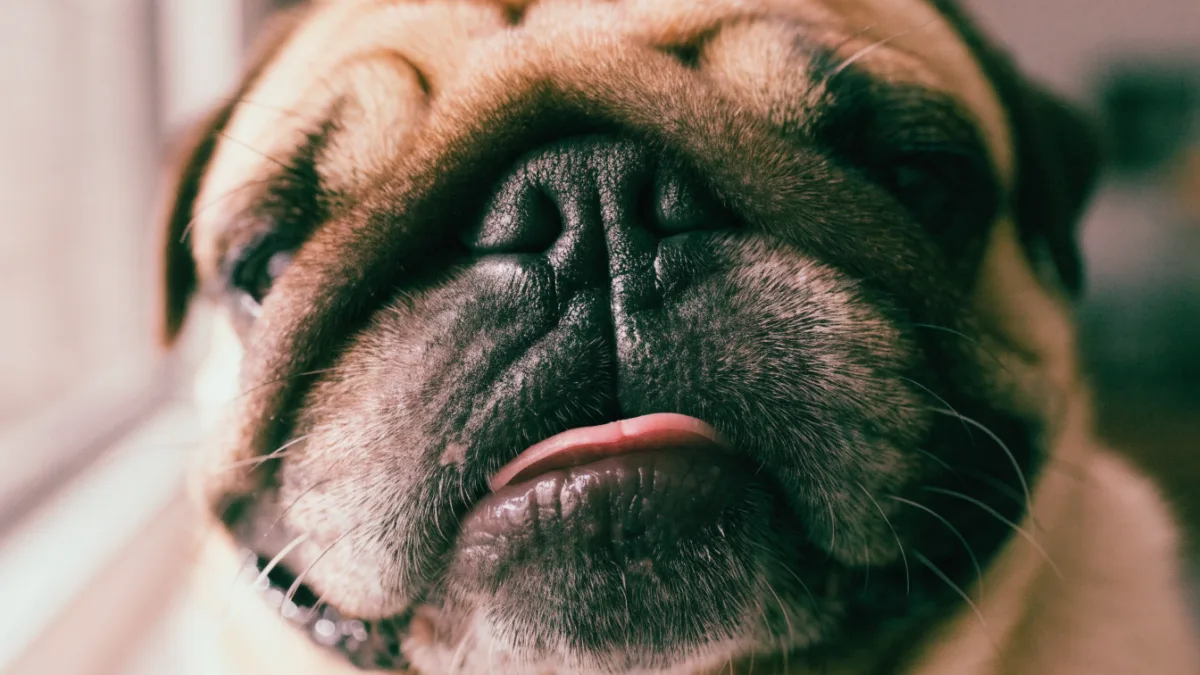
The barbecue was in full swing when Marta noticed the sound — a harsh, roaring rasp coming from under the picnic table. Winston, her eight-year-old Pug, hadn’t run a single step all afternoon. He’d been lying in the shade, thrilled to have a backyard full of visitors to adore. Twenty minutes of happy excitement later, his gums were brick red and his temperature read 105.4°F. “He wasn’t doing anything,” Marta kept repeating when she called us. “He was just sitting there.” And that’s exactly the point. For brachycephalic dog breeds — the Pugs, Frenchies, Bulldogs, and Persians of the world — summer isn’t the only risk. Excitement alone can tip them into heatstroke on a mild day. Here’s why, and what to do about it.
Why Flat Faces Overheat First
Dogs don’t sweat the way we do. Aside from a few glands in their paw pads, their cooling system runs almost entirely on panting — evaporation from the tongue and the moist surfaces of the upper airway. Every breath moves heat out of the body.
Now shrink the machinery. Flat-faced breeds have a compressed skull with roughly the same amount of soft tissue stuffed inside it, which produces.[1] Together, vets call this Brachycephalic Obstructive Airway Syndrome, or BOAS. Less airway surface area means less evaporative cooling per breath — and more work for every breath taken. A dog whose cooling system is already running at a structural deficit has very little reserve left when temperatures climb.
The numbers back this up. A large UK study from the Royal Veterinary College found brachycephalic dogs had roughly twice the odds of heatstroke compared to longer-nosed dogs, with English Bulldogs showing around fourteen times the risk and French Bulldogs about six times. Normal body temperature sits at 101–102.5°F; trouble begins around 104°F, and temperatures above 106°F are life-threatening emergencies. Flat-faced pets can cross that line in.[2]
And as Winston demonstrated, exercise isn’t the only trigger. Excitement — play, car rides, visitors arriving, outdoor events — drives heavier breathing all by itself, even in mild weather.
Dog Heatstroke Symptoms: Catching It Early
Early recognition is everything with these breeds, so learn the progression:
- Early warning signs: heavy, labored panting; loud or “roaring” breathing; thick, ropey drool; bright red or purplish gums and tongue; restlessness or pacing.
- Progressing signs: wobbling or staggering, vomiting or diarrhea, a glassy-eyed stare, collapse, seizures.
The thirty-second check
Two quick tests tell you a lot. Touch your pet’s gums — if they feel hot against your finger, the body is retaining heat. Then press a finger on the gum until it blanches white and release: color should return in under two seconds. Slower than that suggests poor circulation, and it’s time to move.
One cat-specific note I emphasize with every Persian owner: panting in a cat is never normal. A dog pants to regulate temperature; a cat who’s open-mouth breathing is already in trouble.
Cooling Do’s and Don’ts
When a flat-faced pet overheats, what you do in the first ten minutes matters enormously — and some of the most instinctive moves backfire.
Do this
- Move to shade or air conditioning immediately.
- Wet the coat with cool — not ice-cold — water, concentrating on the belly, armpits, groin, and paws.
- Point a fan at the wet coat; moving air dramatically speeds evaporation.
- Offer small sips of water if your pet is conscious and swallowing normally.
- Stop active cooling once temperature reaches about 103°F — overshooting into hypothermia is a real risk.
- Get to a vet even if your pet seems fully recovered. Heatstroke can [3] in ways that only show up 24 to 72 hours later.
Not this
- No ice baths. I know the logic — colder equals faster — but ice-cold water constricts surface blood vessels, trapping heat at the core, and triggers shivering, which generates even more heat.
- Don’t drape a cold towel and walk away. I’ll admit I used to recommend this before the evidence caught up; I’ve changed my mind. A wet towel warms within minutes and then acts as insulation. Towels must be continuously re-wetted with cool water and repositioned.
- Never force water into the mouth of a collapsed or unconscious pet — aspiration is dangerous.
- Don’t delay transport to finish cooling. Cool your pet en route to the clinic.
Cooling Gear: What Works and What’s Oversold
I field a lot of questions about products, so here’s my honest take — with the caveat that independent testing is limited and results vary.
- Evaporative cooling vests (soak-activated) can genuinely lower surface temperature — but only in dry heat. In high humidity, evaporation stalls and the vest becomes a warm blanket. Look for light-colored fabric, good belly and chest coverage, and a snug but not restrictive fit that doesn’t compress the throat.
- Pressure-activated gel mats need no electricity or refrigeration and give pets a cool resting spot. Prioritize durable, chew-resistant construction and non-toxic gel, because some dogs treat these as chew toys.
- Elevated mesh beds are unglamorous and consistently effective — airflow underneath the body makes a real difference.
- Cooling bandanas and neck wraps are low-risk and helpful, with the same humidity caveat as vests.
- Fans, misting systems, and splash pools are the workhorses of flat-faced pet summer management, cheap and reliable.
Everyday Summer Management — Including the Cats
Prevention beats rescue every time. Walk before sunrise or after sunset, and use the seven-second hand test on pavement: if you can’t hold the back of your hand against it for seven seconds, it’s too hot for paws — on an 87°F day, asphalt can exceed 125°F. A parked car’s interior climbs roughly 19°F in ten minutes, so flat-faced pets stay home. Use a harness rather than a collar to protect that already-compromised airway, and keep weight lean, because every extra pound worsens airway obstruction. And talk to your vet about whether your dog is a candidate for BOAS corrective surgery — nostril widening and soft palate resection measurably improve heat tolerance. A French Bulldog patient of mine had both procedures two years ago, and her owner recently told me summer walks went from “ten minutes of misery” to genuinely enjoyable.
Keeping cats cool in summer
Persians, Himalayans, and Exotic Shorthairs face the same squished-airway math, but cats cool differently — they spread saliva through grooming and seek out cool surfaces rather than panting. So build them options: access to tile or ceramic floors, a fan positioned to blow across a frozen water bottle, ice cubes bobbing in the water bowl, and the occasional frozen treat. A shaded gel mat by a window is usually claimed within the hour. And remember: a flat-faced cat who’s panting is an emergency, full stop.
Winston recovered — quick cooling on the drive over and two days of monitoring — but Marta now hosts indoor gatherings from June through September. That’s the adjustment these breeds ask of us. There’s a larger conversation happening too, and it matters: in 2022 a Norwegian court effectively halted breeding of English Bulldogs and Cavaliers on welfare grounds, even as French Bulldogs became America’s most-registered breed. If you’re adding a flat-faced pet to your family, choose breeders who prioritize airway health over extreme facial flatness and who perform airway assessments on breeding stock. The welfare of these breeds won’t come from rescue kits alone — it comes from breeding dogs who can breathe through a summer. Until then, they rely on us to think ahead, watch closely, and keep the fan pointed their way.
Sources
- narrowed nostrils, an elongated soft palate that partially blocks the airway, and sometimes an undersized trachea — rialtoanimalhospital.com
- minutes, not hours — leonvalleyvet.com
- damage the kidneys, gut, and clotting system — facebook.com