

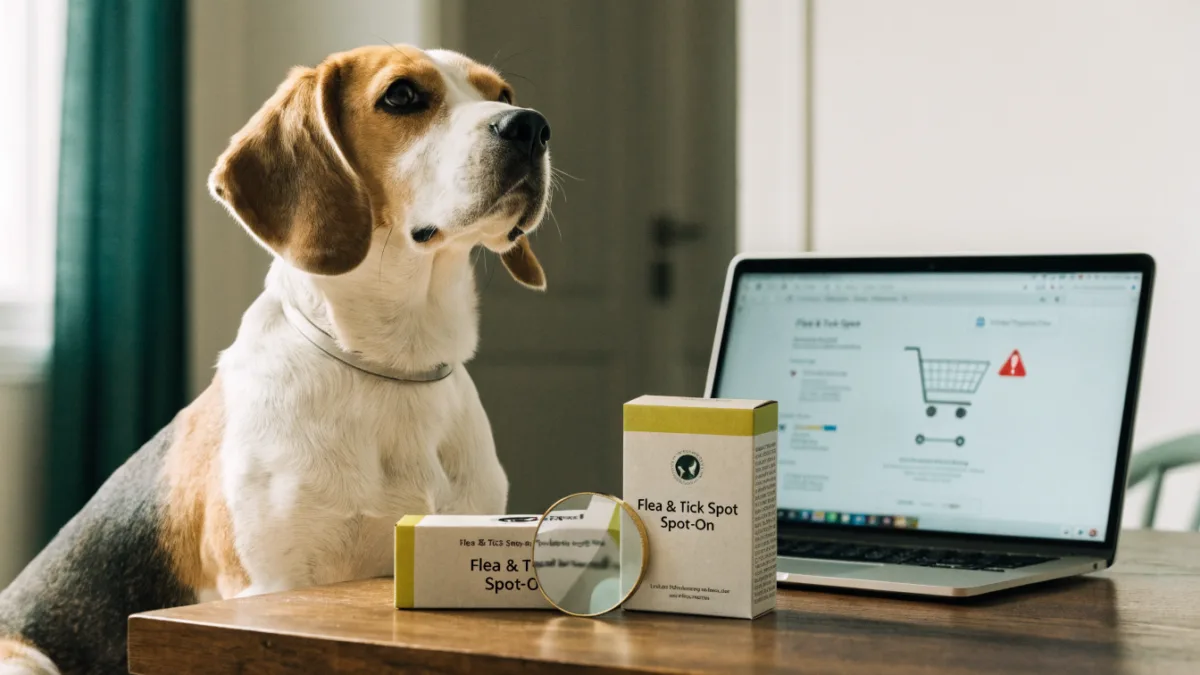
Buying your pet’s medications online is one of the easiest ways to trim the household budget — and I say that as someone who spent the first decade of my career quietly wincing whenever a client mentioned it. The prices at reputable online pharmacies genuinely beat clinic pricing, often by a lot, especially on generics of human-equivalent drugs. The catch isn’t that shopping online is risky. The catch is that the internet mixes real pharmacies with what I’ve come to think of as vending machines: websites that ask you no questions, verify nothing, and simply take your payment and ship you a box. Telling the two apart takes about two minutes once you know what to look for — and those two minutes matter, because what’s inside the box isn’t always what’s printed on the label.
The Half-Price Flea Treatment That Wasn’t
Let me tell you about Rosie, a five-year-old Beagle who came to see me last spring for “fleas that won’t quit.” Her owner — a careful budgeter — had bought six doses of a well-known topical flea and tick preventive from a website she found through a social media ad, at roughly half the price she’d seen anywhere else. The box arrived looking almost right. Almost. The colors were a shade off, the applicators were glued into the card rather than sealed, and nowhere on the packaging could we find an EPA registration number — which, in the United States, every legitimate topical flea product is required to display because these products are regulated as pesticides. By the time Rosie reached my exam table, she had a thriving flea population and, because fleas serve as the intermediate host for the tapeworm Dipylidium caninum, a tapeworm as a bonus. Her owner just looked at the box and said, “I compared prices everywhere. I honestly thought I’d finally won at shopping.” She’d done everything right except the one thing that matters most: she’d never checked who was actually selling.
Here’s the reassuring part — Rosie’s tubes didn’t appear to contain anything poisonous. As far as we could tell, they held mostly inert liquid. That’s the good version of this story. The worse version is real, too: when the EPA cracked down on counterfeit and mislabeled spot-on treatments in the late 2000s after tens of thousands of adverse-event reports, investigators found products with the wrong active ingredient or the wrong concentration, and cats died when canine products containing permethrin — an insecticide most dogs handle fine but cats cannot safely metabolize — ended up sold or labeled for feline use. Counterfeit flea treatment isn’t always a scam that simply doesn’t work. Sometimes it’s a scam that hurts.
The Thirty-Second Rogue-Site Test
The FDA publishes a plain-language guide for pet owners buying medications online, and the red flags it lists are refreshingly practical. The single biggest one: a website that sells prescription medications without requiring a prescription. That isn’t a convenience — it’s a confession. A seller willing to break the law at the front door gives you no reason to trust what happens in the warehouse.
- Sells prescription-only medications with no prescription requested
- No licensed pharmacist available to answer questions
- No physical address or working phone number anywhere on the site
- Prices dramatically below every other seller
- Ships from overseas, or isn’t licensed where you live
- Found you through spam email or aggressive pop-up ads
One more number worth sitting with: when the National Association of Boards of Pharmacy (NABP) reviews online drug sellers, it has consistently found the overwhelming majority out of compliance — historically around 95 percent. That figure covers online drug outlets generally, not pet pharmacies specifically, but it’s why I tell clients to assume a site is unverified until proven otherwise. Skepticism is free; the alternative sometimes isn’t.
How to Verify a Pharmacy Before You Enter a Card Number
The .pharmacy shortcut
In the United States, the NABP vets online pharmacies and licenses the “.pharmacy” domain ending — if the web address itself ends in .pharmacy, the site has been checked for licensure, a staff pharmacist, and real prescription requirements. This program absorbed the older Vet-VIPPS accreditation you’ll still see cited in outdated articles, so don’t worry if a site mentions neither by name. If you’re outside the U.S., your country’s national pharmacy regulator almost certainly keeps a public register of legitimate online sellers. The principle is the same everywhere: real pharmacies are registered somewhere.
Your prescription belongs to you
In many U.S. states, if you ask your veterinarian for a written prescription, they’re legally required to provide one so you can fill it wherever you choose — it’s a right, not a favor, as [1] has long reminded pet owners. And a confession from me: earlier in my career, I quietly discouraged clients from filling online — partly over clinic revenue, partly because I worried about product authenticity. I’ve changed my mind. The verification tools exist now, my clients save real money, and a pharmacy that calls my office for authorization on every order is doing exactly what it should. What I still discourage is the vending machine.
Pick up the phone
A legitimate online pharmacy has a physical address, a working phone line, a pharmacist who answers, and a state license number you can confirm with your state board of pharmacy — usually in about two minutes online. If a site makes any of that hard to find, that difficulty is your answer.
Where the Safe Savings Actually Are
Here’s the nuance that matters for your wallet: cheaper is not the same as dangerous. [1] found that major, reputable online pet pharmacies routinely beat clinic prices, sometimes by half or more on generics — which makes sense when you realize many pet medications are the exact same molecules as human drugs, just with different labels and doses. The category keeps mainstreaming, too: [2] at its human pharmacies — your veterinarian sends the prescription directly, or you walk in with the written one — which can also open the door to low-cost generic programs on human-equivalent medications.
The fine print on manufacturer guarantees
Many makers of heartworm and flea preventives offer guarantee programs — covering the cost of heartworm treatment, for instance, if your dog tests positive while on their preventive — but honor them only when the product was purchased through a veterinarian. That doesn’t make buying online wrong. It means the lower price can carry a quiet trade-off, and it’s worth doing that math for your own pet before you check out.
Check the box, every single time
Even on a site you trust, inspect product when it arrives. Auto-ship subscriptions are wonderfully convenient, but they also make it easy for a bad batch to slip past month after month — a counterfeit that arrives on schedule is still a counterfeit. And it’s worth knowing that some sellers have historically sourced product through unauthorized distribution channels (the subject of genuine legal disputes between manufacturers and large pet pharmacies over the years), so even authentic product can arrive expired or improperly stored. When you open the package, look for:
- No EPA registration number on flea or tick topicals (other countries have equivalent registration schemes)
- Foreign-language labeling, or fonts and colors that look slightly “off” compared to what you’ve bought before
- Applicators glued rather than sealed into the card, or torn and re-glued blister packaging
- Product inside that looks separated, discolored, or gritty
So — verified or vending machine. The safe-savings formula is short: prescription required, pharmacist reachable, real address, a .pharmacy designation or your national regulator’s register, and a quick once-over of the box when it lands. Do that, and the internet is genuinely your friend on price. Skip it, and you’re betting on Rosie’s half-price tubes. You don’t have to pay clinic prices to protect your pet — but you do have to pay attention, and the [3] is a good page to bookmark before your next order. One last thought: buying only what you’ll use, and disposing of expired topicals through a take-back or household hazardous-waste program rather than the trash or drain, keeps those insecticides out of streams, where they’re lethal to aquatic insects and amphibians. Safe for your pet, easier on your budget, and kinder to the waterways downstream — that’s a deal worth checking out.
Sources
- Consumer Reports — consumerreports.org
- CVS Pharmacy now fills pet prescriptions — cvshealth.com
- FDA's own guidance — fda.gov