

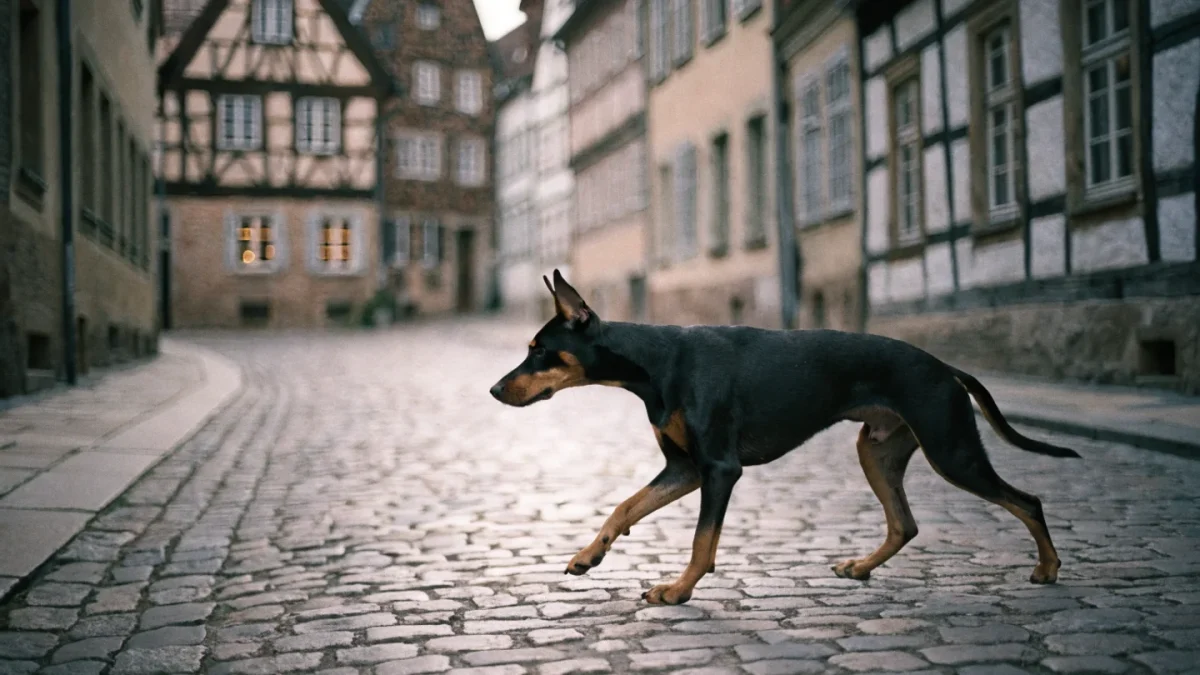
The Doberman Pinscher was created because a man with a dangerous job needed a dog nobody had built yet. In the late 1880s, Karl Friedrich Louis Dobermann collected taxes in and around Apolda, a small industrial town in the German state of Thuringia. Tax collecting in that era meant carrying money through rural areas where robbery was a real occupational hazard. Dobermann needed a dog that would stay close, intimidate the hostile, and protect him if intimidation failed. Nothing on the market met those specifications. So he decided to build one.
What makes this origin story unusual is not just the motivation — it is the method. Dobermann happened to run the local dog pound, giving him access to a rotating inventory of breeds and crossbreeds. He spent roughly a decade experimenting with combinations, selecting for courage, loyalty, speed, intelligence, and an imposing physical presence. He was not a formal breeder. He kept no published records. But he knew what he wanted and he had the raw material to pursue it.
The Apolda Foundation
The exact breeds that contributed to the early Doberman remain a matter of educated speculation. Dobermann died in 1894 without leaving detailed breeding records. Breed historians generally agree on a core group of likely contributors: the old German Shepherd (a herding type distinct from the modern breed), the Rottweiler, the German Pinscher, and the Weimaraner. Greyhound blood almost certainly entered the mix — the AKC and the Doberman Pinscher Club of America note that crosses with Greyhounds and Manchester Terriers were made around the turn of the twentieth century, likely by Otto Goeller, giving the breed its streamlined silhouette and fluid movement.
The Black and Tan Terrier, the old German Pointer, and the Thuringian Shepherd are also cited as possible contributors. What is clear from the resulting breed is that Dobermann selected heavily for drive and temperament over appearance. His early dogs were reportedly rougher in type than the modern Doberman — heavier-boned, less refined, and relentlessly bold.
After Dobermann's death, the work of standardizing the breed fell to other Apolda breeders. Otto Goeller is the most significant. Goeller refined the breed toward a more elegant physical type while preserving the protective temperament. He established the first Doberman breed club in 1899 and is credited with stabilizing the breed enough for formal registry acceptance.
The name "Dobermann Pinscher" honored the breed's creator directly — an uncommon practice in the dog world. "Pinscher" is a German term roughly translated as "terrier" or "biter," reflecting the breed's original function. Many registries later dropped "Pinscher" from the official name, though both forms remain in common use.
Rapid Adoption and Early Working Roles
The Doberman gained recognition from the German kennel system in 1900 and spread rapidly across Europe in the following decade. The breed's combination of intelligence, trainability, physical capability, and intimidating appearance made it immediately attractive for police and military applications.
German police forces were among the earliest adopters. By 1910, the Doberman was established as a police dog alongside the German Shepherd. The two breeds filled different niches — the German Shepherd excelled in versatility and stamina, while the Doberman offered greater speed and a more intense protective response.
The modern Doberman temperament — that characteristic combination of alertness, handler-focus, and discriminating wariness — was already recognizable in these early working dogs. Karl Dobermann had selected for those traits, and Goeller's refinements did not diminish them.
World War I and International Spread
World War I put the Doberman on the global stage. Germany deployed Dobermans extensively as sentry dogs, messenger dogs, and patrol dogs. Their speed made them effective runners between units. Their protective instincts made them reliable sentries. Reports from the period describe Dobermans working under artillery fire, navigating trench systems, and alerting handlers to approaching threats.
As with the German Shepherd, Allied soldiers encountered the breed during the war and were impressed. Dobermans began appearing in kennels across Europe and North America after 1918. The first Doberman Pinscher Club of America was founded in 1921, and the breed gained steady popularity through the 1920s and 1930s — though it never achieved the mainstream cultural penetration of the German Shepherd, partly because its protective temperament made it less suited to the "everyman's dog" image.
World War II: The Devil Dogs of the Pacific
The Doberman's most famous chapter of military service came during World War II, specifically with the United States Marine Corps in the Pacific Theater. The 1st Marine Dog Platoon, deployed to Bougainville in November 1943, was composed primarily of Dobermans donated by civilian owners through the Dogs for Defense program.
These dogs worked as scouts, sentries, messengers, and mine detectors in jungle conditions that were punishing for both humans and animals. They moved ahead of patrols to detect enemy positions. They carried messages between units in terrain where radio communication was unreliable. The 1st Marine Dog Platoon saw limited casualties on Bougainville itself — records indicate that only two dogs and two handlers did not return from that campaign. The heavier losses came later, during the battle for Guam in 1944, where 25 Marine war dogs — mostly Dobermans — were killed by combat, disease, heat stroke, and hookworm.
The Doberman war memorial at the National War Dog Cemetery on Guam — a life-sized bronze Doberman sculpted by Susan Bahary, entitled "Always Faithful" — was permanently installed in 1994 on the 50th anniversary of Guam's liberation. Its granite base is inscribed with the names of the 25 dogs killed during the campaign. The cemetery had fallen into jungle overgrowth before Dr. William Putney, commanding officer of the 3rd Dog Platoon, campaigned for its restoration and relocation to a new site on the Naval Air Station. The statue's inscription reads "Given in trust" — a reference to the civilian owners who surrendered their personal dogs for military service.
This wartime service cemented the Doberman's image as a fearless, loyal, and capable working dog. It also contributed to the breed's intimidation factor in the public mind — an association that would prove both beneficial and problematic in the decades that followed.
Post-War Evolution
The post-war era brought divergent trajectories for the Doberman across different countries. In Germany, the breed remained closely tied to its working roots. Schutzhund (later renamed IPO, now IGP) testing remained a prerequisite for breeding in many programs, maintaining selection pressure for working temperament and physical soundness.
In North America, the breed shifted toward conformation showing and pet ownership. American Dobermans developed a somewhat different type: taller, more refined, with longer necks and a more elegant silhouette. European lines retained heavier bone, more substance, and generally higher working drive.
The 1970s and 1980s were pivotal decades. The Doberman surged in popularity as a status symbol and personal protection dog. Unfortunately, this surge attracted volume breeding operations that prioritized appearance and market demand over health screening and temperament stability. The consequences of that period are still felt today — the breed's cardiac health crisis, in particular, has roots in genetic bottlenecks created or deepened during the rapid breeding expansion of those decades.
The genetic legacy of those foundation crosses and subsequent breeding decisions is still shaping the breed's health profile today, particularly regarding dilated cardiomyopathy and color dilution genetics.
The Breed Today
The modern Doberman Pinscher exists along a spectrum. At one end are dogs bred for competitive working sport — high-drive, physically robust, and intense. At the other are dogs bred primarily for companionship and conformation — calmer, more refined, and sometimes lacking the working instinct that defined the breed's early decades.
Both types trace back to Karl Friedrich Louis Dobermann's dogs in Apolda. Both carry the breed's characteristic intelligence, loyalty, and alertness. But the gap between the extremes has widened enough that a working-line Doberman from a European program and a show-line Doberman from North America can look and behave quite differently.
The Doberman faces challenges that its founder never anticipated. Dilated cardiomyopathy threatens the breed's long-term viability. Breed-specific legislation in various jurisdictions targets the breed based on appearance. The cosmetic debate over ear cropping and tail docking continues to divide the community.
But the core of what Dobermann built persists. The dog that walks beside its person, watches the room, and will not leave when things get difficult — that dog is still recognizable in kennels and living rooms around the world. The tax collector from Apolda wanted a partner, and 130 years later, partnership is still the defining trait of the breed he created.
The full Doberman Pinscher breed guide covers the practical realities of living with this breed today — health screening, exercise demands, grooming, and whether the Doberman's intensity is a match for your life. The history explains why the breed is the way it is. What you do with that understanding determines whether you and a Doberman belong together.