

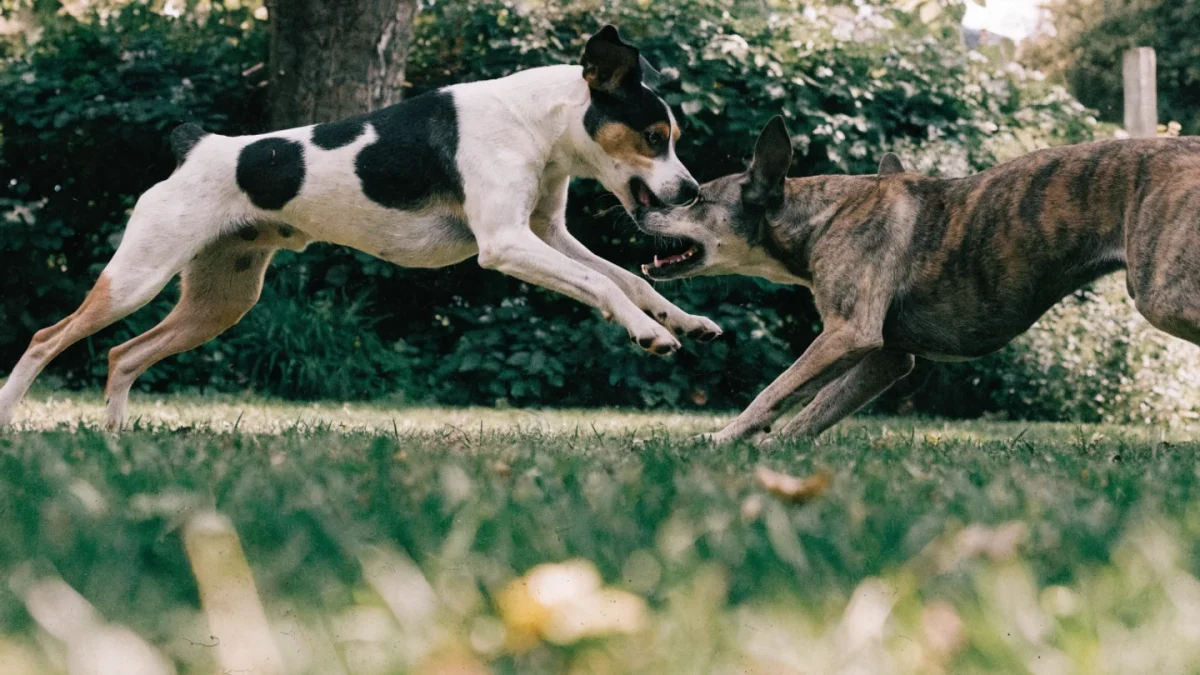
There's a line in dog play between "getting pretty rough" and "this is about to go sideways." Learning to see that line is one of the most useful skills you can develop as a dog owner.
Body slamming, pinning, relentless chasing without breaks, hackles up across the back, hard eyes — these are signals that the play has gotten too intense. Not necessarily that it's about to turn into a fight, but that arousal is at a level where the risk of it doing so has increased significantly.
What Over-Arousal Looks Like
Between dogs:
- Hackles raised (can be normal, but combined with other signals it means elevated arousal)
- Play stops looking bouncy and starts looking stiff
- One dog is trying to disengage but the other won't let them
- Hard body slams with no breaks
- Mounting repeatedly
- Hard, rapid barking rather than soft play vocalizations
- The roles stop switching (same dog is always on top or always chasing)
During play with humans:
- Escalating nipping or mouthing pressure
- Hard, rapid panting combined with fixed stare
- Dog can't respond to name or familiar cues
- Arousal is clearly higher than the play intensity justifies
Why Play Escalates
Play activates arousal systems. Long sessions of continuous, high-intensity play can take dogs over their threshold. The combination of physical stimulation, social stimulation, and competition creates a feedback loop.
Dogs that don't have reliable internal brakes — the ability to self-regulate arousal — will escalate until they hit the wall. Some dogs hit that wall with a fight. Others just hit it with mouthing or body slamming that gets excessive. Either way, a break is needed before it was reached.
Interrupting Before It Tips
Build a reliable stop-play cue. Practice interrupting play sessions regularly — not just when things get out of hand. Cue a pause in play (name, or a specific word), reward the dog for orienting to you, then resume play or end the session. The pause should happen during normal play, not just as emergency intervention.
Short sessions with multiple breaks. Five minutes of play, break, five minutes, break. The breaks give arousal time to come down and reset. Dogs that get 30-minute continuous sessions with no interruption often end up at much higher arousal than dogs who play in shorter bursts.
Interrupt before the signals appear. If you wait until the body slamming starts, you've already let things escalate. Know how long it takes your dog to ramp up, and interrupt proactively before that point.
Between-dog play. If one dog is trying to disengage and the other won't let them (the disengager turns away and gets immediately re-engaged, walks off and gets followed and body-slammed), intervene. The dog that won't allow the other to disengage is playing at a level the other dog isn't consenting to. Call the high-arousal dog out, give them a brief settle, then decide whether to allow re-engagement. (See also: relaxation protocol for dogs.)
When to End the Session
If a dog has hit clearly over-threshold — stiff, hard stare, escalated vocalization — end the play session. Separate the dogs calmly (not dramatically). Give them time to come down before any reintroduction.
The goal is to end sessions on a good note before they hit the wall, not to let things escalate and then manage the fallout.