
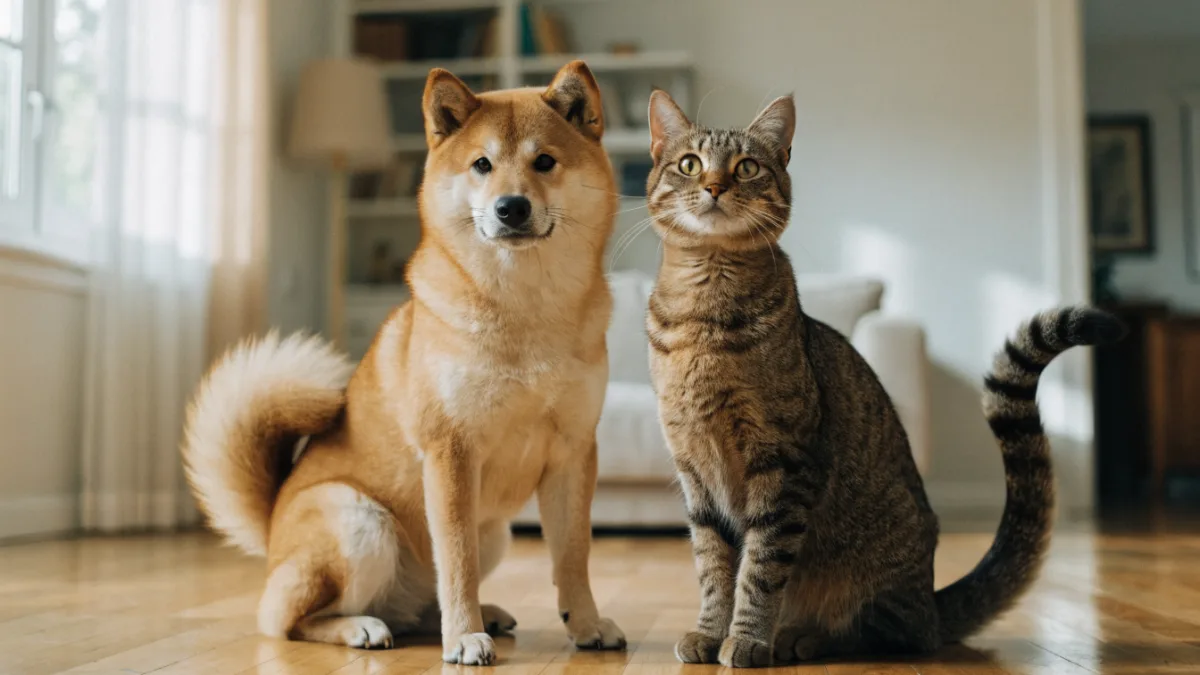
Last spring a family called me about their two-year-old Lab, Biscuit, and the tabby they’d adopted a week earlier. Everything had been peaceful. Then Biscuit spotted the cat’s tail swishing against the couch cushions, read it the way a dog reads a wag, leaned in to play, and caught a claw across the muzzle. Nobody did anything wrong. They just translated cat using a dog’s dictionary — and that’s close enough to get everybody in trouble.
A Wag Is an Arousal Meter, Not a Happiness Meter
Here’s the most persistent misread in all of pet body language: a wagging tail means the animal feels something strongly, not that the animal is happy. The tail gives you the volume. The message lives somewhere else — in the ears, the eyes, the posture.
In dogs, wagging signals arousal, and arousal can point in any direction. Dogs wag right before they pounce on a toy, right before they bark at the fence, and sometimes right before a bite. I’ve watched dogs wag hard at the vet’s office with their ears pinned and their bodies pressed into a corner. That tail wasn’t saying “I love this.” It was saying “I am extremely worked up.”
Cats flip the script. The movements we’d call wagging — swishing, flicking, thrashing — most often signal irritation, overstimulation, or predatory focus. The [1] as flat myth for cats, and [2] puts it simply: the meanings are often completely different from what the same motion would mean on a dog. Same instrument, different language.
The Dog Tail Decoder
Speed and stiffness come first
- Loose, fast, whole-body wag: the hips and spine join in, the face stays soft. Classic friendly arousal.
- The helicopter: a circular wag that spins like a propeller. Usually genuine joy — and many dogs save it for their favorite people.
- Slow, stiff wag: tension and uncertainty. A slow wag is a question, not a welcome.
- Fast wag on a frozen body: arousal that could tip either way. Watch, don’t reach.
I’ll admit a miss here. Early in my career I told an owner her slowly wagging shepherd was “just being friendly.” He wasn’t. He was deciding. That misread cost me a bruised forearm and a permanent lesson: stiffness beats speed, every time.
Height sets the temperature
- High and stiff: alert, confident, possibly reactive. Give it room.
- Neutral and relaxed: the everyday default. Nothing to report.
- Tucked tight: fear or anxiety. Don’t corner a tucked-tail dog to reassure it — let it choose to come to you.
The right-versus-left thing is real, but don’t try it at the dog park
Research worth knowing: a 2007 study in Current Biology from Giorgio Vallortigara’s lab in Italy found that dogs wag predominantly to the right when looking at something positive (their owner, for instance) and to the left when looking at something threatening. A 2013 follow-up found that dogs watching left-biased wags showed elevated heart rates and stress behaviors — so dogs are literally reading each other’s wags. The catch is that you and I can’t reliably judge that asymmetry in real time. Treat it as fascinating trivia, not a party trick.
Know your breed’s neutral
A Greyhound’s tail naturally hangs low — that sweep isn’t a signal. A Malamute or a Pomeranian carries a curl over the back, so “high tail” is just Tuesday. Docked tails and natural bobtails (think Manx cats, or bobtailed dog breeds) shrink the signal surface, and those animals lean harder on ears, eyes, and weight shifts to compensate. Learn your dog’s normal carriage first. The headlines are the departures from it.
The Cat Tail Decoder
Cats have 19 to 23 tail vertebrae — roughly 10 percent of all the bones in their bodies. That’s a lot of hardware for one appendage, and they use it: a balance pole in motion, a flag at rest. [3] frames it well — every swish, flick, and curl is the tail “talking,” and once you start listening, cats stop being mysterious.
The friendly signals
- Straight up with a hooked tip: the friendly greeting. This is the closest thing cats have to a happy wag.
- Upright with a full quiver: maximum excitement, often saved for a favorite person walking in the door.
- Tail wrapped around your arm or another pet: the feline version of an arm around your shoulder.
- Soft, slow swishing with a relaxed body: usually a content cat, thinking cat thoughts.
The warnings
- Low lashing or thrashing: irritation or overstimulation. Quality of movement matters — a relaxed bounce is curiosity; a stiff, whip-like lash is a countdown.
- Puffed into a bottle brush: fear or defensive aggression. The cat is trying to look bigger than it feels.
- Slow, deliberate swish while crouched, pupils blown wide: hunting mode. A pounce is loading.
- Tucked low or wrapped tight around the body: fear or pain.
The petting sequence behind most cat bites
The scene: cat on your lap, purring, everything wonderful. Ten minutes in, the tail starts thumping. A minute later the skin along its back ripples, the ears flatten — and then teeth find your hand, and everyone says it “came out of nowhere.” It didn’t. The tail announced it two minutes early. A huge share of cat bites to hands happen exactly here, after a missed tail warning. Build the habit: the moment the tail starts going during petting, stop. Let the cat stay or leave, and let it restart contact on its own terms. That one habit is basically cat-bite prevention 101.
Where Dogs and Cats Get Their Wires Crossed
Back to Biscuit. In dog, a moving tail is usually an invitation. In cat, a flicking tail is usually rising irritation or locked-in focus. So the loop builds: the cat flicks because the dog is pestering it, the dog sees motion and moves closer, the cat flicks harder, and the dog reads the escalation as excitement. This feedback loop is the number-one source of dog-cat friction in the homes I visit.
The fix runs both directions. Give the cat vertical escape routes — a cat tree, a gated room with a gap the cat fits through and the dog doesn’t. Teach the dog a rock-solid leave-it and reward it heavily for checking in with you instead of chasing motion. And interrupt early: the second the cat’s tail starts flicking, redirect the dog before the cat has to do the job with a paw. Never punish the cat for the swat. The swat is the conversation.
Never Read the Tail Alone
A tail is one instrument in the band. High, stiff tail plus a hard stare, a still body, and a closed mouth? That’s a dog telling you to back off, wag or no wag. Same high tail with a loose wiggle, a play bow, and a soft open face? Game on. Upright cat tail with relaxed whiskers and a slow blink? Pet away. Thrashing tail with flattened ears and dilated pupils? Hands off entirely. When the signals disagree, weight your read toward the uncomfortable ones. Skipping one petting session costs you nothing. Repairing trust after a bite costs weeks.
So here’s the takeaway: the tail tells you how much your animal feels, and the rest of the body tells you what. Spend one week deliberately watching your own pets — learn where your Lab usually carries his tail and where your tabby usually holds hers, because the departures from normal are the real headlines. Do that, and you’ll start catching the flicks and swishes before they turn into scratches and bites. Cats especially have spent decades wearing the “unpredictable” label while broadcasting clearly the entire time — we just weren’t listening. Learn the language, and you get a household where everybody finally understands each other. That’s the whole game.
Sources
- GCCF calls out the "wagging means happy" assumption — facebook.com
- PetMD's guide to cat tail language — petmd.com
- Jackson Galaxy — facebook.com