

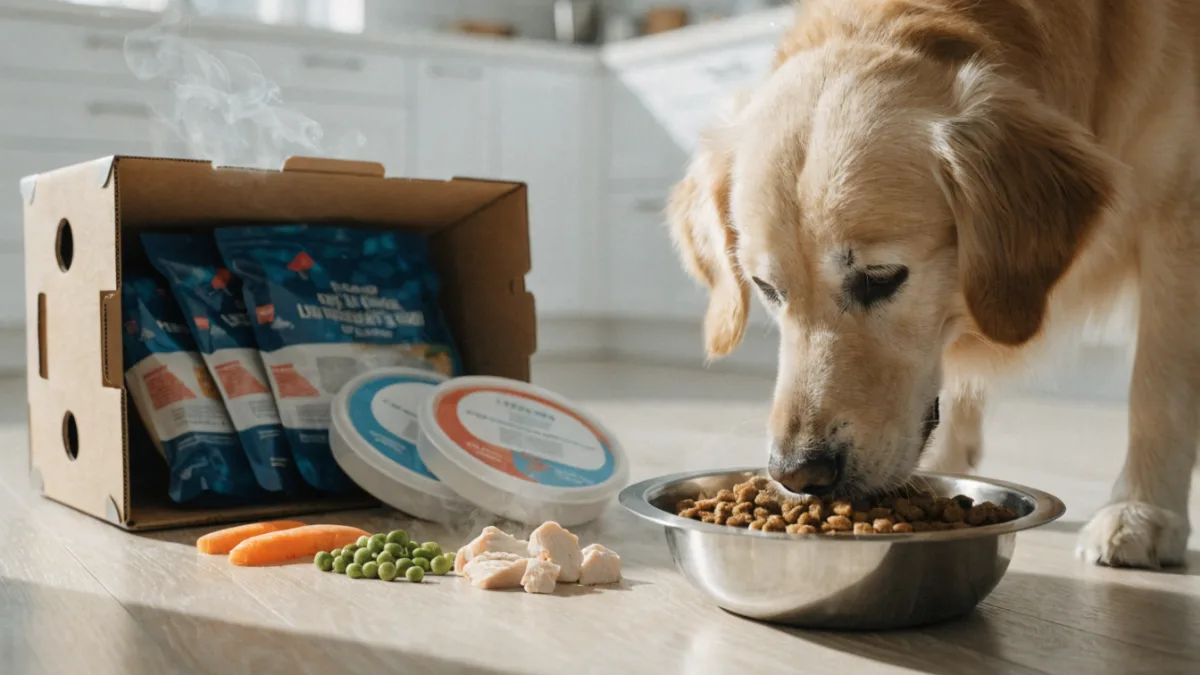
When one of my clients — a project manager named Dana who routinely works ten-hour days — told me her dog’s food now shows up in a refrigerated box on her doorstep, her exact words were, “I know it sounds absurd, but Biscuit has never eaten this well in his life.” That conversation happens in my exam room about once a week now. Fresh dog food delivery has grown from a niche curiosity into a crowded market, with subscription startups, local fresh-food kitchens, and even established refrigerated-shelf brands competing for space in your fridge. Freshpet, long a grocery-store refrigerated brand, recently launched its own direct-to-consumer subscription with [1] that ship chilled rather than frozen — a sign of just how competitive this category has become. So let’s do what I do with my clients: run the honest math, talk about who actually benefits, and figure out how to judge quality without a nutrition degree.
What “Fresh” Actually Means (and What You’re Paying For)
The core pitch is simple: refrigeration replaces artificial preservatives, and a gentler cooking process replaces the high-heat extrusion used to make kibble. The result is food with more moisture, more aroma, and — according to the companies selling it — more of the meat dogs evolved to crave.
There’s real substance here. Fresh food genuinely smells and tastes more like food, which matters more than most owners realize. But I’ll be straight with you: “fresh” is a processing description, not a nutritional guarantee. A freshly made diet can still be poorly balanced, and a well-formulated kibble can still be excellent nutrition. I’ve changed my mind on this category over the past decade — I used to dismiss fresh food as expensive marketing, and I was partly wrong. The format has legitimate advantages for certain patients. It just doesn’t automatically outclass everything else on the shelf.
The Cost-Per-Calorie Math, Without Flinching
Let’s use a real example: a 45-pound adult dog eating roughly 1,100 calories a day. In my experience reviewing diets with clients, a quality kibble typically lands around $1.50 to $2.50 per day for that dog. Fresh subscription diets usually run $5 to $9 per day. That works out to well under half a cent per calorie for kibble versus roughly a cent or more per calorie for fresh — in plain terms, fresh food delivery generally costs two to four times as much for the same energy.
Price is the category’s biggest friction point, and pet owners don’t mince words about it. As one Reddit user put it in a thread about refrigerated food:
“It’s expensive af.”
That sentiment runs throughout the [2] — quality rarely gets disputed, but the monthly bill stings. Don’t forget the hidden costs, either: packaging, insulated shipping, and the occasional spoiled bag when life gets busy and the fridge runs out of room.
There’s also a challenger argument worth hearing. Some [3] than leading subscription brands, and skipping cross-country refrigerated shipping cuts cost and freshness risk. It’s a competitor talking, so verify the numbers yourself — but the underlying point is fair: subscription convenience carries a premium, and it isn’t the only way to feed fresh.
Who Genuinely Benefits From Fresh Food
The Picky Eater
Pip, a 6-year-old Cockapoo, came to me after turning down three different kibbles over six months. His owner was hand-feeding him by the end. We transitioned him to a fresh diet, and she texted me a video the first week: Pip spinning in front of the fridge. “He acts like I’ve been starving him his whole life,” she said. Palatability is the single most reliable advantage of fresh food — the moisture and aroma are simply more appealing than dry extruded nuggets.
The Senior Pet
Gus, a 13-year-old Labrador, is my other favorite example. His sense of smell had dulled with age, his teeth were tired, and his arthritis medication was rough on his stomach. Soft, aromatic, easily-digested food got him eating again — and in seniors, keeping weight on and muscle intact isn’t cosmetic. It’s a quality-of-life issue.
Cats, With an Asterisk
The best fresh cat food options are harder to find — the feline market is much smaller than the canine one — but cats can benefit doubly. Many cats are chronic under-drinkers, and a moisture-rich diet supports urinary health. If you go this route, look for added taurine and a clear complete-and-balanced statement for all life stages or adult maintenance.
Who Doesn’t Need It
A healthy adult dog thriving on a balanced kibble doesn’t need an upgrade. Don’t fix what isn’t broken. And if you’re tempted to cook fresh food yourself, I understand the impulse completely — but homemade diets are notoriously unbalanced without professional guidance. Ask your vet for a referral to a veterinary nutritionist before going that route.
Portion Accuracy: The Underrated Superpower
Here’s where I think fresh subscriptions quietly earn their keep, and it’s the angle nobody markets hard enough. Researchers have found that household measuring cups are surprisingly inaccurate — owners routinely over- or under-portion by amounts that compound into real weight change over months. Pre-portioned packets, calculated from your pet’s profile, remove that guesswork entirely.
Winnie, a beagle who came to me at 38 pounds needing to lose seven, is proof. Her owner had been “measuring” kibble with a cup that somehow always ran heaping. Six months on vet-guided pre-portioned fresh meals, with weigh-ins every three weeks, and she hit her target. Was it the fresh food itself? No — the calorie deficit did the work. Fresh food isn’t magic for weight loss. But the built-in portion control and the lower calorie density per cup (all that moisture adds volume without calories, which helps hungry dogs feel satisfied) made the plan stick. One important note: any weight-loss plan should be built with your veterinarian, including a target weight and a calorie budget. Never wing it.
How to Judge Quality (Because Most Owners Admit They Can’t)
The most telling finding from owner discussions: people paying premium prices openly admit they don’t know where to even start evaluating what they’re buying. So here’s the checklist I hand clients, whichever brand or local kitchen you choose:
- A nutritional adequacy statement — in the US, that’s an AAFCO statement for the right life stage; other countries have equivalent certifications
- A named animal protein as the first ingredient, and a company that employs or consults a veterinary nutritionist
- Protein compared per 1,000 calories, not by percentage — moisture content makes percentages wildly misleading between fresh brands, so ask for calorie-basis numbers
- Clear calorie content on the label, stated per cup or per package
- A cold-chain shipping guarantee and transparent recall history
Price per 1,000 calories is the great equalizer when comparing subscriptions against local options — that single number cuts through nearly all the marketing.
So, is the fridge delivery worth it? For picky eaters like Pip, seniors like Gus, hydration-challenged cats, and dogs like Winnie whose waistlines need the accountability of pre-portioned meals — yes, many households will find it worth every penny. For a healthy adult dog doing well on a good kibble, it’s a luxury, not a necessity. One last thought as you decide: refrigerated cross-country shipping carries a real carbon and packaging footprint, so consolidating deliveries, recycling that insulation, or sourcing from a local kitchen lets you give your pet the benefits of fresh while keeping the planet — which they’ll inherit alongside us — in the bargain, too.
Sources
- five scoop-and-serve recipes — freshpet.com
- discussion among dog owners — reddit.com
- local fresh-food makers claim their recipes contain significantly more protein — dogdogcat.com