

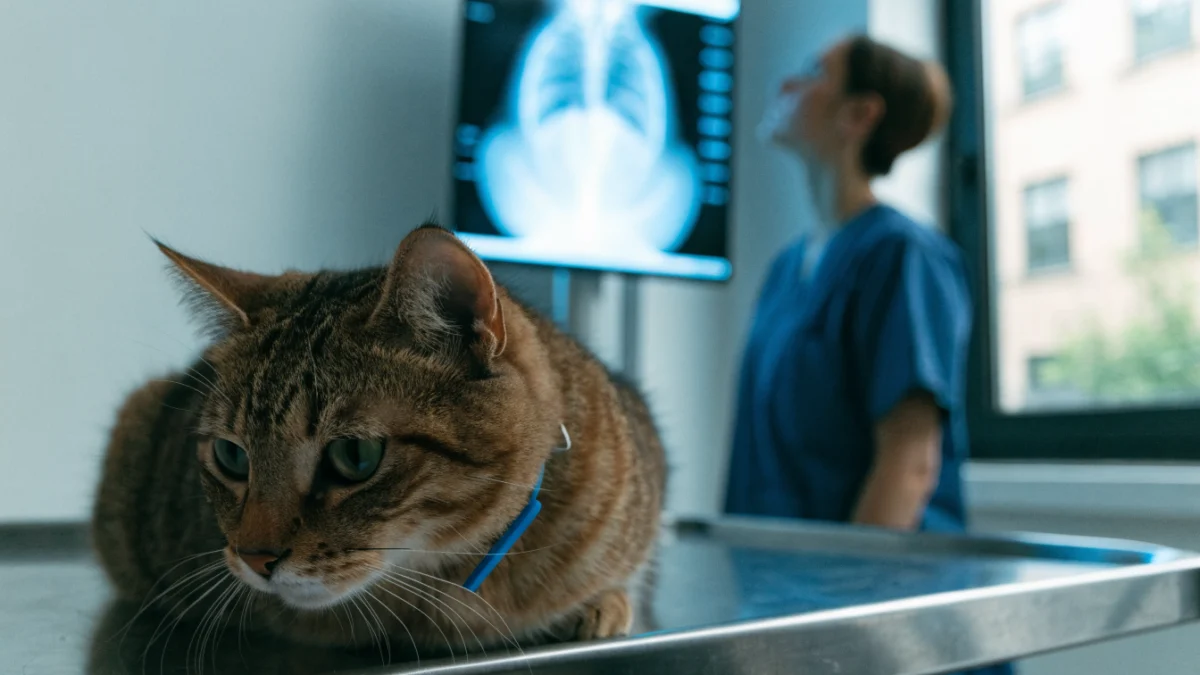
Just last spring, a client named Marisol brought her eight-year-old indoor tabby, Luna, into my clinic. Luna had been perfectly normal that morning—eating, basking in her window sunbeam, swatting at the dog’s tail. By afternoon, she was gasping for air on Marisol’s kitchen floor. “She just started coughing and then collapsed,” Marisol told me, her hands shaking as she handed me the carrier. We rushed Luna into the back, and what I found on her chest X-rays stopped me cold. Her lungs were a mess of severe inflammation that looked almost like asthma—but it wasn’t asthma. It was heartworm. Luna had never set a paw outside her apartment.
The Parasite That Was Never Meant to Be Here
Here’s something that surprises most of my clients: heartworms don’t actually want to be in cats. Dogs are what parasitologists call the definitive host—the natural, intended target where the parasite thrives, matures, and multiplies. When a heartworm lands in a dog, it’s basically checked into a five-star hotel. The worms grow to adulthood, set up shop in the heart and pulmonary arteries, and produce thousands of offspring that circulate in the bloodstream, waiting for the next mosquito to carry them forward.
Cats, on the other hand, are what we call atypical hosts. Think of a heartworm trying to survive inside a cat like a tropical fish dropped into an ice-cold lake. The cat’s immune system recognizes the invader immediately and mounts a fierce, aggressive defense. Most of the migrating worm larvae never make it to maturity. In fact, a 2020 study by Hays and colleagues found that while 28% of dogs in tested populations had adult heartworm infections, only about 4% of cats did. Sounds reassuring, right? Here’s the problem: when researchers combined antibody and antigen testing to look for any evidence of exposure—meaning cats whose immune systems had encountered heartworm larvae even if the worms didn’t survive—that number jumped to 19%. Nearly one in five cats had been exposed.
Why Fewer Worms Can Mean Worse Outcomes
This is where the story takes a dark turn, and it’s the reason I lose sleep over feline heartworm in a way I don’t with canine cases. A dog might carry twenty, thirty, even fifty adult worms and still walk into my clinic coughing but alive. The disease progresses relatively slowly in dogs over months or years, giving us time to diagnose and treat. Cats typically harbor only one or two worms. Sometimes just one. And that single worm can kill a cat within hours.
I remember a colleague describing a case that still haunts her—a three-year-old Maine Coon named Sir Reginald who came in for routine dental cleaning. His pre-anesthetic bloodwork and chest X-rays looked fine. He went under, the dental went smoothly, and he recovered normally. Three weeks later, he dropped dead in his owner’s living room. On necropsy, they found a single adult heartworm in his pulmonary artery. One worm. The sudden death was likely triggered when that worm died and caused an acute anaphylactic-type reaction.
In cats, heartworm disease isn’t really a heart disease at all—it’s a devastating lung disease that we call HARD, or Heartworm Associated Respiratory Disease.
The Deadly Mechanism of Dying Worms
Here’s what happens, and it’s crucial to understand if you have a cat. Because the feline body is so hostile to heartworms, most of the parasites die before they ever reach adulthood—usually around three to four months after the initial infection. That sounds like good news, and in dogs it would be. But in cats, it’s actually the moment of greatest danger.
When a juvenile worm dies inside a cat, it doesn’t just quietly disappear. It breaks apart inside the delicate blood vessels of the lungs. The cat’s immune system, already on high alert, reacts to this dead worm tissue like a bomb going off. Massive inflammation floods the pulmonary tissue. Blood clots form. The airways constrict. The result is acute respiratory distress that can look identical to a severe asthma attack—or it can cause sudden collapse and death without any warning whatsoever. I’ve seen cats present with wheezing, coughing, and vomiting that owners assumed was a hairball problem, only to discover the real cause was heartworm-associated lung damage.
The Diagnostic Trap
If you’re thinking, “Well, I’ll just get my cat tested,” I need to be honest with you about something that frustrates veterinarians daily. Standard heartworm testing in cats is deeply flawed, and the veterinary community is still debating how to handle this.
The antigen test we use so effectively in dogs detects specific proteins produced by adult female heartworms. It’s reliable in dogs because they typically harbor multiple mature worms, including females. But cats often have only one or two worms—and those worms are frequently male or haven’t reached full maturity. The result? Antigen tests produce false negatives in cats at alarming rates. A cat can test negative and still harbor a lethal infection.
Antibody tests offer a different piece of the puzzle—they tell us whether a cat’s immune system has ever encountered heartworm larvae—but they can’t confirm whether an active infection exists right now. They simply prove exposure happened at some point. The most accurate approach combines both test types along with echocardiography (ultrasound of the heart), which can sometimes visually identify worms in the pulmonary arteries. But this is expensive, and some veterinarians argue that the high false-negative rate makes routine annual testing less valuable for cats than for dogs, potentially giving owners false reassurance.
I’ve changed my own thinking on this over the years. Early in my career, I was less aggressive about recommending combination testing for cats. But after seeing enough cases like Luna’s—cases where a single antigen test came back negative while the cat was actively dying from heartworm-associated lung disease—I now believe that when we suspect heartworm in a cat, we need to cast the widest diagnostic net possible.
When There’s No Cure, Prevention Becomes Everything
This is the part of the conversation I dread having with cat owners. In dogs, we have an adulticide treatment—a medication called melarsomine that kills adult heartworms. It’s not pleasant, it’s not cheap, and the treatment process takes months, but it works. Dogs can be cured.
There is no approved adulticide for cats. Melarsomine is toxic to felines—using it would likely kill the cat before it killed the worms. So when a cat is diagnosed with heartworm disease, everything we do is supportive, not curative. We give steroids to reduce the terrifying lung inflammation. We manage symptoms. We provide oxygen therapy during acute crisis episodes. And essentially, we try to keep the cat alive long enough for the worm to die on its own—knowing full well that the worm’s death might be what kills the patient.
This is why the veterinary community has shifted so aggressively toward a prevention-first paradigm for cats. Monthly heartworm preventatives—both topical and oral formulations—are highly effective at killing heartworm larvae before they can migrate into the tissues and cause problems. They’re safe, they’re relatively inexpensive compared to emergency critical care, and they work. The American Heartworm Society and other veterinary organizations now recommend year-round prevention for all cats, regardless of indoor or outdoor status.
Indoor Cats Are Not Safe Cats
I hear this constantly: “But Dr. Mitchell, my cat never goes outside.” I understand the logic, but mosquitoes don’t respect closed doors. They slip through screens, they hitchhike into homes on clothing, they breed in the tiny pools of water collecting in plant saucers or shower drains. A 2019 survey found that a significant percentage of heartworm-positive cats were described by their owners as strictly indoor animals. Luna, the tabby I mentioned at the beginning—she hadn’t been outside in eight years. We traced the likely source to a mosquito that entered through a damaged window screen during summer.
When you live with a cat, you’re not deciding whether heartworm exposure is possible—it almost certainly is at some point. You’re deciding whether exposure becomes infection. And that decision hinges entirely on whether that cat is on consistent, year-round prevention.
The Bottom Line for Cat Guardians
We managed to save Luna. She spent four days in our oxygen cage, received aggressive corticosteroid therapy, and slowly recovered as the inflammation in her lungs subsided. Whether she still harbors a worm or whether it died and cleared during that crisis, we may never know for certain—her follow-up tests remain inconclusive, which is painfully common in feline cases. She’s now on monthly prevention and will be for the rest of her life.
Not every cat is as fortunate. The hard truth about feline heartworm disease is that by the time you see symptoms, you’re often in an emergency situation with limited treatment options and no guarantee of survival. The worms may be fewer, the infection rarer, and the host more resistant—but the consequences are disproportionately severe. Prevention isn’t just the best strategy for cats. Right now, with no feline-approved cure available, it’s the only one that actually works.
If there’s one thing I hope you take away from this, it’s this: talk to your veterinarian about heartworm prevention for your cat, even if that cat has never felt grass beneath its paws. The cost of monthly prevention is a fraction of what an emergency hospitalization will run—and more importantly, it might save your cat from becoming a story I have to tell at my next continuing education seminar, the kind that keeps all of us in the profession up at night.