

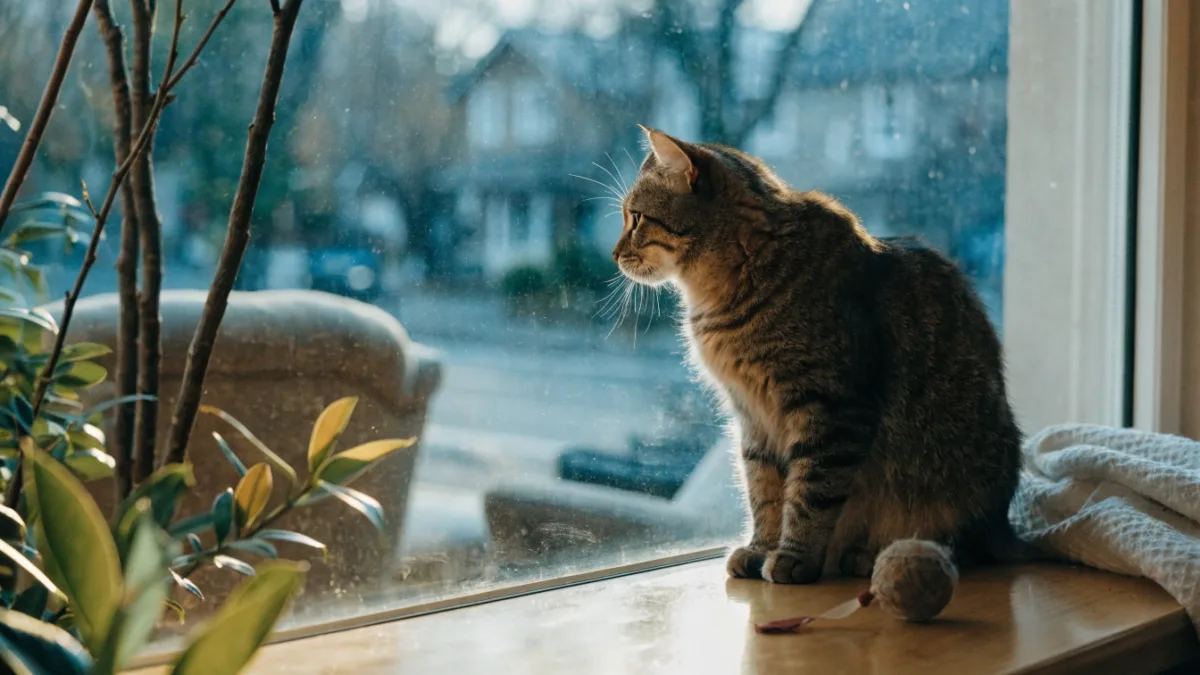
Picture a rainy Tuesday evening: a four-year-old calico named Marigold is brought into a clinic, her owner in tears. Marigold had been hit by a car. Her left hind leg was shattered, and she was in shock. She survived — three surgeries and a considerable amount of money later — but the case is the kind that stays with you. Her owner, a kind woman in her sixties who lived on a quiet country road, asked with red eyes: “I thought she’d be happier outside. Was I wrong?” The honest answer, based on decades of data, is sobering. Let’s talk about why where your cat lives has a dramatic, measurable impact on how long they live — and what that means for those of us who love them.
The Numbers Don’t Lie: A Decade-Long Difference
If you’ve ever wondered whether keeping your cat indoors truly matters, the statistics are striking. Indoor cats live, on average, between 12 to 20 years, with many reaching their early twenties. Free-roaming outdoor cats, by contrast, average just 1 to 5 years of life. That’s not a typo. We’re talking about a potential difference of ten to twelve years of companionship.
I remember presenting this data at a community talk a few years back, and a man in the back raised his hand. “My cat Whiskers lived to be eighteen, and he was outside every day of his life.” I smiled and nodded, because he’s right — there are always outliers. But statistics describe populations, not individuals. For every Whiskers who beats the odds, dozens of cats don’t make it past their second or third birthday. An [1] looked at cat ownership patterns across multiple countries, and the findings reinforced what those of us in clinical practice see every day: where and how a cat lives is one of the strongest predictors of how long they’ll live.
What’s Actually Killing Outdoor Cats?
Vehicles: The Leading Cause
The most common cause of premature death in outdoor cats is vehicular trauma. Cats don’t understand traffic. They spook, dart, and make split-second decisions that put them directly in the path of a two-thousand-pound vehicle moving at speed. I’ve seen it more times than I care to count. Even on quiet suburban streets, a single unexpected car backing out of a driveway can be fatal.
Predators You Might Not Expect
Depending on where you live, outdoor cats face threats from coyotes, foxes, raccoons, and even birds of prey. A client of mine in a wooded suburb lost her seven-month-old kitten to a hawk. She hadn’t even known hawks hunted in her area. In rural environments, coyotes are a devastatingly efficient predator of domestic cats. In urban areas, it’s the traffic. The specific threats vary, but the danger doesn’t.
Disease and Fights
Then there’s the invisible danger. Outdoor cats interact with other cats — feral colonies, neighborhood strays, and other pets allowed to roam. These encounters lead to bites, scratches, and the transmission of serious viral infections. Feline Leukemia Virus (FeLV) and Feline Immunodeficiency Virus (FIV) are the two big ones. FeLV suppresses a cat’s immune system and dramatically increases their risk of cancer and other diseases. FIV, sometimes called “feline AIDS,” works similarly by slowly damaging the immune system over years.
Bite wounds from territorial fights also lead to painful abscesses — pockets of infection that often require surgical drainage and antibiotics. I once treated a tomcat named Bruno who came in with three separate abscesses from fights in a single week. His owner finally decided to keep him inside after I explained that each fight was essentially a game of Russian roulette with FeLV and FIV.
“But Aren’t Outdoor Cats Happier?”
This is the question I get more than any other on this topic. And I understand where it comes from. Cats are natural hunters. They’re curious, active, and mentally stimulated by the complexity of the outdoor world. There’s something in us that resists the idea of confining an animal that, deep down, wants to roam.
But happiness is a tricky thing to measure, and I’ve changed my mind on this over the years. Early on, I was more neutral about outdoor access. I figured the mental enrichment outweighed the risks for some cats. Then I started paying closer attention to the outcome data — the traumatized cats, the sick ones, the ones who’d been hit by cars. I stopped seeing the outdoors as enrichment and started seeing it as a minefield.
The truth is, we can provide everything a cat needs indoors. Mental stimulation comes from interactive play, puzzle feeders, window perches where they can watch birds, and climbing structures that let them express their natural vertical territory behaviors. Hunting instincts can be satisfied with wand toys, laser pointers (always end with a physical toy they can “catch”), and food-dispensing toys that make them work for meals.
The Magic of the “Catio”
One of the best developments I’ve seen in recent years is the rise of the catio — an enclosed outdoor patio designed specifically for cats. These structures allow cats to experience fresh air, sunshine, and the sights and sounds of nature without exposure to the dangers of free roaming. They can be as simple as a window box or as elaborate as a full screened-in porch with multiple levels and climbing platforms. I’ve had several clients build them, and the transformation in their cats’ behavior — more relaxed, more active during play sessions, sleeping more soundly — has been remarkable.
Leash-training is another option that’s gained traction. Yes, you can walk a cat on a leash. It takes patience and the right harness, but many cats take to it surprisingly well and enjoy supervised outdoor time. The key word there is supervised.
The Demographic Shift: Who Keeps Cats Indoors?
The research I mentioned earlier revealed some interesting patterns about who keeps cats indoors. Owners aged 26 to 35 — largely Millennials — are significantly more likely to keep their cats strictly inside. This aligns with a broader cultural shift in how we view pets: less as independent outdoor animals and more as family members whose safety we prioritize. City dwellers, not surprisingly, also lean toward indoor-only living. High traffic density and lack of safe outdoor space make the decision almost automatic.
What I found particularly interesting was the multi-cat factor. Households with more than one cat are more likely to keep them all indoors. This makes intuitive sense — cats provide each other with social interaction and play opportunities, reducing the perceived need for outdoor stimulation. If you’re considering getting a cat and you work long hours, adopting a pair might actually be one of the best things you can do for their collective wellbeing.
I saw this play out with a client named Derek, who adopted two littermates after his old cat passed away. He’d always let his previous cat outside, but with the kittens, he decided to keep them in. “They entertain each other,” he told me at their one-year checkup. “Honestly, I don’t think they even know what they’re missing.” Both cats were healthy, bright-eyed, and at ideal body weights. Contrast that with Marigold, the calico I mentioned earlier, who was an only cat with free outdoor access.
The Wildlife Factor
I’d be remiss if I didn’t mention the other side of this conversation. When we talk about outdoor cats, we tend to focus on the risks to the cats themselves — but free-roaming cats also pose a significant threat to local wildlife. Domestic cats are not native to most ecosystems where they live, and they are exceptionally efficient hunters. Free-roaming and feral cats are responsible for the deaths of billions of songbirds and small mammals every year. Wildlife biologists and conservation organizations have been sounding the alarm on this for years, and the data is sobering.
This isn’t about making cat owners feel guilty. It’s about recognizing that keeping cats indoors is a win-win — it protects our cats and the native wildlife that has no natural defense against such an effective predator. The endangered songbird in your backyard doesn’t stand a chance against a cat who’s just doing what comes naturally.
Making the Transition
If you currently have a cat who goes outdoors, you might be reading this with a sinking feeling. I get it. Transitioning an outdoor cat to indoor living can be challenging, but it’s absolutely doable. The key is gradual change and environmental enrichment. Start by increasing indoor play sessions. Add vertical spaces — cat trees, shelving, window perches. Consider building a catio or leash-training. If your cat is used to hunting for part of their meals, switch to food-dispensing puzzle toys.
Be patient. Some cats will vocalize and seem frustrated at first. This typically improves within a few weeks as they adjust to their new routine. And if you’re struggling, talk to your veterinarian — we can help troubleshoot and rule out any underlying medical issues that might be contributing to behavioral changes.
At the end of the day, the choice between indoor and outdoor living for your cat is one of the most consequential decisions you’ll make as a pet owner. The statistics are clear: indoor cats live dramatically longer, healthier lives. And with thoughtful enrichment — catios, interactive play, environmental complexity — they can live happier lives, too. When I think about Marigold, recovering in her cage that evening, and the decade of life she might lose to the outdoors, I’m reminded of why I advocate so strongly for keeping cats inside. We owe it to them, and we owe it to the wildlife they would otherwise impact. The great indoors isn’t a compromise. It’s a gift — of time, of health, and of the many more years we get to spend with the animals we love.
Sources
- international study published in 2021 — pmc.ncbi.nlm.nih.gov