

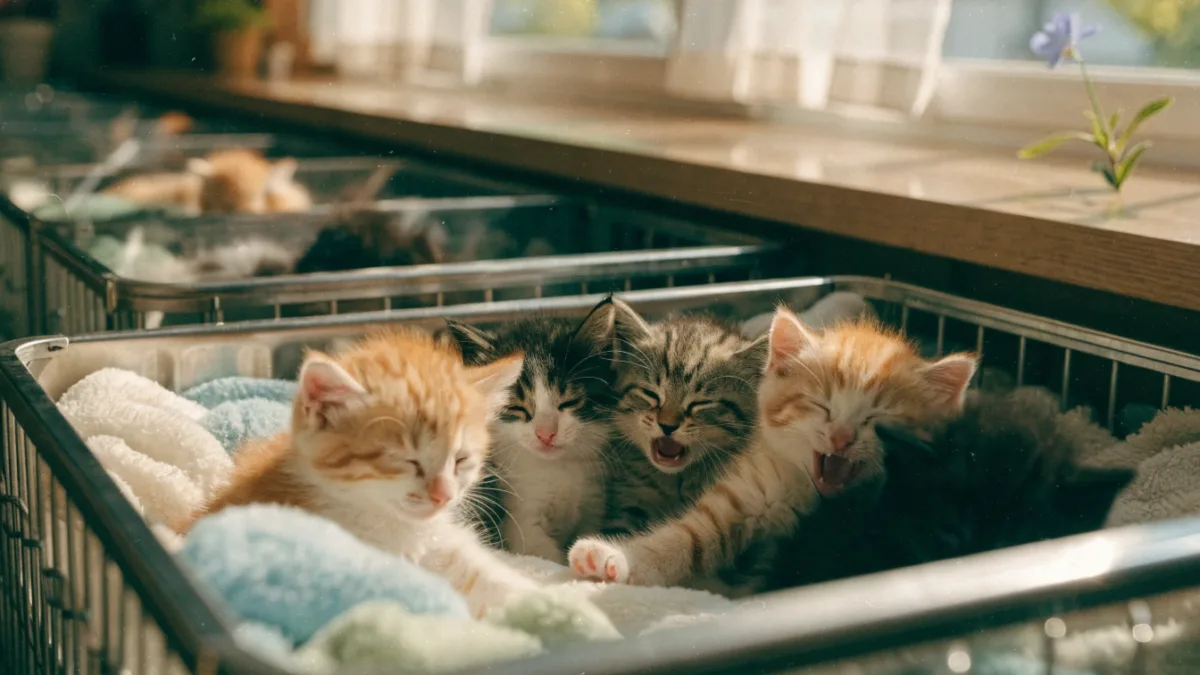
Walk into an animal shelter in January and you can count the kittens on one hand. Walk into the same shelter in May and you’ll start to wonder if there’s a portal to another dimension in the back room. Shelter workers call this annual flood kitten season — the months-long surge of litters that runs roughly from early spring through fall — and despite the adorable name, it’s the most exhausting stretch of the year for everyone inside. The,[1] describes shelters getting flooded with litter after litter, most of them born outdoors to stray or feral cats. So what’s actually behind this every single year, and what can one person reasonably do about it? More than you’d think.
The Biology of the Boom
Kitten season isn’t random — it’s daylight. Cats are what biologists call seasonally polyestrous, which is a fancy way of saying their reproductive cycles get switched on by increasing day length. When the days start stretching in late winter, female cats begin cycling, tomcats notice (they always notice), and by the first warm weeks of spring, the first litters arrive. Warmer weather and better access to food do the rest, boosting how many kittens born outdoors actually survive long enough to end up in someone’s care.
Then the math compounds. A female kitten can get pregnant as young as four months old — before many people have even thought about fixing her — and an unspayed female can produce two to three litters a year of four to six kittens apiece. You’ve probably seen the viral claim that one cat and her descendants can spawn hundreds of thousands of cats within seven years. That figure is a mathematical projection, and researchers have genuinely squabbled over it, but even the conservative versions of the math will ruin your afternoon.
Kitten season is “the scariest time of the year” for newborn kittens, in the words of the [2] whose estimate is that only about 25% of kittens born to feral mothers survive to six months.
One more wrinkle: in regions where winters are mild or disappearing, shelters report the season creeping longer — intakes arriving earlier, lingering later, sometimes stretching toward year-round. A longer warm season is simply a longer breeding season.
What the Flood Does to a Shelter
Shelters mark the start of kitten season on social media, usually with a chipper.[3] What they don’t show in those videos is the intake room by June: kennels designed for a trickle now holding a tide, food budgets blown, medical supplies dwindling, and staff making wrenching decisions about space. Every spring, the math gets harder.
The hardest cases are bottle babies — neonatal kittens too young to eat on their own. They need feeding every two to three hours, around the clock, weekends included. No shelter can staff that. Which means the kittens who need the most intensive care are the ones a shelter, on its own, is least equipped to save. Foster homes are the bottleneck-breaker. There is no version of kitten season that goes well without them.
I learned this the loud way. Three springs ago I fostered a bottle-baby litter thinking it would be tiny purrs and Instagram content. It was a two-week blur of alarm-clock feeds, weighing kittens on a gram scale at dawn, learning that newborns need help even going to the bathroom (look it up — it’s a whole thing), and one orange kitten who screamed like a fire alarm until fed, and then screamed some more anyway. His siblings got adopted. He did not leave. My senior cat, Dumpling, watched the entire arrangement with the expression of someone whose retirement got cancelled. Biscuit is asleep on my keyboard as I type this. Foster fails are real, I regret nothing, and I also regret everything.
How to Help in Ways That Actually Move the Needle
If you’ve ever googled “how to help animal shelters,” you’ve probably gotten vague answers. During kitten season, the needs are specific — and smaller than you’d think.
Foster — especially if you’re nervous about it
Most shelters and rescues train you, hand you supplies, and stay on call. And bottle babies aren’t the only option: many programs need short-term “kitten vacation” fosters (two weeks of kittens too small for the adoption floor), recovery fosters for mild illnesses, and on-call homes for surprise intakes. Fostering does double duty — it saves that litter and frees a kennel for the next animal through the door. Adopting during kitten season counts too, for exactly that reason.
Donate what shelters actually run out of
- Wet kitten food — the single most requested item, most places
- Kitten milk replacer (never cow’s milk; kittens can’t digest it)
- Heating pads without automatic shut-off, or microwavable warming disks — kittens can’t regulate their own body temperature
- Clean towels and fleece blankets
- A gram kitchen scale — daily weight gain is the number-one health signal in young kittens
- Cash, which becomes formula, vaccines, and spay surgeries
Check your local shelter’s wish list first — needs vary, and shelter systems differ from country to country.
Don’t kit-nap
If you find a plump, clean litter of sleeping kittens and no mother in sight, she is almost certainly nearby hunting — not abandoned. Watch from a distance for several hours before intervening. Kittens who are warm, quiet, and chunky are being cared for. Kittens who are cold, dirty, crying nonstop, or in immediate danger are a different story: call your local shelter or rescue for guidance before scooping. Shelters spend every spring trying to spread this message, because a healthy litter brought inside without its mom loses the one caregiver perfectly built for it.
The Root Cause: Spay/Neuter and the TNR Fight
The single most effective intervention is the least exciting one: fix cats before spring. Because kittens can become pregnant at four months, “we’ll spay her when she’s a year old” is precisely how kitten seasons happen. Early-age spay/neuter — around eight weeks old and two pounds — is now standard practice in shelter medicine, though norms vary among private vets, so ask yours about timing.
For cats with no home to fix them from, there’s TNR: trap-neuter-return. Volunteers humanely trap community cats, have them spayed or neutered and vaccinated, mark them with a tipped ear, and return them to their territory — where they live out their lives without producing litter after litter. More municipalities are funding these programs at scale, and some report measurable drops in kitten intake afterward.
Worth being honest about: TNR is contested. Bird and wildlife conservation groups argue outdoor cats are devastating to native wildlife — one widely cited 2013 study by Smithsonian and U.S. Fish and Wildlife Service researchers estimated free-roaming cats kill 1.3 to 4 billion birds annually in the U.S. — and some question whether TNR reduces populations fast enough. Cat welfare groups counter with their own data showing intake declines where TNR is done seriously. Both camps cite real studies, and the argument isn’t settled. But here’s where they overlap: nobody benefits from millions of kittens born outdoors. Not the cats — remember that 25% survival figure — and not the wildlife.
That’s the takeaway I’d leave you with. Kitten season is a catastrophe you can set your calendar by, which means it’s also one of the few crises we can see coming and quietly shrink. Every unplanned litter prevented is a kennel that stays open, a 3 a.m. bottle feeding that never has to happen, and one less generation of cats struggling outdoors where they die young and pressure the birds and small mammals trying to share the landscape. Fix your cat before spring. Foster a litter, or fund one. Wait for mom. None of it is glamorous, and all of it works — Biscuit, currently drooling on my spacebar, is living proof of the part where you keep one.
Sources
- Wisconsin Humane Society — whsadopt.org
- Community Cat Coalition of Washington — facebook.com
- "new arrivals!" reel — instagram.com