

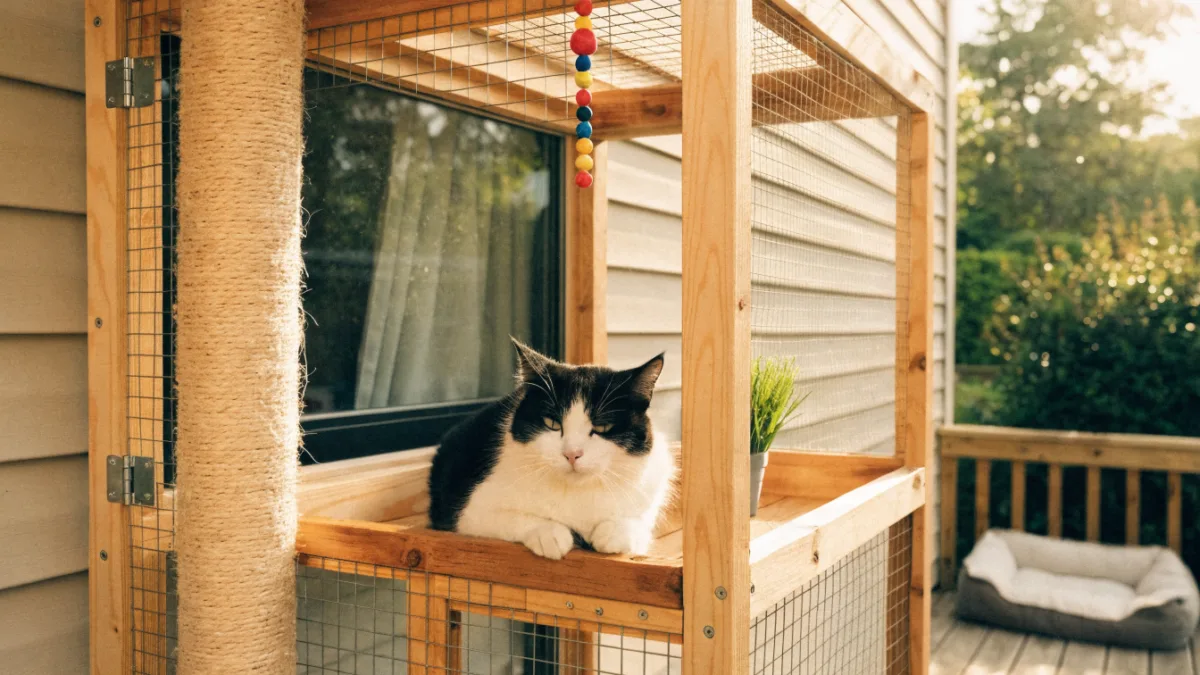
For two years, my cat Mochi treated our living room window like a personal insult. She’d press her entire face against the glass, trill at the sparrows, and then — because the birds refused to be caught through a pane like reasonable prey — take out her frustration on the corner of my couch. Then came the 5 a.m. yowling. Then the curtain climbing. Something had to give, and it was not going to be the couch.
The fix was a catio — a fully enclosed outdoor cat space that gives her real sun, real wind, and real bird drama with zero cars, coyotes, or toxic plants in the equation. It’s the rare solution that works for everyone: indoor cats commonly live 10 to 15 years or more, while free-roaming outdoor cats average just 2 to 5 because of traffic, predators, and disease. But keeping a small predator locked in a box its whole life creates its own problems. The catio is the middle ground, and it resolves most of the complaints that make cat parents tear their hair out.
Why Indoor Cats Slowly Lose Their Minds
Most “problem behaviors” in indoor cats are boredom wearing a disguise. The usual suspects:
- Destructive scratching — the couch is not the target, it’s just the only interesting texture in the room
- Excessive vocalization — Mochi’s dawn patrol of yowling was her version of a strongly worded letter
- Nighttime attention-seeking — a cat with unspent hunting energy at 3 a.m. is a cat with a plan, and you will not enjoy the plan
- Weight creep — by most estimates, half or more of pet cats in the U.S. are overweight, largely because indoor life is sedentary
- Litter box stress — understimulated cats often take their angst out on the closest thing they can control
What outdoor access adds is stimulation you genuinely cannot replicate indoors: shifting wind, changing smells, the slow-motion soap opera of the bird feeder. A catio doesn’t just contain your cat outside — it gives their brain a job. Within a week of ours going up, Mochi’s 5 a.m. concerts mostly stopped. She was tired. Gloriously, appropriately tired.
Pick Your Format: Four Catio Ideas That Scale
The Window Box
The gateway catio. It’s a small enclosed shelf that mounts outside a window, accessed through the open window or a wall-mounted cat door. Expect roughly $50–$300 in materials if you build it yourself. Newer designs use clear polycarbonate panels for a panoramic “cat solarium” effect, which is exactly as smug as it sounds. If you’re unsure whether your cat will even care, start here.
The Balcony Wrap
If you have a balcony, you can wrap the existing railing and overhead with mesh to create a fully enclosed zone — this is the classic apartment move. Costs run the gamut depending on size, but it’s one of the cheapest ways to get meaningful square footage.
The Attached Walk-In
The sweet spot for most houses: a frame structure connected to the house through a cat door, window, or screened porch. Big enough for you to sit inside (highly recommended — it’s the best seat in the house now), small enough to build in a weekend or two. Free and low-cost,[1] are widely available, so you’re not designing from scratch.
The Freestanding Enclosure
The full backyard build: shelves at multiple heights, ramps, perches, maybe a sunbathing platform. Any outdoor cat enclosure at this scale becomes a landscape design project, and honestly, the sky’s the limit — cedar tunnels, climbing towers, the works.
The Honest Cost Breakdown: DIY vs. Prefab
Here’s roughly what each tier runs, DIY versus prefab or professionally built. Prices swing with lumber and your local hardware situation, so treat these as planning ranges:
| Catio type | DIY cost | Prefab / professional |
|---|---|---|
| Window box | $50–$300 | $200–$600 |
| Small attached enclosure | $200–$600 | $500–$1,500 |
| Large walk-in enclosure | $500–$2,500 | $1,000–$5,000+ |
| Custom professional build | — | $3,000–$10,000+ |
My opinion, worth every penny you’re paying for it: DIY if you own a drill and have a free weekend, prefab if you’d rather skip the lumber store and the swearing. The markup on prefab is real, but so is the finish quality. Either way, build small before going big — a $150 window box will tell you whether your cat is a catio cat or a “I preferred the couch, actually” cat.
How to Build a Catio That Actually Works
Materials That Matter
A good [2] will walk you through framing, but the non-negotiables are these:
- Mesh: galvanized welded wire or hardware cloth, 16-gauge, with openings of 1″ x 1″ or smaller. Chicken wire is a suggestion, not a barrier — raccoons can tear through it, and raccoons are exactly who you’re building against.
- Framing: 2×2 or 2×4 lumber, cedar or pressure-treated.
- Access: escape-proof latches on every door. For walk-in catios, a double-gated entry (two doors with a small vestibule between them, like a kennel transition) prevents the door-dash escape artist special.
- Roofing: polycarbonate panels give shade, rain protection, and UV filtering in one move.
The Safety Checklist
- Perches and shelves at multiple heights — cats measure a space vertically, not horizontally
- Full or partial shade plus a fresh water station
- Cat-safe plants only. No lilies, sago palm, or azaleas — all seriously toxic. Cat grass and catnip are safe bets.
Regional Reality Checks
Your climate dictates your build. In desert heat, like the [3] full shade coverage, real ventilation, and heat-safe materials aren’t optional — a sun-trap catio is worse than no catio. In regions where coyotes, hawks, owls, or snakes are part of daily life, heavy-gauge mesh and a dig-proof base edge are what turn an outdoor space into a safe one. That heavy-gauge wire isn’t just keeping your cat in; it’s keeping the neighborhood’s wildlife career opportunities out.
The Dog Sun Zone (and Renter-Friendly Workarounds)
Borrowing the Concept for Dogs
Dogs want the same thing cats want: a safe patch of outdoors they can access without you playing doorman. The model I’ve seen work beautifully — and the one my friend Jake built for his retriever, Waffles — is a secured run off the house with a dog door, positioned alongside or sharing a wall with the catio. Multi-pet households get adjacent outdoor zones: the cats sun themselves on their shelf, the dog flops in his patch of sun, everyone watches the same squirrel from their own territory. For the dog side, prioritize shade coverage, constant water, a dig-proof floor, and shelter from wind — that’s environmental design, not training, and it’s the part people skip.
If You Rent
You are not shut out of this, I promise. Before anything else, check your lease, building rules, and any homeowners association policies — visible exterior structures are a classic friction point, and it’s better to know upfront. Then look at no-drill options: freestanding balcony enclosures that sit inside the railing, tension-mounted mesh systems, and pressure-fit window units that come down without a trace. When you talk to your landlord, bring a removal plan — “this leaves zero structural damage” is a genuinely persuasive sentence.
There’s a saying in catio circles that I think about more than is probably normal:
A catio protects your cat from the world, and the world from your cat.
Both halves are true. Cats free-roaming in the U.S. alone kill an estimated 1.3 to 4 billion birds and billions more small mammals every year, and the IUCN lists the domestic cat among the world’s worst invasive species — that’s the uncomfortable cost of “letting them be natural.” Meanwhile the coyotes, raptors, and cars on the other side of that equation are why outdoor cats live such short lives. The catio is one of the only setups that conservation groups and cat welfare advocates actually agree on, which in the indoor-versus-outdoor wars is nothing short of a diplomatic miracle. Annual catio tours now run in cities from Seattle to Tucson, so the idea has thoroughly left the fringe.
Mochi still yells at birds every morning. The difference is that now she does it sun-warmed and safely enclosed, sleeps through the night, and has mostly forgiven the couch. If your cat is pacing the windowsill like it owes them money, build the window box first. You’ll know within a week whether you’re about to become one of those people with a cedar tunnel in the backyard — and speaking from experience, it’s a great thing to become.
Sources
- downloadable catio plans — catiospaces.com
- step-by-step build guide — coloradoanimalrescue.org
- Arizona builds cat owners share in catio communities — facebook.com