

My friend Sarah called me last summer in a state of quiet shock. She’d just spent a genuinely offensive amount of money on new sod, and her Border Collie mix, Biscuit, had transformed it into what could only be described as an archaeological excavation site. “He found a mole,” she said, voice flat. “One mole. And now I have a crater where my lawn used to be.”
I’d love to say I offered wisdom, but I was standing in my own living room watching my cat Mochi press her face against the window screen so hard her whiskers bent sideways, making a sound like a broken thermostat. She wanted OUT. Not the supervised porch-sitting kind of out. The real kind. The kind that ends with me standing in a neighbor’s bushes at dawn in my pajamas, shaking a treat bag and losing an argument with a nine-pound animal.
Both situations taught me the same thing: if you don’t design outdoor space around how your pet actually behaves, the yard designs itself — usually into mud pits and escape routes. And here’s the part nobody tells you upfront: dogs and cats need completely different things from the outdoors.
The Dig-Proof Dog Yard: Outsmarting the Excavator
Dogs need room to run, a place to do their business, and — critically — boundaries they can’t undermine. Sometimes literally.
Surface Wars
Let’s talk ground cover, because this is where most people get it wrong first. Natural grass seems like the obvious answer, and it’s lovely — until you have a high-energy dog running the same fence-line path every time a squirrel taunts them. Grass in high-traffic or shady spots shreds fast. Then comes the mud. So much mud.
Pea gravel is a popular alternative, and I understand the appeal: decent drainage, doesn’t turn to soup in rain, looks tidy. But some dogs eat rocks. Not all of them, not even most, but enough that any vet will tell you it’s a real and expensive problem. Intestinal blockages from swallowed stones are not a casual vet visit. Rough gravel also wears down paw pads over time.,[1] look for smooth, rounded river rock, and keep pieces large enough that they’re obviously not food.
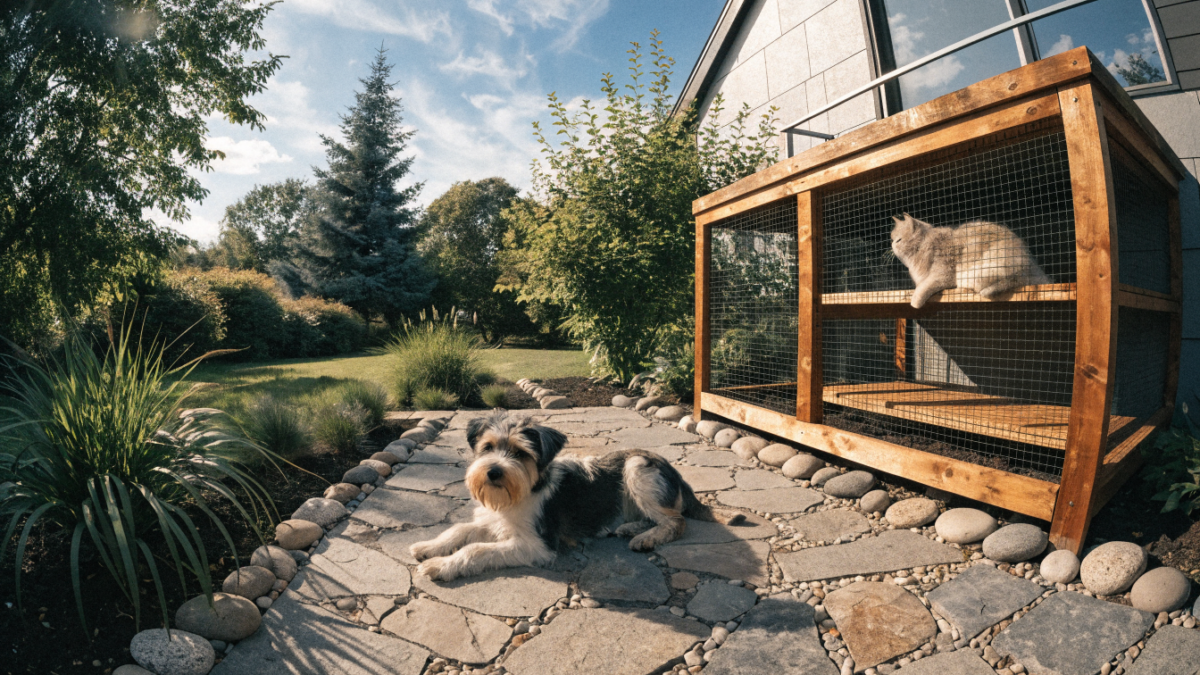
Flagstone and heavy pavers are the durable option. They look fantastic, they’re nearly indestructible, and no dog is digging through them. They’re also pricey and can get slippery when wet. Best for pathways and patio zones rather than a full-yard solution.
And then there’s synthetic turf, which is where opinions get loud and feelings get hurt.
The Turf Debate
I have feelings about artificial grass, and they’re complicated.
Synthetic turf has become the go-to for small yards, shady lots where grass refuses to grow, and homes with dogs who treat lawns like a personal vendetta. It stays green. It doesn’t die. It doesn’t turn into a mud pit in October..[2] now come with antimicrobial backings and improved drainage systems for urine — a sentence I never expected to write, yet here we are.
But synthetic turf has real downsides. It absorbs heat. In direct sunlight, artificial grass can reach temperatures that burn paw pads. If you live somewhere with intense summers, this isn’t a minor inconvenience — it’s a safety issue where your dog literally cannot walk on their own lawn at midday. Newer heat-reflective turf technologies are helping, but it’s still a factor you need to test before committing.
There’s also the environmental question: microplastic shedding, water runoff concerns, the reality of laying a plastic carpet over soil. I’m not going to declare synthetic turf evil or perfect. It’s a trade-off. Know what you’re trading.
Zoning: Give the Yard a Job Description
What actually saved Sarah’s yard wasn’t a single material — it was zoning. Instead of one undefined “dog space,” she created distinct areas with different purposes.
- Play zone: Durable surface for fetch, wrestling, and general chaos
- Bathroom zone: A designated patch where Biscuit was consistently redirected, concentrating waste in one area instead of killing grass everywhere
- Rest zone: Shaded area with a water station for cooling down between bursts of enthusiasm
Dogs are happier when their environment has clear purpose. And honestly? So are humans, because you’re no longer stepping in surprises while walking to the compost bin.
Dig Prevention: Fortifying the Fence Line
If your dog is a digger — and some breeds arrive with what amounts to built-in shovels — the fence line is your weak point. The most effective structural deterrent is hardscaping along the base: heavy pavers, large stones, or buried hardware cloth extending from the fence bottom underground. You’re making a physical statement that this is not a tunnel entrance.
I’m not going to wade into dog training — that’s Jake’s territory and he’s better at it than I’ll ever be — but addressing the underlying motivation for digging matters too. Some dogs dig because they’re bored. Some dig because they’re hot and seeking cool earth. Some dig because there’s a mole, and the mole must be caught, and no fence will stand in the way of destiny. Combine the structural fix with the behavioral one.
The Catio: Because Your Cat Shouldn’t Be Decimating Songbirds
Now we shift gears entirely, because cats are a different puzzle.
Here’s the thing I think every cat owner needs to sit with honestly: free-roaming domestic cats are an environmental disaster. They’re listed among the world’s most destructive invasive species. They’ve contributed to the extinction of dozens of bird and small mammal species globally. This isn’t a hot take — it’s well-documented conservation science. When Mochi sits at the window chattering at sparrows, I remind myself that her hunting skills, while genuinely impressive, do not belong in my local ecosystem.
Catios — cat patios, enclosed outdoor spaces — are the answer that lets everyone win. Your cat gets fresh air and stimulation. The local wildlife gets to keep living.
Enclosure, Not Open Yard
Unlike dogs, cats can’t just have “the yard.” They climb anything. They compress their bodies through gaps that shouldn’t physically accommodate them. They vanish with a casualness that’s honestly impressive and deeply stressful.
A proper catio is fully enclosed — screened or welded wire on all sides, including the top and floor. The floor matters: cats dig too, especially when motivated by something interesting on the other side. Many designs use a wire flooring base with patches of natural grass or soft synthetic turf on top for lounging comfort.
The good news is that [3] You don’t need to be a carpenter or hire one. Modular DIY kits are widely available online, and many people assemble them in a weekend. The surge in demand actually gives me hope — it suggests more cat owners are taking the wildlife impact seriously rather than pretending it doesn’t exist.
Vertical Space Is Everything
This is the fundamental difference between designing for dogs and designing for cats. Dogs think horizontally. Cats think in three dimensions.
Where a dog wants a long stretch of ground to sprint across, a cat wants height. A well-designed catio uses vertical space with ramps, shelves, staggered platforms, and high perches. Mochi’s catio has a top shelf accessible via a carpeted ramp, and she spends most of her outdoor time up there, surveying the yard like a small furry dictator who believes she owns everything she can see.
Include multiple levels, varying platform sizes, and a sheltered spot for when your cat wants to feel hidden. Scratching posts mounted to structural supports are a bonus. The goal is an environment that lets your cat express natural behaviors — climbing, perching, observing, scratching — in a space where they can’t get into actual trouble.
Plants, Mulch, and the Things That Will Ruin Your Week
This section applies to both dogs and cats, because both species will absolutely put things in their mouths that shouldn’t go there.
Let’s start with the obvious villain: cocoa mulch. It sounds fancy. It smells like chocolate. It also contains theobromine — the exact same compound that makes chocolate toxic to dogs. Ingested in sufficient quantity, it can kill them. There is no version of this where cocoa mulch is worth the risk. Don’t use it. Not even a little. Not even “in the front yard where the dog doesn’t go,” because dogs are creative about boundaries.
Plants to avoid in any pet-accessible area:
- Lilies — extraordinarily dangerous for cats; even pollen grooming off their own fur can cause kidney failure
- Oleander — highly toxic to both dogs and cats
- Sago palm — seeds and leaves can cause liver failure
- Foxglove and autumn crocus — cardiac and gastrointestinal toxicity
Safer choices include catnip (obviously), spider plants, Boston ferns, calathea, and culinary herbs like basil, rosemary, and thyme. For outdoor landscaping specifically, native plants are ideal because they support local pollinators — bees, butterflies, the whole essential network — and they’re already adapted to your climate, which means less maintenance and less supplemental watering.
When in doubt about any plant, check the ASPCA’s toxic plant database before it goes in the ground. It takes thirty seconds and might save you an emergency vet trip.
When You Have Both
Plenty of households are running a mixed-species operation, and the outdoor spaces can coexist with some planning. The dog needs ground-level territory for running and bathroom routines. The cat needs elevated, enclosed space. These aren’t competing needs — they’re different needs happening at different heights.
Just keep the catio positioned away from the dog’s high-traffic sprint zones. A dog bombing past a catio at full speed is not enrichment for your cat. It’s a jump scare on loop. Give the catio a calmer sightline, ideally facing whatever part of the yard gets the most bird traffic, because watching birds is essentially cat television and they will never get tired of it.
The Bigger Picture
Here’s where I get a little earnest, so stay with me.
The way we design our yards matters beyond our own pets. When you build a catio instead of letting your cat free-roam, you’re directly reducing pressure on local wildlife populations that are already struggling with habitat loss. When you choose native plants over ornamental invasives, you’re feeding pollinators that keep entire ecosystems functioning. When you pick the right durable surface for your dog instead of constantly reseeding grass that dies every summer, you’re reducing water use and fertilizer runoff.
“Pet-scaping” — designing outdoor space around animal behavior rather than just aesthetics — is becoming a recognized category in landscaping, not an afterthought. That’s a good thing. It means more knowledge, better materials, and fewer stories that start with “I spent how much on sod?” and end with a dog standing proudly in a crater.
Design for the animal you actually have, not the yard you saw online somewhere. Your dog will stop tunneling under the fence. Your cat will stop trying to phase through the window screen. The birds in your neighborhood will stick around. And you’ll finally be able to look at your backyard without sighing.
Sources
- If you go the gravel route — landscape-design-in-a-day.com
- Modern pet-specific turfs — shrubhub.com
- prefabricated catio kits have exploded in availability — petponderosa.com