

I have a bone to pick with the pet industry. Walk into any major pet supply store, and you will immediately spot them: the carpet-covered cat trees. They are bulky, they are usually beige or putrid gray, and they look like a 1990s office cubicle mated with a scratching post. My cat Barnaby, a sixteen-pound tuxedo cat who firmly believes he is the center of the universe, loves those things. I, however, do not want my living room to look like a discount bin of shag carpeting.
When I realized Barnaby needed more vertical space to survey his kingdom (and to stop using my linen couch as a launching pad), I looked into buying a stylish, modern cat tree. The price tags were genuinely shocking. We are easily talking $150 to $300 for something that looks decent. That is when I decided to take matters into my own hands. If you are willing to put in a little elbow grease, you can build a totally custom, eco-friendly cat tree using upcycled furniture for under $20. Better yet, it will actually complement your home decor instead of looking like a feline eyesore.
The Case for Going Vertical (And Going Upcycled)
Cats are hardwired to climb. In the wild, a high vantage point is a matter of survival. It allows them to spot prey, keep an eye out for predators, and monitor their territory. Even though Barnaby’s most dangerous daily activity is walking past my dog Cleo’s food bowl, his brain still tells him he needs to be fifteen feet in the air to feel safe and in control. Vertical space provides vital physical and mental enrichment for indoor cats. It gives them a place to escape, scratch, and lounge.
But buying a brand-new, heavy-duty piece of pet furniture comes with a hidden environmental cost. Manufacturing and shipping massive boxes of new carpet, PVC pipes, and pressed wood across the globe leaves a serious carbon footprint. Upcycling, on the other hand, is a total win-win. You get to save a ton of money, keep bulky items out of landfills, and give your cat a satisfying playground that actually looks like it belongs in a human’s home.
Sourcing Your Materials: The Treasure Hunt
Building an upcycled cat tree does not require a degree in carpentry. It just requires a little imagination and a willingness to hunt. The shift toward “catification”—a massive trend popularized by animal behaviorists and modern interior designers encouraging us to meet our cats’ needs without sacrificing human aesthetics—means people are getting wildly creative with basic household items.
You can build an incredible structure out of things people are literally giving away. I recently saw an inspiring DIY project where someone built a massive, multi-level cat tower entirely out of items they found for free on local community groups.
What to look for
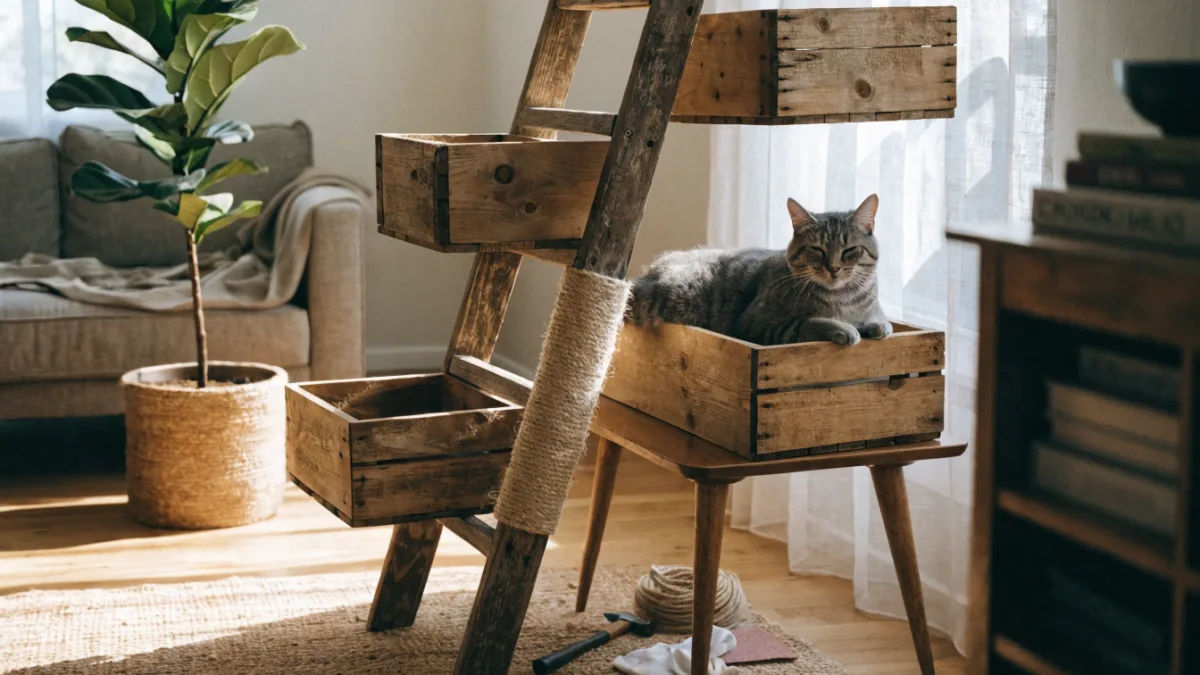
- Vintage Wooden Ladders: An A-frame wooden ladder is practically a pre-fab cat tree. The steps are perfect for jumping, and you can easily attach platforms between the rungs.
- Wooden Crates: You know those vintage wine crates you see at flea markets? Screw a few of them together, some pointing inward as cozy sleeping hideaways and some outward as open-air shelves, and you have an instant cat condo.
- Old Side Tables: A sturdy side table with a lower shelf can be flipped upside down or modified to create a heavy, stable base for higher perches.
- Scrap Plywood and Driftwood: If you want a truly organic look, thick branches of driftwood make incredible, natural-looking support posts. Scrap plywood is perfect for cutting custom-sized lounging platforms.
I scored an old, slightly wobbly wooden step ladder from a yard sale for $5, and grabbed a couple of unfinished wooden crates from a local thrift store for another $10. Total spend: $15. The look on Barnaby’s face when he realized I was building this for him? Priceless. Though, to be fair, he mostly looked annoyed that I was making noise.
The Unsexy Part: Safety and Structural Integrity
Okay, we need to talk about physics and chemistry. This is where DIY pet projects can get a little tricky, and it is a massive debate in online builder forums. You are balancing a stylish design with the reality of a ten-to-fifteen-pound animal hurling itself at top speed onto your structure. If your tree is wobbly, your cat will never use it, or worse, it will topple over and hurt them.
Structural Integrity
When you are using uneven materials like driftwood or old ladders, stability is paramount. If you are going tall, you must anchor the structure to the wall. Use heavy-duty L-brackets and wall studs. Do not just rely on gravity to keep your cat safe. Barnaby does not do anything gently. If he leaps onto a platform, it needs to hold his dead weight plus the momentum of his jump. Use wood glue and long, thick wood screws to secure your platforms. Test it yourself—push down on every level before you let your cat anywhere near it.
Material Toxicity
This is the part where I tell you to put down the sandpaper and pay attention. If you are upcycling vintage furniture, you have to be acutely aware of material toxicity. Older painted furniture, particularly pieces dating back to the 1970s or earlier, often contain lead paint. Cats scratch, and sometimes they chew. If they ingest lead dust or wood chips, it is a veterinary emergency. If you are unsure about the history of a painted piece, strip the paint entirely using safe methods, or seal it completely with a non-toxic, pet-safe hard shellac.
You also have to be careful with how you finish the wood. Standard wood stains and construction adhesives from the hardware store are highly toxic to cats. The fumes alone can cause respiratory distress, and licking the residue will land you at the animal hospital. Always use VOC-free, water-based, pet-safe paints, and skip the chemical glues in favor of mechanical fasteners like screws and brackets. If you wouldn’t put it near a toddler, don’t put it near your cat.
Designing for Human Eyes and Cat Claws
One of the best parts of building your own cat tree is that you get to be the interior designer. You do not have to settle for ugly gray plush. Instead of wrapping your posts in standard pet carpet—which traps odors, sheds, and looks dingy after a month—think about what actually works for your home and your pet.
For my ladder tree, I left the natural wood grain visible. I sanded it down and finished it with a natural, non-toxic wax. For the lounging platforms, I used remnants of a washable canvas fabric I found at a craft store, stapled securely to the wood underneath so I can remove and wash them when Barnaby inevitably drops a hairball on them.
Want to satisfy their need to scratch? Wrap a few of the support legs tightly in natural sisal rope. It looks coastal, it is incredibly durable, and it saves your furniture. If you have a specific color palette in your living room, paint your wooden crates to match. You have complete creative control, which means you can engineer something bespoke that fits into the awkward, empty corner of your room perfectly.
Embracing the DIY Imperfections
If you are waiting until you are a master carpenter to try this, stop right there. I recently watched a video of a DIYer attempting a beautiful, sprawling driftwood cat tree, and honestly? It was a bit of a disaster. The drill bit snapped, the levels were slightly crooked, and they had to redo their measurements three times.
But here is the thing: that is exactly what DIY is. Your tree does not need to look like it came out of a high-end architectural magazine. Cats genuinely do not care if your woodcut is slightly uneven or if your paint job has a drip. They care that it is tall, it is stable, and it smells like you. The imperfections are what give these pieces their rustic, custom charm. Plus, when your cat inevitably shreds the side of it with their claws, you won’t feel a fraction of the guilt you would if you had just ruined a $200 piece of designer pet furniture.
Scaling Up: Customization for the Multi-Cat Household
If you share your home with more than one feline, you already know that territorial squabbles are a real issue. One of the biggest advantages of upcycling is that you are not limited by a manufacturer’s dimensions. You can scale your design to fit your entire crew.
By adding extra scrap plywood platforms to a basic wooden ladder or stacking more crates, you can create multiple levels of escape routes. In a multi-cat home, having an “off-ramp” is crucial. If a lower-ranking cat feels cornered on a single-platform pet store tree, they will get stressed and fight. By engineering a sprawling, multi-level custom cat condo, you give every cat in the house a dedicated, safe spot to decompress without bumping into each other.
Building my own cat tree out of junk I found at a thrift store completely changed my living room dynamic. Barnaby finally has his aerial throne, I finally have a piece of furniture that does not offend my eyes, and we kept a ton of perfectly good wood out of a landfill. If you have a free weekend, a drill, and a cat that thinks it owns the place, grab a wooden crate and start building. Trust me, your cat will approve—and your interior design sensibilities will thank you.