

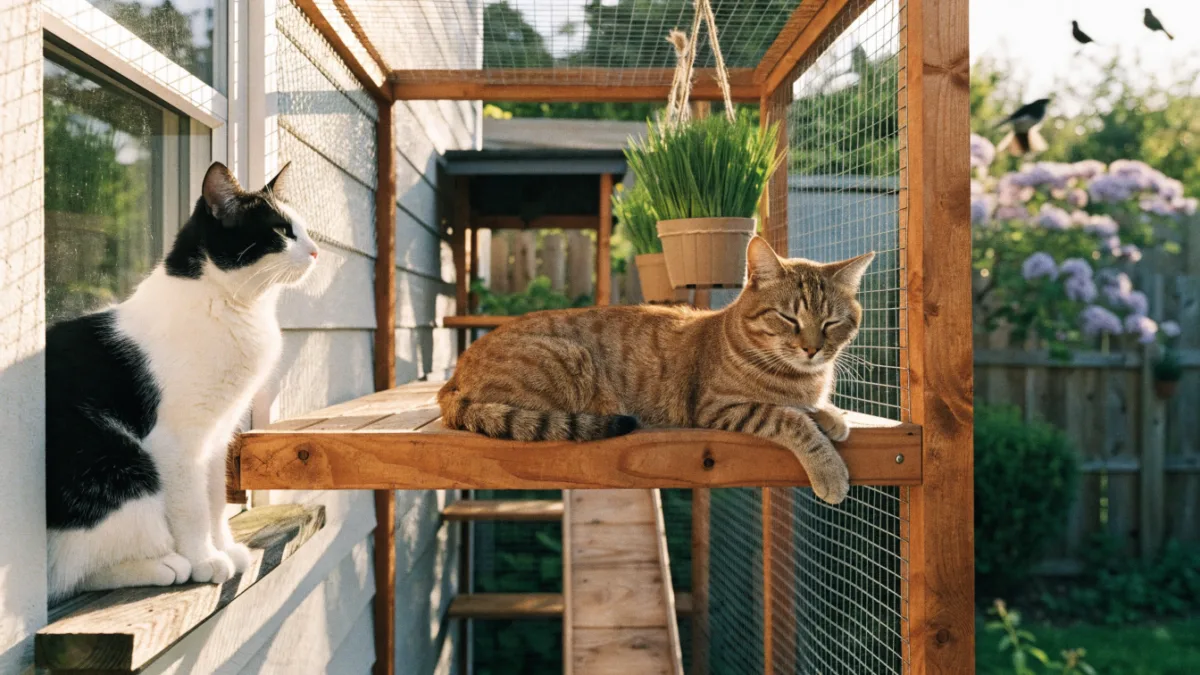
For three summers, my cat Miso spent every sunny afternoon wedged against the living room window, chattering at sparrows with a sound like a rusty hinge having a breakdown. She was a porch stray before we took her in, and she never stopped auditioning for a return to outdoor life. The problem is I know the statistics too well to let her: indoor cats routinely live 10 to 17 years, while free-roaming cats average just 2 to 5, thanks to cars, coyotes, fights, and diseases like FIV and feline leukemia. So there we sat — me feeling like a warden, her feeling like a prisoner with an excellent view. Then we built a catio, and the entire household’s mood shifted within a month. If you have a yard, a balcony, or even just a promising window, here’s everything I wish I’d known before picking up a drill.
## Why “Just Keep Them Inside” Isn’t the Whole Story
Keeping cats indoors is the right call for their lifespan — but safety has a cost, and it’s worth being honest about it. Under-stimulated indoor cats face higher risks of obesity, diabetes, and boredom-driven stress behaviors like overgrooming, furniture shredding, and mysterious litter box grievances. A window gives them visuals, but cats don’t live on visuals alone. They want the smells (rain, grass, whatever the neighbor’s cat left in the comment section of the fence), the textures, the warmth of real sun, and the slow-moving drama of actual birds instead of the YouTube version.
There’s a genuine debate among behaviorists about whether a small outdoor cat enclosure truly satisfies a cat’s roaming instincts. The counterargument — and the one my cats have personally endorsed — is that enrichment quality matters more than range. A 6-by-8-foot space with climbing levels, plants, and a sunbeam beats 400 square feet of flat, boring lawn. That’s the whole philosophy behind the “catification” movement popularized by Jackson Galaxy: design spaces around what cats actually want, and they stop demanding what’s bad for them.
## Catio Ideas for Every Space and Budget
The best catio ideas aren’t the most ambitious ones — they’re the ones that match your living situation and your actual skill level. There’s a version of this project for nearly everyone.
The best catio isn’t the biggest one. It’s the one your cat will actually use — and the one you’ll actually finish.
### The Window Box: $100–$400
A small enclosure mounted outside a window, accessed through the sash or a cat door insert. This is the entry point for apartment dwellers and first-time builders: big enough for a lounging shelf and a sun puddle, small enough to build in a weekend. My version was Miso’s starter model, and she treated it like a studio apartment she’d never leave.
### The Balcony or Small Walk-In: $300–$1,000
Balcony enclosures use mesh or netting systems fitted over and around your railing to create a fully sealed space. Renters, this is your lane — but check your lease and building management before ordering 60 feet of mesh, and inspect the railing’s structural integrity. If you have a small yard, this budget also covers a modest walk-in catio attached to a door or window.
### The Full Backyard Setup: $1,000 and Up
A large attached patio catio or freestanding “cat run,” ideally big enough for a human chair so you can share the space. Serious DIYers can still build at this level, but custom and professionally built catios typically run $1,000 to $10,000 or more. Be honest about your carpentry here — a wobbly, gap-riddled enclosure is worse than none, and this is the tier where bad builds create real escape and injury hazards.
## DIY Catio Plans: The Details That Matter
Whether you draft your own DIY catio plans or buy them, a few non-negotiables separate a sanctuary from a hazard. A solid [1] is worth reading twice before you cut a single board, but here’s the short list:
- Wire: Use galvanized welded wire or hardware cloth with openings of 1″ x 1″ or smaller. Not chicken wire — cats can tear it, push through it, and determined raccoons treat it as a suggestion.
- Framing: Rot-resistant lumber like cedar, because a catio lives outside in the weather for years.
- The roof: Fully enclosed with mesh — birds of prey are a real threat — with optional polycarbonate panels on top for rain and shade.
- Latches: Escape-proof, ideally two-step or locking. Cats study simple latches the way prisoners study guards, and some figure them out.
- Finishing: Sand or cap every sharp wire edge, and make sure every platform is stable under a running, leaping 12-pound projectile.
If you’d rather not do the math yourself, downloadable plans from specialists like [2] run about $40–$80, often with proceeds donated to animal welfare charities — genuinely some of the best money I spent on the project.
## Furnishing the Ultimate Cat Hangout
The enclosure is the container; the enrichment is the point. Vertical space is everything — multi-level perches, a set of three-tiered platforms, ramps, a hammock, maybe a tunnel. Cats measure territory in elevation, not square footage, and the top perch will become the most contested real estate in your home. Add a shaded lounging spot, and if you’re feeling fancy, a small water feature. There’s a strange alchemy in turning a stack of lumber and wire into the [3] — suddenly it’s a backyard feature, not a cage.
Plant a little cat garden while you’re at it: cat grass, wheat grass, catnip, cat thyme, and valerian are all safe and beloved. And memorize the no list, because some common ornamentals are genuinely dangerous — lilies can be fatal to cats even in tiny amounts, and azaleas, sago palms, foxglove, and chrysanthemums belong nowhere near the enclosure.
Two honest footnotes. First, mesh keeps out predators but not fleas and mosquitoes, so keep parasite prevention current — that’s a conversation for your vet. Second, introduce the space gradually. Miso moved in on day one like she’d been waiting her whole life, because she had. My other cat, Gnocchi, indoor-born and deeply suspicious of novelty, refused to enter for two weeks — then one morning claimed the top perch and now glares at anyone who approaches it. Supervise the first outings, let them set the pace, and trust the process.
## The Part Nobody Expects: It’s for the Birds, Too
Here’s the angle that turned me from “indulgent cat parent” to “quietly smug conservationist.” A landmark 2013 study in Nature Communications estimated that free-ranging domestic cats kill 1.3 to 4 billion birds and 6.3 to 22.3 billion small mammals every year in the U.S. alone. The domestic cat sits on the IUCN’s list of the 100 worst invasive alien species and has been linked to the extinction of dozens of birds, mammals, and reptiles. Miso has murder mittens and no ecological conscience — that’s not a flaw, it’s just what cats are.
This is why cities like Portland and Seattle now host annual catio tours, often co-hosted by humane societies and wildlife organizations — a collaboration between cat people and bird people that historically happens roughly never. Both sides finally agree on something: a cat that’s safely contained is a win for everyone with a heartbeat.
So that’s the real case for the build. Miso got her outdoor life back without the outdoor statistics, Gnocchi got a penthouse perch she doesn’t deserve, and I got to stop feeling like the villain of my own living room — while the sparrows at my feeder got to keep existing. A catio is one of the rare projects that protects the animal you love and the wildlife around you in the same swing of the hammer. Start small if you need to. Even one window box makes your corner of the world a little safer for everyone in it.
Sources
- catio safety primer — hermitagecatshelter.org
- Catio Spaces — catiospaces.com
- ultimate cat hangout — awanj.org